

Writer: Anthony Clark
Directors: Poppy Sutch, Maddy Corner and Anthony Clark
In Shakespeare’s As You Like It, Jaques famously describes one man in his time as playing many parts in seven stages, or acts, of life. Those seven rough demarcations provide the inspiration for a septet of short plays by Anthony Clark, under the umbrella title of SHE.
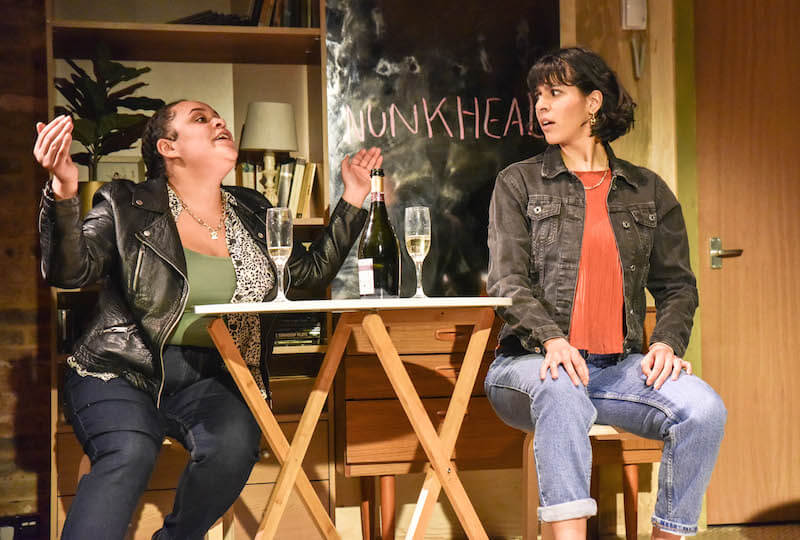
The two women in each piece are played by Chenise Lynette and Safeena Ladha, with each actor using the opportunity to showcase their versatility. Perhaps conscious of the need to reuse actors, Jaques’ seven ages are all altered to revolve around women in their early 20s. Thus, the “mewling and puking infant” is an offstage screaming child, wailing while her mother and aunt spar over the mother’s ailing mental health and what course of action may be best for the young child. At the other end of the Shakespearean scale, old age is represented by two drama students working on an improvised scene in which their characters must be aged and infirm.
This approach of rooting the stories in women at a fixed age in life is most effective during the second piece, paralleled with As You Like It’s schoolboy creeping unwillingly to school. Two old school friends convene at a local restaurant, intent on making life difficult for the manager who tormented and bullied them at school. But while the setting works, Clark’s occasionally overblown writing struggles to match. Throughout the whole work, much of his dialogue never feels as if it fits the characters, and that deficiency is at its height here. Lynette is given a prolonged monologue that, with the character’s Northern roots, suggests a Victoria Wood-like level of comedy that fails to emerge from the script. As with much of the dialogue, it works better on the page than it does in performance.
Other pieces rely on well-worn character tropes that never quite escape the threat of caricature, such as Lady’s portrayal of an over-earnest environmental campaigner whose single-minded attitude to her campaign makes her oblivious to the suffering of those around her. And in the evening’s weakest piece, the concept of communing with spirits via second-hand clothes – a séance crossed with a jumble sale, if you will – fails to escape the confines of its outlandish setup.
But there are moments to savour, too. Two sisters journeying up to visit their newly-widowed mother, with one sister harbouring her own tragic news, is quietly, subtly affecting. Earlier in the evening, Jaques’ stage of the lover’s “woeful ballad” turns into a spoken word open mic performance about digital sexual harassment, highlighting how “upskirting” and sharing of pictures without consent are prevalent problems among teenagers. And even in the weakest playlets, Ladha and Lynette create a strong sense of their distinctive characters.
Jaques’ monologue about the seven ages of man ends in dementia and death – a “second childishness and mere oblivion”. And while Clark’s improvising students somewhat undermine the tragic nature of the source material’s conclusion, the breadth of his writing provides the basis for two actors, in their time, to play many parts. For Lynette and Ladha, all the world is now their stage.
Continues until 11 February 2023
