

Writer: Scott Horgan
Director: Maddy Corner
Director Maddy Corner’s queer retelling of Shakespeare’s classic tragedy comes to Riverside Studios, in a stunning performance that should be the new benchmark for Shakespeare adaptations.
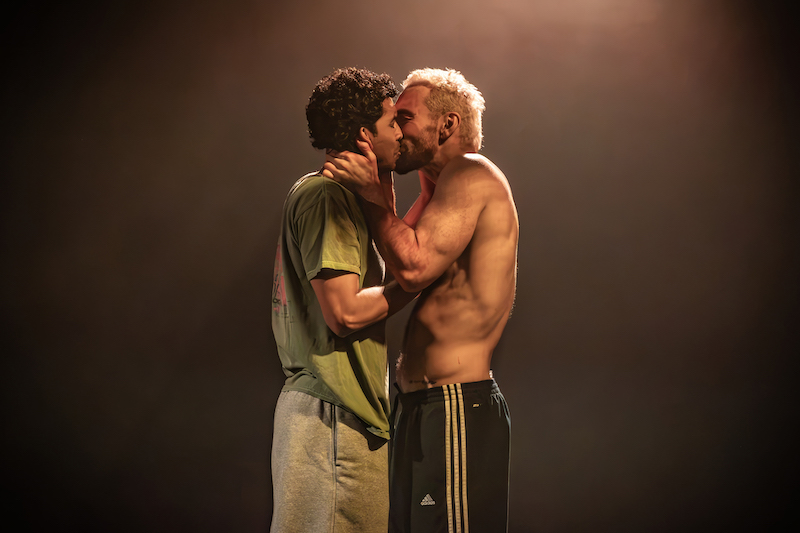
Local Croydon heartthrob Romeo, on the back of a breakup, meets Hamed in a nightclub, and quickly the pair become besotted. Battling Romeo’s dark past of crime and Hamed’s personal battle with his faith, their love grows on the streets of London. Hamed tries to come to terms with his feelings and his religion over a series of talks with his Imam and friend. Romeo discusses his newfound love with his sister and friends, who are wary of him once again wearing his heart on his sleeve. After a first act filled with humour and heartwarming romance, the second act brings a rise in tension that culminates in a crescendo of violence and tragedy befitting the classic Shakespeare.
Romeo & Hamed is written in contemporary prose poetry and is saturated with London slang, weaving Shakespeare’s language throughout. The dialogue flows between the original text and writer Scott Horgan’s own poetry, keeping Romeo and Hamed feeling both authentic and new. The writing, peppered with humour, is outstanding. Even the more sexualised language and occasional curse words are enormously tasteful. Horgan manages to rhyme ‘Lydia’ with ‘chlamydia’ in the first lines, giving the audience a taste of things to come. Romeo and Hamed delivers some of the best writing in London off-West End theatre since Beau Hopkins’ SALT, which also debuted at Riverside Studios. It is an astounding achievement for Horgan’s debut play.
Horgan is excellent as Romeo, and Anish Roy flawless as Juliet’s stand-in Hamed. Taz Rahman’s Amina is hysterical and believable as Hamed’s younger sister. Asif Khan is heartbreaking as Imam Yusuf, and Micah Loubon’s Mercutio-inspired Nico makes the entire audience cry. All the characters have a real, brilliant chemistry, be they friends, family, or lovers.
The creative team thank their queer-Muslim focus group, who are clearly vital to the creation of the play. Questions about appropriation, or putting on a play about a culture other than your own, could be asked of Romeo & Hamed, but at no point does the play feel uncomfortable. It feels like an authentic play about young love in London.
Romeo & Hamed avoids the obvious tropes one would expect in a London multicultural queer Shakespeare reimagining: external homophobia and Islamophobia are largely absent in the play, and Horgan also leans away from the gang-war element, saving the Montagues and the Capulets from being reduced to opposing factions in a Postcode War, in a sort of theatrical queer Kidulthood.
The dramatic twists leading to the inevitable ending of Romeo & Hamed are slightly shoehorned, but there is no easy way to sneak up on the most famous tragic ending in theatre history. It works, largely. Sinew Productions and Slime and Pies Co Productions have put on a play that is near flawless.
Runs until 6 September 2026
