

Writer: Samuel Beckett
Director: Dave Wybrow
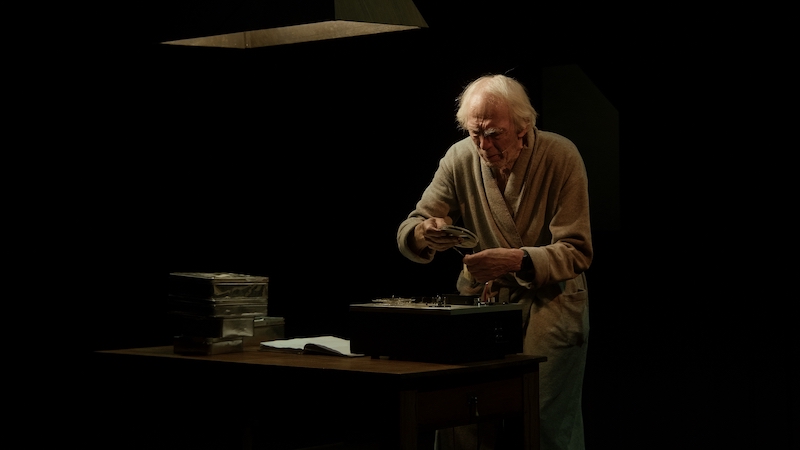
A bare room lit with a single hanging lamp. A wooden desk. A chair. An old man limps on stage and sits. Here we enter Krapp’s world, a place in this dark space that is memory, intangible and yet so concrete.
Krapp’s Last Tape, written by Samuel Beckett in 1958, tells of an older man (Krapp, played by Peter Marinker) listening to a recording he made 30 years prior. The premise itself leans into a deep exploration of self, ageing, and memory, as we see Krapp forget the very words used by his younger self. In The Cockpit’s production, director and producer Dave Wybrow works closely with Marinker, an actor who, in addition to having played the role in his early 40s, has recently been diagnosed with Alzheimer’s. Wybrow’s inspiring initiative adds a powerful new dimension to the production and, as the performance unfolds, the audience is witness to two simultaneous storylines: one anchored in Beckett’s script, and another created by the very act of performing.
Indeed, right from the start, the one-man play becomes a quiet duo, as Marinker’s monologue is interspersed with quiet live in-ear prompts operated masterfully by stage manager Marta Fossati. The audience’s immersion in Beckett’s deeply poetic texts thus somehow becomes more poignant, as Marinker is audibly reminded of the very choreography of the piece, all while listening to his own younger voice, bringing a realism to the interaction which reaches far beyond the text. Though short, minimalist and relatively unconventional, this performance is undeniably beautiful. Accompanied by Duncan Henderson’s superbly sober stage design, we clearly see Marinker’s actor’s touch shining strongly despite the obstacles.
After the final bow, when Marinker joyfully picks up his discarded banana peels, the weight of these 50 minutes leaves one deep in thought, as we reflect on ageing, cognitive functions, memory, disability and even what it means to act. Yet how joyous is it to see how moments etched in the past are forgotten and relived, before being recorded for the future.
Runs until 5 September 2026
