

Writer: Jesper Fink, Maya Ilsøe, Charlotte Sieling
Director: Charlotte Sieling
Charlotte Sieling’s Margrete – Queen of the North focuses on the impressive figure of the fourteenth-century Danish queen who succeeded in uniting Denmark, Norway and Sweden under the long-lasting Kalmar Union. When the film opens, Queen Margrete, played with compelling emotional power by Trine Dyrholm, is arguing for a united army to protect the three countries from invasion by the Hanseatic League. To bolster this, she seeks political union with England, having negotiated a marriage settlement between her adopted heir Eric and Princess Philippa, the young daughter of Henry IV.
Fifteen years before, her only son, Oluf, had died in mysterious circumstances. Margrete and her court are therefore rocked when news arrives that Oluf has been found alive, and a bedraggled, but appealing young man is brought before them. The film seeks to probe the explosive mystery – can Margrete recognise the son who she believed had died as a boy? If he is truly her son, then Eric loses the throne. There is much that is Shakespearean in the drama that unfolds. If the man claiming to be Oluf, King of Denmark, is not who he says he is, who is he? Has a treasonous faction created a false prince to undermine the union? Other archetypal dramas are drawn on. There is something of Sophocles’ Oedipus Rex in the plot’s dependence on the testimony of a wet nurse. There are larger questions at stake too: should political expediency – the necessity of maintaining the peaceful union – be allowed to override moral truths? Margrete needs to install Eric as king and promote the union with England to maintain hard-won political stability. Has she, as rumour has it, had her own son murdered years before, a sacrifice to unity with Sweden?
As director, Sieling, who also co-wrote the script, works hard to maintain the mystery, creating a rich ambivalence to the scenes of political warring and to those of Margrete’s psychodrama.
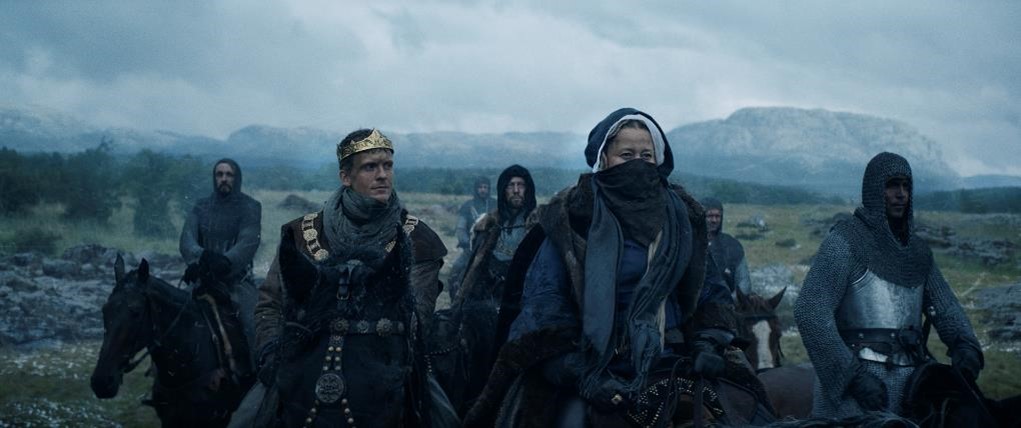
All this is played out against striking scenes of bleak, wintry Scandinavian landscape. Even inside the Danish castle, winds howl and whistle. Every scene is beautifully shot, Rasmus Videbæk’s cinematography showing the frozen forests and coast line in a palate of muted colours. Interior scenes are painterly, with gorgeous lighting framed by the surrounding darkness.
But this is no Game of Thrones. The film is directed at a stately pace, the script solemn, the mood relentlessly grim. Jon Ekstand’s likeable sound track adds to the melancholy mood. Nor is it an easy film to read. To watch it is to remain troubled by the complicated politics. Who are we to trust? Is Queen Margrete the heroine she is initially presented as? Or has she a Lady Macbeth-like ruthlessness that would allow her to sacrifice everything to maintain power? So much depends, for instance, on the role of her sole confidante, the priest, Peder. To retain the central mystery, he must remain silent and the relationship between the two is coldly asexual. It is something of an unrewarding role for Borgen’s Søren Malling. If he has been controlling the queen for his own ends, it’s not easy to understand his motivation. There is the added difficulty that Sieling clearly signals which characters are untrustworthy, only to reverse our expectations in the course of the film’s revelations.
It’s a beautifully made film and eminently watchable, even if the plot ultimately fails to satisfy.
Signature Entertainment presents Margrete – Queen of the North on Digital Platforms 14th March
