

Writers: Thor Klein, Lena Vurma and Elena Poniatowska
Directors: Thor Klein, Lena Vurma
Thor Klein and Lena Vurma write and direct Leonora in the Morning Light, a biopic about the British-born Mexican artist, Leonora Carrington, based on a fictionalised treatment of her life by Elena Poniatowska. Carrington’s reputation has been recuperated in recent years, revealing her importance as an artist in her own right and as the one who feminised surrealism. As a young woman, her story of her rebellious childhood and her rejection of bourgeois norms endeared her to the likes of André Breton and Salvador Dalí. She had an affair with the German artist Max Ernst which the film puts at its centre. But Carrington ultimately rejected key Surrealist concepts, including its worship of the Freudian unconscious, and that of the female muse, the Femme Enfant. Importantly, she developed her own deeply-felt theories about the relationship of the unconscious mind and art.
The life of the mind is difficult to portray in film. Klein and Vurma focus on the catastrophic breakdown Carrington experienced in the 1940s to suggest that this allows her to break free of imprisoning conventions. The precipitating event, they imply, was the arrest of Ernst in France as a hostile alien in 1940. Having left his wife, he had moved with Carrington to the Ardèche the previous year. Following his arrest, she descends into madness, and is institutionalised after being found wandering the streets of Madrid. The film makes much of this, showing scenes of brutal ECT treatment and her various encounters with male doctors. This is problematic. Carrington in fact went on to have a highly successful career in Mexico and to become a powerful voice of female liberation. But the film remains in the debatable territory where artistic genius is associated with madness. More significantly, it downplays Carrington’s rebelliousness, evident from childhood. Admittedly the film show us flashbacks to her as a child, but the framing of these scenes in long shot in which the child Leonora is barely visible, fail to convince.
This is part of a technical issue which dogs the film. There’s a large cast of characters, so it’s hard to distinguish one misogynistic Surrealist artist from another. Scenes shown through doorways and a tendency to avoid close ups don’t help. Plus keys lines are mumbled. Did Ernst’s epiphany really come after his “parent” died? (Wikipedia reveals it was his parrot). There’s also rather too much clunky exposition: “I don’t know if you heard the news that Franco has just marched into Catalonia?” asks one party guest before camera swings round to show us, through a doorway, Surrealists apparently rehearsing a Surrealist play.
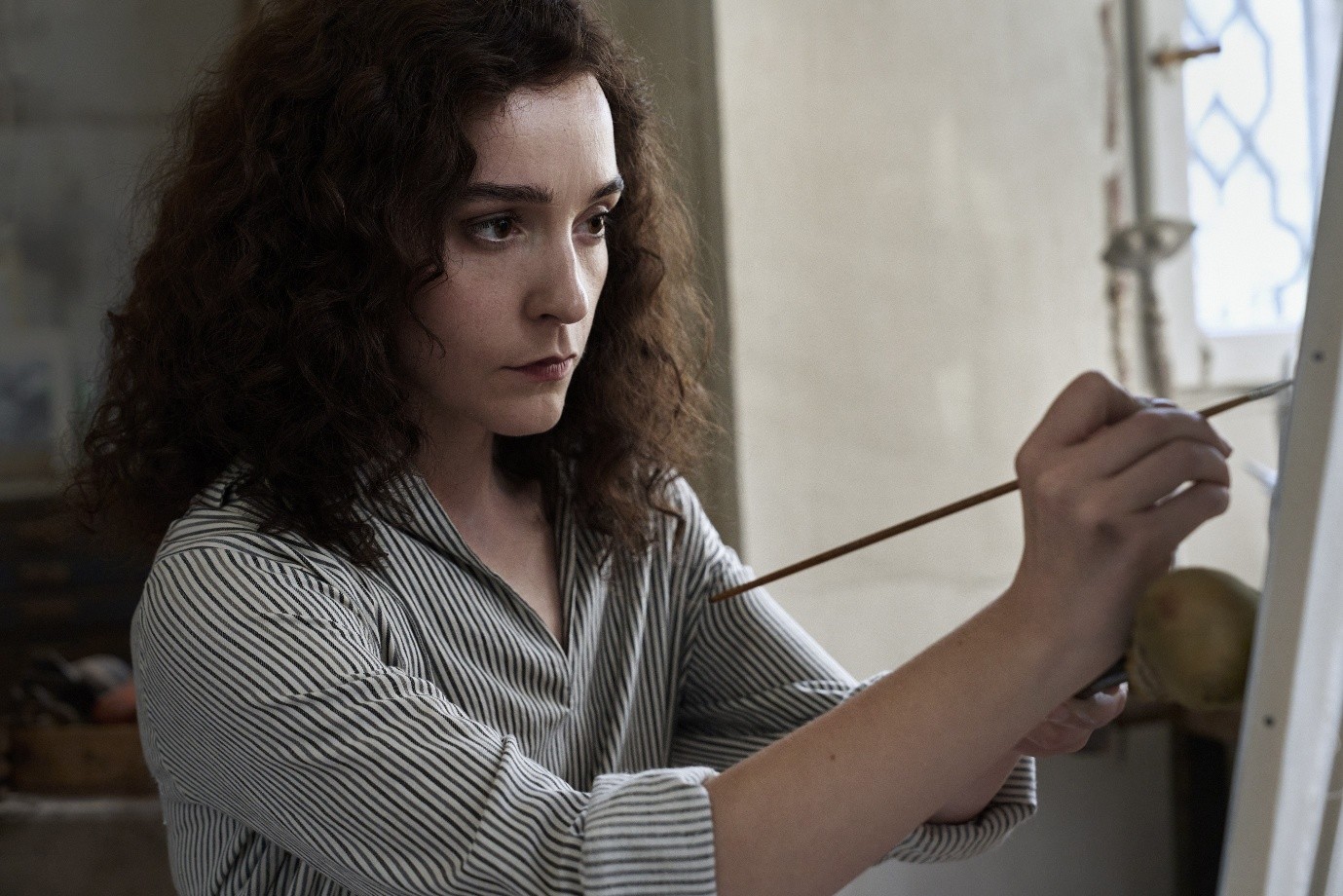
Olivia Vinall certainly looks the part of Carrington, both in her beauty and the fierce gaze seen in photographs. But she is forced into a monotonal performance, often having to remain silent while employing that fierce gaze. What do we make of her line “I was so absurdly happy,” when we so rarely see her in a state of elation?
The directors work hard to insert key motifs from Carrington’s work, so label the chapters into which the film is divided ‘The Horse’, ‘The Hyena’ and so on. But these tend to be rendered banal by overly literal writing. For example, when Carrington arrives to join Ernst in Paris, he nips behind a curtain to bring out a surprise: a rocking horse! Only then does the Carrington character reveal to him that her father had punished her in childhood by burning her beloved rocking horse. We are not, presumably, supposed to think Ernst was psychic, but simply wonder at this strange motif.
Leonora’s importance as a painter is undeniable, but Leonora in the Morning Light does not serve her reputation well.
Leonora in the Morning Light will be released in UK and Irish cinemas on 29 May 2026.
