

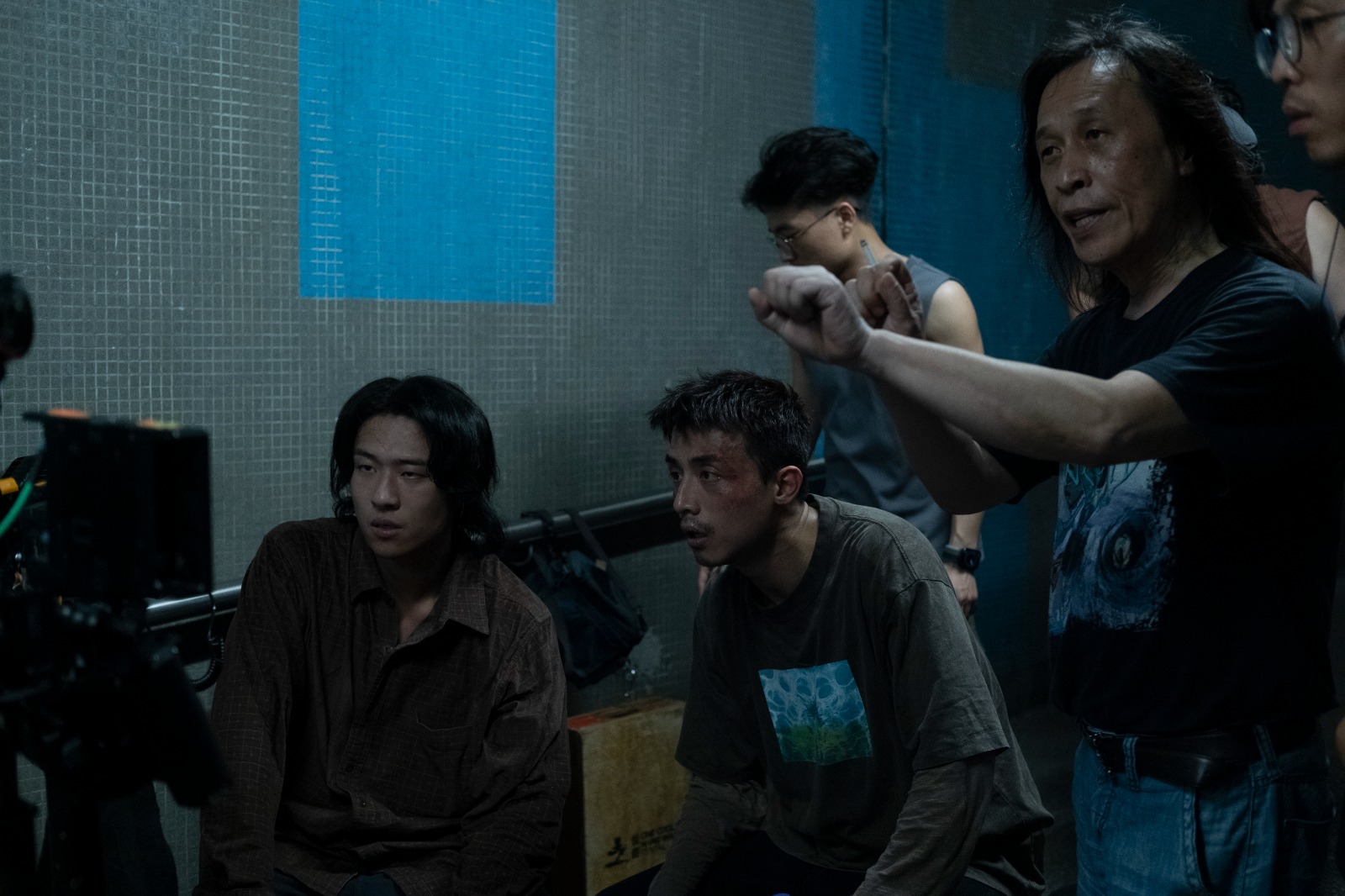
Herman Yau’s We’re Nothing at All takes the loose framework of a real 1998 Wuhan bus bombing and relocates it to contemporary Hong Kong. The film follows the aftermath of a Valentine’s Day bus explosion, while gradually tracing the lives of Fai and Ike, a gay couple pushed to the margins of society while also telling the story from the prospective Lung Sir, the retired forensic expert. Self-funded by Yau, the film brings together his long interest in social realism, genre filmmaking and stories shaped by neglect.
Speaking to The Reviews Hub, Yau discusses the film’s relationship to real events, the responsibilities of adaptation, the casting of Anson Kong and Ansonbean, and why the film’s Chinese and English titles open up very different meanings.
This interview has been edited for clarity and length. It contains details and spoilers of the film’s plot.
TRH: The film is inspired by the Wuhan bus bombing. What motivated you to adapt this story?
Herman Yau: For the Wuhan bombing case, I just took the framework. Other than that, I think the elements that the movie and the real happenings share in common are that it involves a gay couple, and that they are the underdogs of society.
Because I shifted the story from Wuhan to Hong Kong, the elements in the movie, the context, the so called social issues, and the time are different. The Wuhan incident happened in 1998, while the background of this story is Hong Kong society in recent years.
In short, I took the framework of the real happening and recreated it into a story that happened in Hong Kong and involved Hong Kong citizens.
TRH: At what point did this story or inspiration become more of a Hong Kong story? What kind of Hong Kongness did you want to bring into it?
Herman Yau: The Hong Kongness is hard to say in words. But I think any audience, after they watch the movie, can recognise the term you mentioned as Hong Kongness. It is already very explicit in the film, in the graphic image, the dialogue and the elements.
As the scriptwriter of this movie, I am kind of an editor. I gather the happenings in reality in Hong Kong and make them into a kind of chronological order that can be seen as a story. In between those real happenings, those gaps are the creative part. I use creativity to connect all those real happenings in a logical way, so that they can be easily understood by the audience.
TRH: What motivated you to self fund this project? Do you feel there is a moral responsibility while adapting to a real life tragedy?
Herman Yau: I self funded this movie because I wanted to have more say in some decision matters.
I do not think I have that kind of moral responsibility in relation to the Wuhan case, because I just took the framework of that real happening. I did not take the very personal elements, or their lives, of the gay couple in Wuhan. In fact, I would say that the audience can see in this movie that all the elements happen. I would say that 90 per cent of the content in this movie comes from reality.
What I mean by reality is something like the character Fai in the movie, how he grew up, and the trauma during his teenage years. This comes from one of my friends. He is about 20 years younger than me, and I would not, and never will, disclose his name. Also, the taxi driver who crashes into the bus is based on a real happening that many Hong Kong people, and even people overseas, can watch on YouTube.
What I want to say is that I am quite sensitive to moral responsibility as well. When referring to the real happening in Wuhan, I do not think I have this kind of moral responsibility. For what the audience sees in the movie, some elements or content come from my friends, but I will not disclose their names. For example, in Fai’s character, the trauma during his teenage years comes from one friend, while the part about him working on a construction site comes from another person. These kinds of elements in reality come from different people, and I put them into one character. At this point, I think I am quite aware of the moral responsibilities, so that I can protect those people, or the sources of the content in this movie, so that they will not be referred to or recognised by the general audience.
TRH: The film is structured through this dual narrative. What made you decide to begin the story with Lung Sir’s perspective?
Herman Yau: For Lung Sir’s part, in a way, he is the narrator of this story, but I do not want to make this character functional. So I try my best to inject dramatic elements and a dramatic relationship between him and the people around him. When you are talking about the dual narrative, I think it is an easier way for me to tell the story, rather than using a strict timeline narrative.
TRH: When you moved the story from Wuhan to Hong Kong, some details of the real couple were kept, like the saying about “not beautiful lives” on a beautiful day. But some other details were left out. What factors did you consider during the adaptation when deciding whether to keep or leave out something for the film?
Herman Yau: Like finishing their lives, their not beautiful lives, on a beautiful day. This line comes from the original one. It is what I read in the news report. To me, it is just a line, or a kind of statement. I do not consider this to be something personal or not so personal. When I first read this line, I felt it was very romantic, in a tragic way. So I put this into the movie because I really like this line. It uses simple words, but with a deeper meaning, and that is romantic.
TRH: What motivated you to cast Anson Kong in this role? His appearance in the film is rather different from his usual public image as an idol. How did you develop his look and screen presence for the character?
Herman Yau: Firstly, because he is quite famous in Hong Kong, it is kind of a commercial consideration. Other than this consideration, I have a hunch that AK is a very promising artist.
To the public, he is an idol. To me, as a film director, it is my job, and I would also have a kind of satisfaction if I can successfully transform an artist from their usual public image into the protagonist in a movie. At least from the very beginning, I wanted to achieve this. On the other side, AK really put a lot of effort into playing this role. He has a very good mindset in the way he understands what an actor is.
The basic principle is that an actor on screen is not the same as the real person in reality, or the appearance, or the image before the public. He understands this very well. I think I have chosen the good one and the right one.
TRH: In terms of performance, because the film is centred around this gay couple, did you have specific care or an approach when directing the intimate scenes between the two actors?
Herman Yau: Firstly, the first part of your question. AK and Ansonbean, they are straight. But they know many LGBTQ+ people. In the Hong Kong film industry, in the art department or costume department, actually in every department, we can easily find gay or lesbian people. In terms of understanding them, I think we, as a director, and AK and Ansonbean as actors, have a very good understanding of their behaviour. But at one point, the characters in this movie are the underdogs, because the peers or the community, the LGBTQ+ community that we always have contact with in reality, are roughly speaking from the middle class.
But in this movie, by pinpointing those homosexual people, they are from the underclass. They look like underdogs of society. So on top of how we understand the LGBTQ+ community, we have to acquire an understanding of that. I think I know very well about the life of the underclass in Hong Kong.
But I was not quite sure from day one when I met AK and Ansonbean. Throughout the conversation and communication, I tried to share my experience of encountering those people, and I tried my best to let them understand. AK and Ansonbean, I think they are very smart and very clever. Also, when they played the roles in this movie, I mean during the preparation stage, they really tried. At least they spent time meeting those people to understand more about their behaviour, and how they walk and how they speak, something like that.
And the intimate scenes are just from my imagination and also from the movies that I watched. It also does not go that far, because in some parties with friends, among my friends there are gay couples and lesbian couples. They have very intimate, how do you say it, anyway, quite intimate behaviour, but only as far as what you see in the movie.
So I also have that kind of understanding that is not only from imagination, but also from direct confrontation, by which I mean being on the same occasion and being able to see it. But I have to add one more thing: what I met in reality is also decent. What I want to emphasise is that what I saw in reality is only as far as what is in the movie. But I just want to emphasise that I would not say that I knew nothing before the shoot.
TRH: The film shows people who are marginalised in Hong Kong society. Do you think Hong Kong cinema nowadays still has the power to make the audience care for those marginalised communities?
Herman Yau: I would not say, or I do not think, we have the power to change anything, or to make people shift from one idea to another. In this sense, I would say that movies are not so powerful. But just as we see in this movie, and actually in our daily life, this movie is about a tragedy in the end. In fact, in the movie, there is no single incident that is so powerful that it can lead to the ending. It is bit by bit.
So in terms of this kind of logic, now that we are talking about making movies, I do not think one movie is so powerful. But bit by bit, if we have the same kind of people making the same kind of movie with the same attitude and the same target, I think bit by bit we can change the world, or society, or the people around us.
TRH: The Chinese name of the film means “what we are not”, but the English name means We’re Nothing at All. Could you explain your thinking behind the naming of the film?
Herman Yau: The Chinese title and English title are not equivalent, either in meaning or in translation. To me, I like the Chinese title more. But we use this English title, and I admit that I still think that We’re Nothing at All is easy to understand and catchy to the audience. It does not move away from the theme of this movie.
But We’re Nothing at All is more like a statement, and it would not lead to as much thinking from the readers. The Chinese title has a kind of vagueness. It is not so exact, and it would lead to more imagination for the reader. Because we have got everything translated, the Chinese, your translation is very good, the Chinese title you just said when you were asking me.
TRH: I think it is “what we are not”.
Herman Yau: All right, “what we are not”. I like the “what”, “what we are not”, because these words do not have an explicit meaning on “what”. And this “what” can be imagined by the reader. You can substitute this word with anything. “What we are not”. Now, I say that I am not a woman, or I am not English, something like that. So it can allow more meaning. On another point, I prefer the Chinese name more. In this movie, like Fai and Ike, to me, they are something, and they mean something in our society. So when we go back to the English title, I would appreciate it if the reader can read it as a kind of irony, rather than only as a statement.
We’re Nothing at All is released on 29 May 2026.
