

Writer: Ollie Wimbush
Director: Emily Hawkins
It’s perfectly normal not to enjoy your birthday as you get older, and Andy, waking up in the detritus from last night’s party, probably has more reason to resent it than most in Ollie Wimbush’s 45-minute largely non-speaking play Cataclysmic. Slow to reveal itself but using sound, video, lighting and performance to tap into Andy’s shifting moods, the eventual meaning of the piece performed at The Hope Theatre is unclear but seems to induct the protagonist into a belated and reluctant adulthood.
Much of the early part of the show is filled with visual clues to who Andy is, what has happened to them and the life they have led so far. It opens with a search for identity, as a piecing together of memory becomes the focus, with the actor picking their way through the memories and gifts strewn across the floor. How much of this is relevant to the purpose of Cataclysmic is unclear, but there is certainly an impression of two time periods meeting, perhaps two versions of Andy sharing a space as the 15th birthday banner, the nano iPod and CDs hint at another time period.
Some of the best work is in Wimbush’s sound design, a series of menacing devices that suddenly turn themselves on without explanation; a speaker that plays a party noise that Andy instantly recoils from, music from another device and a series of home videos showing a childhood also associated with parties and music – and although these are snippets cut with white noise by video designer Emily Hawkins who also directs, the impression is of a series of earlier birthdays leading to this one. The way the sound becomes increasingly threatening and the anxiety, building both in Andy’s responses and in the room, is interesting, drawing on absurdist theatre techniques to imply a form of control external to the room.
There are other hints that all is not well for the protagonist, who tries to escape frequently but finds the door locked, trapping them inside. There is much more to reflect on here for the creative team that might help the audience to find deeper meaning in the work, and it’s not clear what or who this larger force is and what it wants Andy to discover. The Waiting for Godot quality is useful. Not letting the character leave until they find some kind of resolution in all of the carnage they seem to have caused is a strong concept, but this could be more than a dramatic device that leads Andy to a revelation and acceptance, perhaps a form of punishment, perhaps a political commentary on artificially extended youth or social infantilisation.
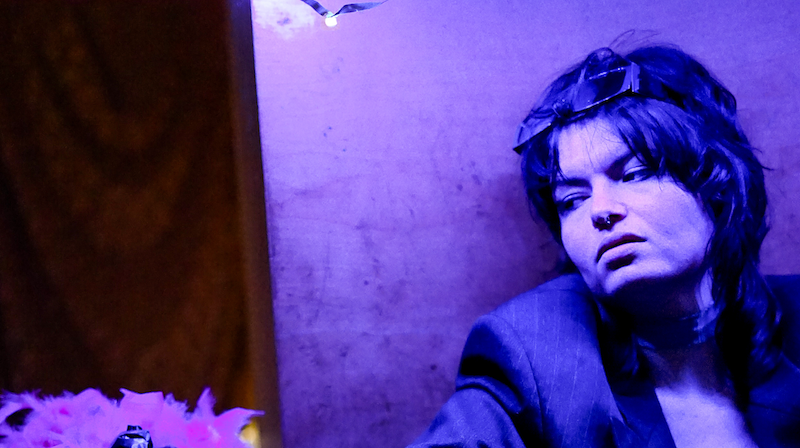
It’s well performed by Vera Majoor, who also designs the lighting, capturing Andy’s changing moods and occasional recognition of the audience (something which could also be more clearly defined), but within it Majoor manages to say a great deal with no words at all and, alone onstage in a complex piece, gives a strong, silent performance.
Runs until 4 July 2026
