

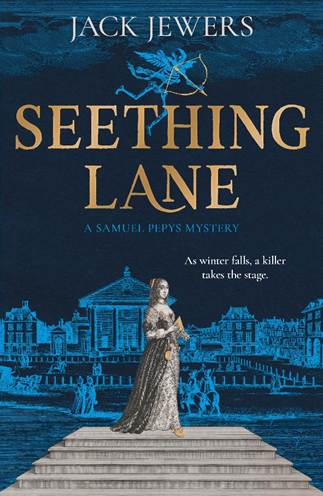
When it comes to historical fiction, timing is everything. For his second novel, Jack Jewers returns to the 17th century and it’s hard to think of a better period in which to create drama. Just a couple of generations’ reach from Shakespeare, and a few years after the Great Fire of London, not to mention the restoration of Charles II to the throne, Jewers’ novel, Seething Lane, is set in 1670 and bears witness to these seismic changes through its principal character, diarist Samuel Pepys.
From the start, Jewers makes it clear that this Samuel Pepys is a work of imagination: many of the facts of his life are present in the novel, but Jewers allows creative licence to take hold. As we join Pepys in the opening scenes, we find him acting as an administrator for the Order of the Royal Oak, a secret organisation that has Pepys spying on a preacher who seems to threaten the stability of the Crown. Returning home to his offices in Seething Lane, Pepys is intercepted by a young man who begs to have a word with him. He is too busy, and distracted, to respond.
When Henry Fitzwilliam, an aristocrat with direct links to Charles II’s eldest son, is found dead, Pepys’ keenly observant eye is recruited to find the killer. A shocking connection between Fitzwilliam and the young man at Pepys’ office door soon becomes apparent. As London experiences its worst winter in decades, Pepys’ investigation takes him from the Palace to the intimacy of backstage theatre life, as Charles II’s mistress, Nell Gwyn, returns to the stage.
Jewers successfully recreates a world captured in the pages of Samuel Pepys’ diaries. While no-one misses Cromwell, there is still an insistence on old values and privileges that chafe against an incoming 18th-century modernity. Seething Lane doesn’t heave under the weight of history; it bustles with life: urban grime and Restoration glamour. Jewers resists the temptation to overwrite 17th-century dialogue: the stuffiness sometimes associated with historical fiction doesn’t apply here. Someone is even called a “pillock” (and with good reason). Jewers’ experience as a filmmaker keeps the plot moving and the characters engaging.
While Pepys, as a literary character, remains elusive and a touch bland as a detective, Jewers’ best work is in his supporting cast. The world of Drury Lane Theatre is beautifully drawn: playwright Aphra Behn dominates the page wherever she appears. Nell Gwyn, the larger-than-life actress who steals the heart of the monarch, is an absolute riot. Jewers imagines her as a Cockney girl whose street-smarts save the day on more than one occasion. The reader is forgiven if they fall in love with her too.
What is really impressive is how Jewers combines scholarship with readability. He balances the wealth of research it takes to write such a novel with a page-turning murder mystery. But after the mystery is unravelled, what remains with the reader is the vibrant energy of the world that Jewers so clearly adores.
Seething Lane is published by Moonflower Books at £18.99 and is out now
