

Writer: Rachel Wagstaff
Director: Jonathan O’Boyle
There is a tendency to believe that Agatha Christie’s novels are quaint little period pieces, harking back to a time of society parties, maids in service, endless cups of tea and when villages were microcosms unaffected by the outside world. But while adaptations often portray them that way, Christie’s novels were often contemporary affairs that touched on a changing world, even if those changes were viewed from the perspective of the English middle and upper classes.
A case in point is 1962’s The Mirror Crack’d from Side to Side, the last of Christie’s Miss Marple novels to be set in the familiar village environs of St Mary Mead. While the location had long been seen as the quintessential English idyll, The Mirror Crack’d shows it facing change. A new housing development has seen an influx of new residents – from the sniffiness of long-standing residents, there’s a strong implication that it is social housing populated by “undesirables”. The old guard is changing, too: Dolly Bantry, the old owner of the local manor house, Gossington Hall (itself the former setting for Christie’s The Body in the Library), has had to sell up following her husband’s death, and the place has been bought by movie star Marina Gregg and her producer husband, Jason Rudd, who are filming a period drama nearby.
So the pressure on village life from both ends of the socioeconomic spectrum is already present in Rachel Wagstaff’s stage adaptation, when a party hosted by Gregg results in the unexpected death by poisoning of a St Mary Mead resident. And of course, it falls upon perspicacious spinster Jane Marple (Liza Goddard) to solve the crime and let the police know.
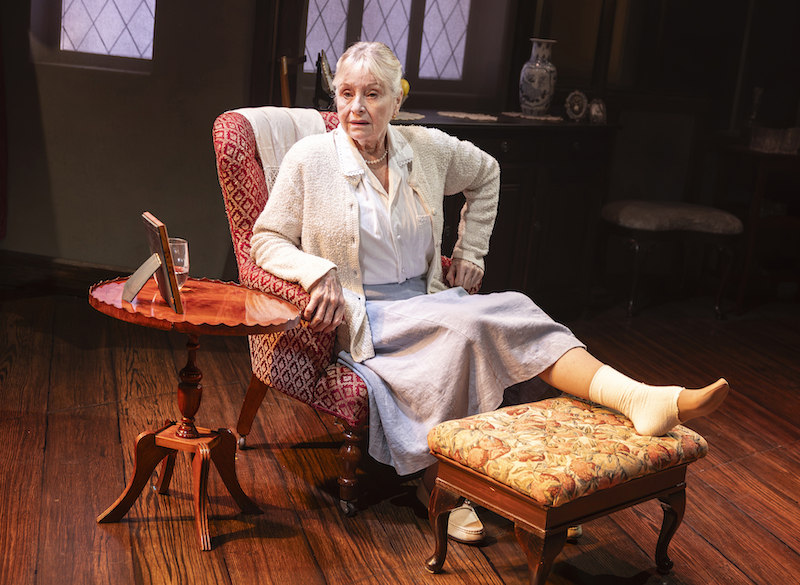
One of the major problems with any Marple adaptation is that Christie’s beloved problem solver is rarely directly in the centre of any action, often piecing together what happened through side observations or picking up on throwaway comments from the mystery’s other characters. That’s especially true in The Mirror Crack’d, where Miss Marple is incapacitated from the off, homebound with a twisted ankle. Wagstaff and director Jonathan O’Boyle use this to the play’s advantage, with frequent re-enactments of scenes that happened elsewhere as people describe events to her.
Goddard is a fine, if occasionally anodyne, Miss Marple, sometimes struggling with the character’s passivity, especially during her immobility in Act I. She works well, though, with the characters who buzz around her, especially Elysia Showan’s Cherry, the young woman from “the development” who has come in as a home help, and Annie Wensak’s Dolly, who offers the requisite sense of sharp snobbishness. The pair offers up plenty of humour, with Wagstaff dialling up much of Christie’s underrated wit into a much broader affair. While that is for the most part enjoyable, the play’s reduction of Inspector Craddock to a bumbling fool serves neither the character nor the play very well. Christie’s policemen are often blind to the behaviours and circumstances that Marple and Poirot can spot more easily, but they are always professional, and never as stupid as the poor inspector is shown to be here.
More interesting are the characters within the central mystery, led by Sara Crowe’s Marina. While Crowe doesn’t quite pull off the exotic glamour the character is supposedly infused with, it still suggests a star hanging tooth and nail onto her status as the British film industry begins to fade, one more capture of a 1960s England undergoing upheaval. As Marina’s tragic backstory emerges, Crowe also reveals the character’s vulnerable side.
As the mystery deepens, Act II sees Goddard’s Marple, now partially recovered from her ankle and interacting directly with the suspects, given more to do, with Goddard revelling in the increased mobility. Fans of the original novel may have fun spotting where Wagstaff chooses to deviate from the source material – some side characters, subplots and even motives are either elided or dropped – while retaining the central core of the mystery intact, while those new to the story will find there is a decent guessing game to be had out of what even the author’s fans will admit was not one of Christie’s finest works.
One noticeable difference between the early 1960s setting and our own is perhaps one of the play’s few subtleties. The death penalty had yet to be repealed, so those accused of a crime as heinous as murder would fully expect to be hanged. That prospect raises its head on several occasions, and the matter-of-factness of such a future for any murderer (or suspected murderer) helps to elevate the stakes in ways that a contemporary murder mystery often cannot.
That helps the piece play out as a perfectly fine, satisfying adaptation. It may be neither as sharp nor as satisfying as Christie’s own works for the stage, but it retains enough of the author’s eye for character and plotting that one can leave the play feeling that the mystery was put together well, the unmasking of the murderer feels earned, and that Miss Marple has once again proven to be an expert in the frailties and follies of human nature. A final injection of pathos right at the very end helps ensure that The Mirror Crack’d leaves one feeling satisfied, as well as desiring a really nice cup of tea.
Runs until 31 October 2026
