

Writer: William Shakespeare
Director: Sacha Duchamp
It is common for modern Shakespeare adaptations to reinvent the story in some way, presenting the piece with a clever or ‘current’ angle. Sacha Duchamp’s production of Measure for Measure is no different and certainly takes an ambitious swing in its delivery of the classical piece.
As the audience members enter they are given either a white or black ticket and told this will have significant bearing on their experience. With no further instruction the play begins and, despite the suspense of what is to come, it is a slightly underwhelming affair; an expositional opening scene played out in front of a black curtain on an empty stage. However, the audience is then split according to ticket colour, with half of the viewers taken to an alternative seating area on the other side of the curtain. The lack of set design suddenly makes a lot more sense as, from this point, the production plays out two scenes at a time.
For those unfamiliar with the plot: Under stricter laws regarding fornication, Claudio is arrested by Lord Angelo and sentenced to death for impregnating the unmarried Juliet. Meanwhile, Claudio’s sister Isabella is about to enter a nunnery when she is drawn into saving him. She begs Angelo to save her brother and he propositions her, offering Claudio’s life in exchange for sex.
Naturally the play does follow a dual narrative, focusing on either Claudio or Isabella who only share the stage once. Therefore there is some merit to the idea and the inspiration behind it is theoretically interesting. Of course, in reality, playing out two different scenes simultaneously in the same, small space is a logistical nightmare. Admittedly the company seems well-prepared for this creative challenge, with the actors able to switch sides of the curtain slickly for their various scenes and appear unaffected by the noise from the other side of the curtain whilst performing.
For the audience, however, it is very difficult to focus on the words of the scene you should be watching when they blur so often with the very audible simultaneous drama. Whilst the skeleton of the plot can still be salvaged from the aural chaos, the detail and beauty of the text is completely lost, which is unforgivable for Shakespeare-experts and, at the least, frustrating for casual viewers.
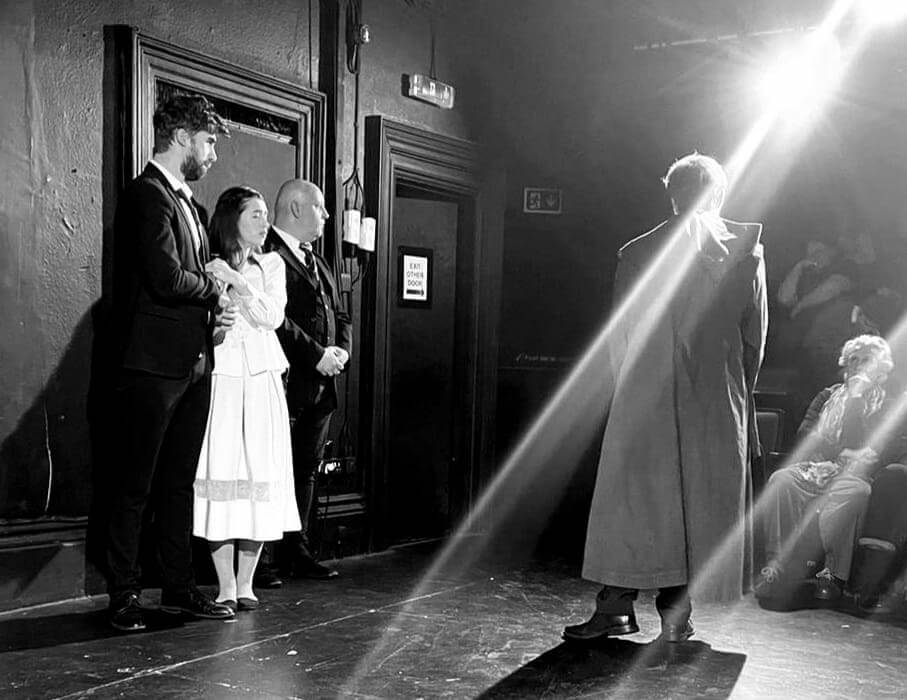
This set-up is discarded for the second act and instead the action plays out, without the bisecting curtain, in a traverse set-up. This makes for much smoother storytelling and, in fact, the courtroom-esque layout is quite impactful when the characters inevitably receive their judgements.
The cast are not exactly cohesive, with everyone seeming to perform on a different energy level. Some performers are giving it the grand treatment you would expect at Shakespeare’s Globe, and these cast members certainly win the shouting match of the first act, while others seem to be giving quieter, more intimate ‘screen’ performances. That is not to say that everyone, or anyone, does a bad job. Harry Mead and Dominic Chambers give stand-out performances as Lucio and Barnadine respectively. Both clearly have a strong understanding of Shakespeare’s text and their playful energies are completely electric to watch.
This production of Measure for Measure makes for bizarre viewing and does feel more like a rehearsal than a final production. It is an exercise in style over substance and, considering you see both halves regardless, it feels somewhat fruitless. The fact that the second act feels so much easier to watch and actually allows the audience to relax into the storytelling, proves that, particularly when reinventing Shakespeare, less is more.
Runs until 5 March 2022
