

Writer: Anton Chekhov
Adaptor: Mike Poulton
Director: James Brining
Faced with the option of updating Chekhov’s classic play and relocating it to a time or place other than Russia in the last 19th century, Mike Poulton has made the conscious decision to leave it exactly where it was in his adaptation, believing that any attempt to modernise Chekhov’s settings to make them relevant is pointless and unwise.
However, under James Brining’s direction, the end result is a production that falls somewhere between a traditional retelling and an update for a modern audience that aims to brings present day vanities into focus. As a consequence, it falls short on both counts.
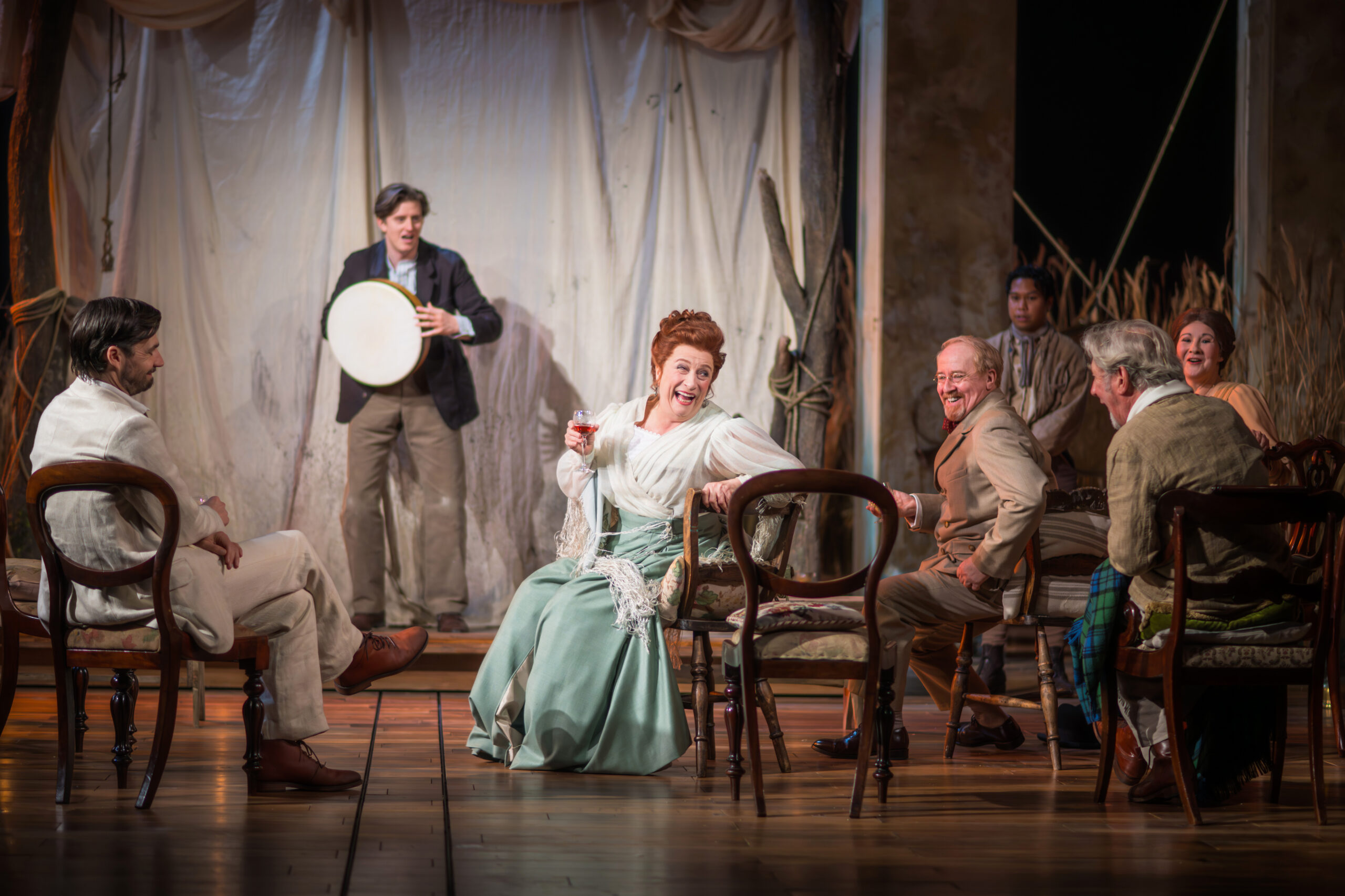
The opening scene is one of the few moments where it achieves its ambitions, as aspiring writer Konstantin prepares to present his new play to an audience including his actress mother Irina Arkadina. This takes place in a makeshift theatre in the garden of the country estate of Sorin, the retired civil servant brother of Irina, who is playing host to her family and her lover Trigorin. Trigorin is a writer from a different school of thought to Konstantin. The latter mistrusts and resents the formers simplistic style and seeming success. The contrast between the two is superbly drawn, and Lorn Macdonald immediately captures the essence of Konstantin as a tortured soul torn between the extent of his ambition and the limitations of his ability, while Dyfan Dwyfor, as Trigorin, has the self-satisfied charm of a man who knows he is held in higher esteem than he maybe deserves to be.
Konstantin’s denunciation of established theatre and take down of the obsessions and preferences of older writers, directors and audiences feels like it could be the start of a manifesto for a 2025 writers collective. In contrast, Irina’s dismissive response to the production also sounds like it could have come straight from the pen of an anti-woke journalist.
However, even here there is a sense that what she is saying is more of a denouncement of modern writers and theatre makers than it is the cries of someone raging against the dying of the light, unable to face a future where she is no longer relevant. Caroline Quentin’s portrayal of Irina brings out the diva but not the desperation of the character. The nagging sense that the production as a whole is not going into characters feelings and motivations with any real depth grows as the play develops.
The plot has the ingredients of an Ayckbourn or Coward farce. Romantic longings abound with Nina, the actor Konstantin has asked to perform in his ill-fated production, becoming obsessed with Trogorin, and Masha, the introverted daughter of the estate managers, longing for a relationship with Konstantin while being drawn into a life and marriage with a teacher who is the exact opposite of what she wants.
Running through this, are the themes of loneliness, loss of youth, unfulfilled ambitions, doubts of the real worth of achievements, and time running out. It is these recurring topics in Chekhov’s work that led to him being a seen as a tragedian until directors started noting the humour and satire in his scripts and characterisations, and productions of his work got lighter.
The problem with this production is that by focusing primarily on bringing out the comedy in the lines, the underlying tragedy in the lives and situations is lost. While they stop short of being caricatures, many of the characters are almost one dimensional and lacking subtlety. The production drifts into a series of set-piece exchanges that work individually but never seem to gel into a cohesive whole. There feels like a lack of connection both between the characters and between the storylines that is only partially resolved by a powerful final scene between Macdonald and Harmony Rose-Bremner, as Nina. The two actors bring home what the characters have longed for and lost, and the personal flaws that have made them powerless to change their fate.
With a very strong cast, the potential for a production that brings home all the humour and pathos in the play is undeniable. It is a shame that this potential isn’t realised.
Runs until 1 November 2025 | Image: Mihaela Bodlovic
The Reviews Hub Star Rating
-
6
