

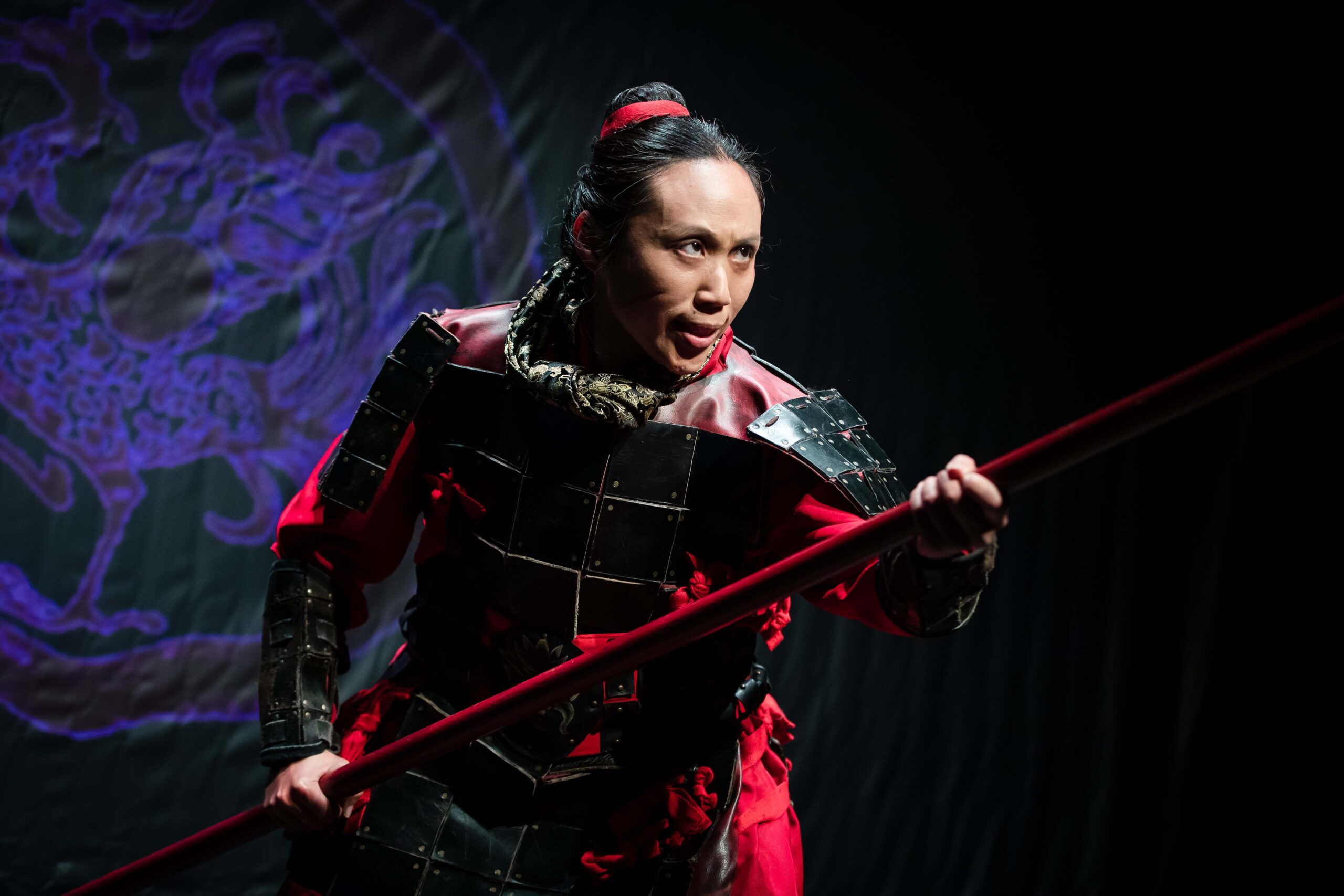
Original concept: Michelle Yim
Michelle Yim has been performing her more-realistic-than-Disney version of the story of Mulan for some years and her assurance with the material is understandable, if still impressive. She is supported by co-producers Grist to the Mill and Red Dragonfly and puts on a polished, if small-scale, performance, with atmospheric sound and the original Chinese words periodically projected onto a screen behind her – the recital of them, mercifully, is in English!
The story, an old Chinese legend, tells of a young woman who joins the imperial army because her father is ill, there is no one else in the household suitable and they will be punished if they cannot provide a recruit. For ten years she serves, becomes a general, then returns to her family to resume life.
The production was billed as suitable for 10-year-olds upwards, but sadly their absence from the matinee performance meant that the girls of York were deprived of an opportunity to discover a new role model: Yim’s thoroughly feminist performance is realistic enough to convince. She appears in full armour, enacting the moves of war, her face resolutely fierce, with a mighty pike as her weapon, and returns to this war-like stance periodically, in between lolling exhausted in a chair or messily eating noodles and telling us her story as she prepares for her last battle.
The advance publicity promises us “the real Chinese heroine” – well, maybe, but the problem is that Yim’s Mulan is typical of those cross-dressers who punctuate the histories of piracy and the armed forces. The early Chinese practice of saving education for boys is one that persisted for many centuries in the West, no less than the East, and Mulan’s tomboy-ish youth, encouraged up to a point by her father, is the perfect preparation for joining the army. The early embarrassment over drinking and failing to understand dirty jokes introduces a rather more light-hearted tone, but is again what one expects.
She does, however, strike an individual note when she worries about what she will become after the army. Will she settle down as wife? Unthinkable. Will her friends and relations accept her as normal? Unlikely. The one thing she can be sure of is that, when her old comrades come to visit, they will talk over old times. Here is the culmination of earlier references to comrades dying – the people she will miss/is missing already are her fellow-soldiers.
Michelle Yim convinces us of the truth of her characterisation, even if it’s the truth we expected.
Reviewed on 12 September 2026
The Reviews Hub Star Rating
-
6
