

Writer: Theo Chester
Director: Tommo Fowler
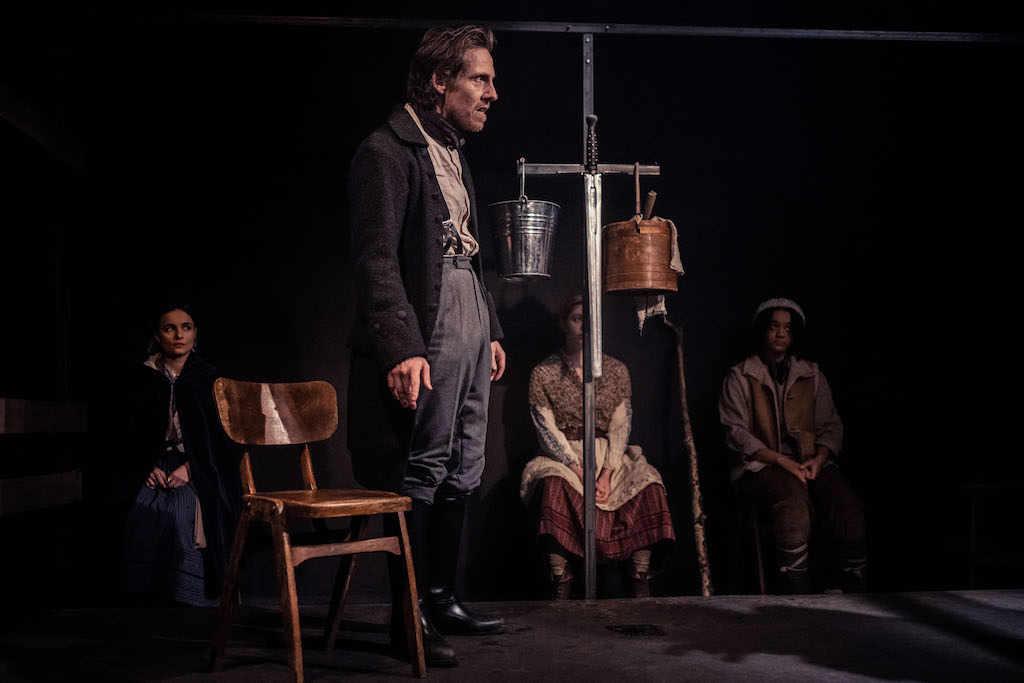
At the start of Theo Chester’s debut play, Stray Dogs, the outlines seem more or less clear, albeit strange. The set, costumes and language generally suggest a timeless past – perhaps the world of folk tales. Central character Jacob (a sound performance by Graham Butler) has inherited the job of Executioner along with a formidable sword which hangs in the otherwise starkly furnished stage. He must behead anyone who falls foul of the Judge, Franz, leader of the wealthy merchants who live in Town. Outsiders like Jacob and his wife Hilde live beyond Town’s walls. Those really beyond the pale, the herdsmen, live in tents. There seems to be some sort of additional caste system by which anyone lower in the hierarchy is considered unclean.
Jacob’s worthy ambition is to be declared Healer, and thus renounce the role of Executioner. He tries to explain his philosophy to the Judge – if the poor herdspeople are given enough grain and he attends to their health, they will become Calm. Calm is his watchword. They will stop fomenting dissent.
But Hilde (a stand-out performance by Abbey Gillett), Jacob’s feisty wife, is more ambitious. She and Jacob are deeply in love, but when one of the herdsmen, Wilf (Coral Wylie) arrives with a severe wolf bite, it is Hilde who proves she has the stronger powers of healing. This leads to Wilf driving a wedge between the couple. He wants more radical action. He wants his people to have land. So far so good.
But soon after this the plot becomes frankly baffling. At the same time, the small cast of five (only Graeme McKnight doubles as Frank and Pig) means that it’s hard to create a real sense of a complex society and Chester relies heavily on exposition. One of the few characters we actually meet is a mysteriously well-groomed young woman, the Lady Ana (Ruxandra Porojnicu), looking like a Little-Blue-Riding-Hood-cum-Spanish-senorita. She is gushingly keen to be on their side, happy to steal grain for the herdsmen from her brutish merchant husband. However her surprising decision to knife him to death leads to a whole lot of problems for everyone.
This first act runs for an hour and a half and there is still an hour to go. Ana flees into the forest with Jacob, who has revealed himself to share a lust for torture. But he still maintains a vision of Goodness. They meet a forest dweller, Pig, who Caliban-like refers to himself in the third person.They also encounter Wolves, who may or may not be the Stray Dogs of the title. Meanwhile Hilde is angry with Jacob and wants to leave with Herdsman Wilf.
It would take a very determined theatre-goer to stay committed to following the plot and themes by this stage. Part of the problem is that despite the (literal) buckets of blood, there is very little variation in the scenes. The characters are largely two-dimensional, and in scene after scene, face each other across the little stage and talk at enormous length. The dialogue needs serious editing to maintain our interest.
The characters also tend to have psychologically improbable switches of mood. Hilde in particular swiftly changes from fury to devotion. The endless shifts in speech register don’t help. At one moment she and Jacob are referring to olden-days style as ‘Husband’, ‘Wife’, but the next she is screaming at him to shut up and fuck off.
Chester seems to want to consider what makes a just society, and adds, rather too late, something about taking radical political action. But would those fat-cat merchants really cave in when Wilf leads the herders in a sit-down strike to demand land?
Stray Dogs is an inflated piece of drama that stretches credulity and audience patience to the extreme.
Runs until 1 April 2023
