

Writer: Margaret Atwood
Director: Juliet Forster
It’s now some 21 years since the distinguished novelist, Margaret Atwood, re-wrote the Odyssey for Canongate’s Myths series, taking the story of Penelope and Odysseus and re-telling it from Penelope’s perspective. Penelope, of course, in the original, was the soul of honour and loyalty, weaving her tapestry by day and undoing it by night to keep at bay those suitors who pestered her during Odysseus’ long absence after the Trojan War, having all those adventures that Homer recounts.
Atwood then adapted the novella for the stage and, with one or two additions from the original, this is the version we see at York with a totally feminine cast and creatives. Penelope, in Amelia Bullmore’s poised and assured, but increasingly melancholy, performance, is dead, in the Underworld, looking back on her life. She has a wry wit and a deep-rooted antipathy to good-time girl Helen.
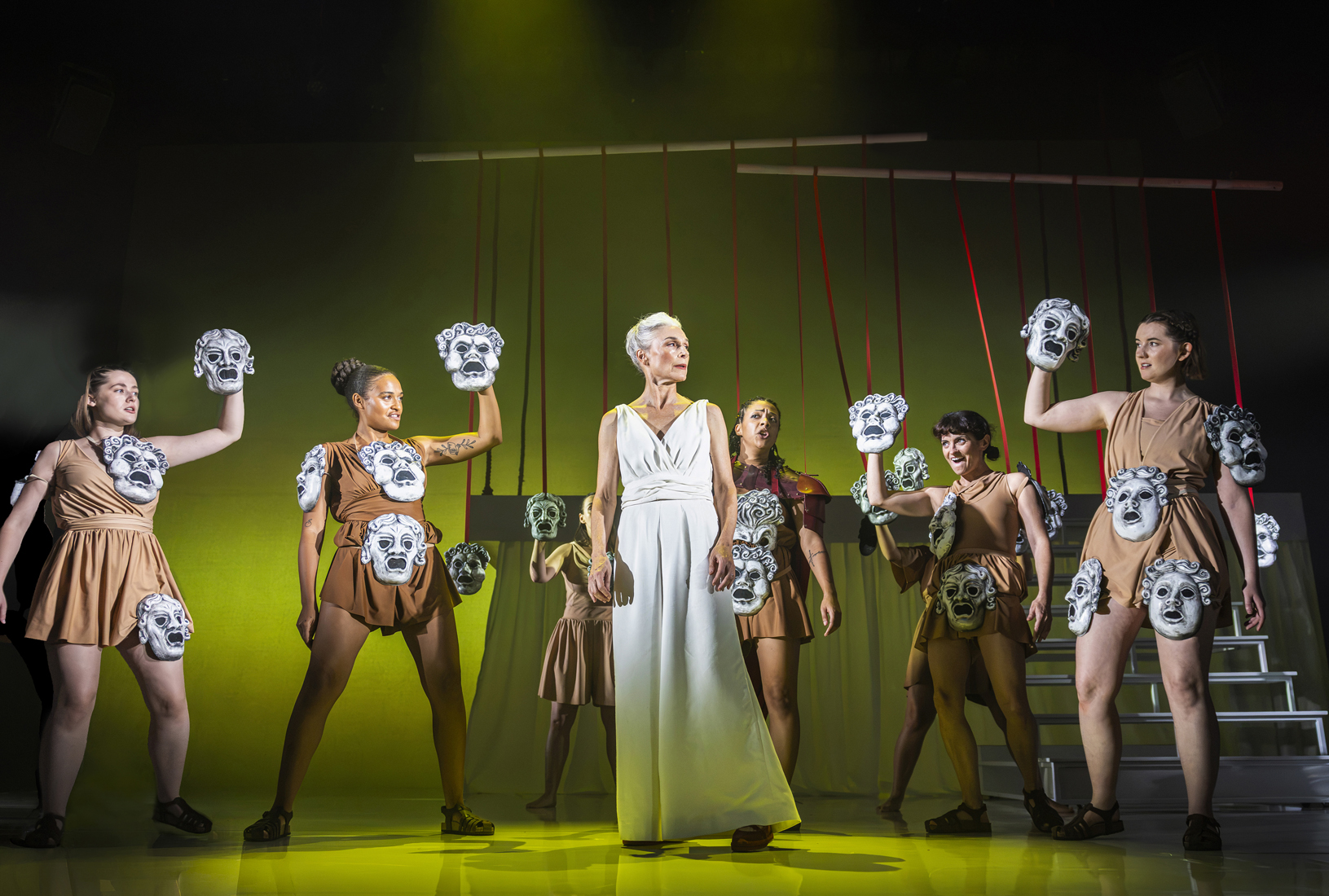
Apart from Bullmore, the cast is made up of eight young female actors playing her maids and also every other part going. One of the problems for Juliet Forster is the question of tone. The individual parts played by “the maids” are often wildly caricatured. Certainly the most effective of these are the young aristocratic warriors who compete for Penelope’s hand and those who mob around as suitors – boorish, uncouth, violent. Is this really how women see the masculine glory of these people? In the days of Trump, there’s no doubt about it. These caricatures are horrifyingly effective, but others, while skilfully done, make less impact.
Where “the maids” score heavily is in the raw energy and range of skills they deploy as a group: dancing in most styles from tap to gymnastic, a little touch of aerialism, puppetry with the young Telemachus, vocal choruses from rousing to eerie, all accomplished with a splendid degree of teamwork, even when there are only five or six of them, the others being on duty playing assorted characters.
So how does Atwood’s Penelope differ from Homer’s? By being there as a person. This Penelope is subject to male dominance in her marriage, ignored by her in-laws, eased out by Eurycleia from love of husband and son (the characterisation of Eurycleia, whilst amusing, eventually seems overdone) and finally achieves a loving sense of community with her maids. The weaving scene with the maids is magnificently done and perhaps the jolt of changing gears is most fully felt in Act 2 when the maids perkily go into a tap dance routine, to be followed by a sickening rape scene and a beautifully poignant lament. Thereafter the skilfully ambiguous tone is replaced by one of outrage.
Even her marriage, as seen by Penelope, fails to match Odysseus’ idealised image. This Odysseus is a trickster – so was Homer’s – but we see Penelope as the wife he returns to, but often feeling second best in his affections to Helen.
Juliet Forster is supported by an expert team, notably Sara Perks, her set economically effective, her costumes combining Greek drapery with neat approximations for instant transformation, Alexandra Stafford with stunning lighting, and Kate Marlais, with a mix of rollicking songs, evocative melodies and subtle underscoring. The result is an entertaining evening that ends up being something much more serious and thought-provoking.
Runs until 31 October 2026
The Reviews Hub Star Rating
-
9
