

Writer: Michel Marc Bouchard (adapted by Armando Babaioff)
Director: Rodrigo Portella
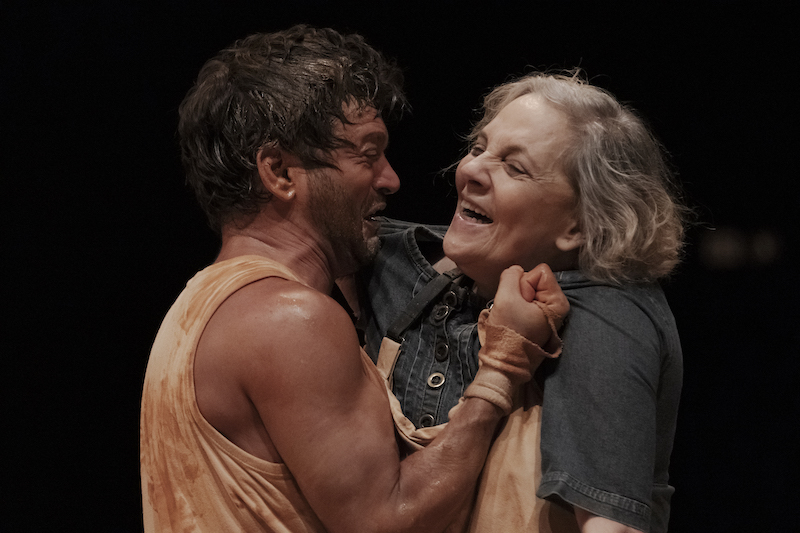
First seen in 2017, the profoundly powerful and viscerally engrossing Brazilian stage adaptation of Michel Marc Bouchard’s Tom at the Farm, translated and produced by actor Armando Babaioff and directed by Rodrigo Portella, finally makes a long-overdue London debut.
The milieu is recognisably South American: untrammelled machismo, oppressive heat, rural isolation and despair, and, in Aurora dos Campos’ stunningly rendered expressionist set, an expanse of rusty brown earth atop a vast plastic sheet that quickly churns into clinging mud. But its themes – the toxicity of lies, the burden of grief, and the multifaceted connection between violence and desire – are universal.
30-something Tom (Armando Babaioff) is a pampered, perfumed city boy bedecked in a black leather jacket, crisp T-shirt and trousers, and pristine white trainers. He has driven a long way, much longer than he anticipated, to the squalid, remote family farm of his boyfriend, Guillaume, who recently died in a bloody motorcycle crash. “Were you one of his friends?” enquires the man’s mother, Agatha (Denise Del Vecchio, otherworldly and broken), who seemingly had no idea her late son was bisexual.
Tom shifts between awkward dialogue with Agatha and fourth-wall-breaking, stream-of-consciousness-like descriptions of the kitchen he finds himself in: “chairs, red tiles on the floor, butter on the table”, he mutters. It is an artifice that highlights the constructed theatricality of the location – there is nothing by way of furnishing in Campos’ set – but also its strange ‘otherness’. This is an alien world for Tom, one in which city rules may not apply. Lighting designer Tomás Ribas washes the stage in dusk brown and fixes his characters with bright overhead beams as if to make the point.
We soon learn that Guillaume had a brother, Francis (Iano Salomão), whom he failed to mention to Tom. We later learn to our horror why Guillaume chose to conceal so many secrets from his boyfriend.
Salomão delivers a towering performance as the brutal, sadistic, damaged Francis who is well aware of his late brother’s sexuality, and determined that Agatha will not find out. “I knew you’d show up some day,” he says vindictively, “if you open your mouth, I’ll make sure there’s nothing left of you.” He means it. A ditch, surrounded by coyotes, is where Francis disposes of the farm’s dead cows. Above it is a gruesome hook on the end of a pulley, a Brazilian iteration of Chekhov’s gun.
Francis tells his mother that Guillaume had a girlfriend, Helen, a fiction he requires Tom to play along with under threat of punishment. Tom finds the imaginary Helen a useful avatar through which to express his own grief, later inviting an alcoholic colleague, Sara (Camila Nhary adds comic light to the piece’s relentless tone of threat), to play the role in person.
Why does Tom stay at the farm over nine days, as Francis’ near-psychopathic violence and unpredictability, and Agatha’s desire to make him a version of her dead son, become apparent? The family is, as Tom tells us, “a rack of old clothes forgotten in a thrift store”. The question is, on the surface, troublesome, but part of this production’s triumph lies in making the choice seem so explicable.
Tom’s anguish disarms his instinct for self-preservation. In Francis, he finds both the brutal opposite of his lover and the closest physical connection. Survivor guilt (and a heady dose of internalised homophobia) causes him to eroticise, even love, his oppressor. The bruises, the head butts, the lacerated wrists are the price he willingly pays to remain connected to what he has lost. Violence and desire become natural partners, as they do in many toxic relationships. The undercurrent of steamy sadomasochistic eroticism between Salomão and Babaioff’s psychologically flailing Tom is perfectly executed.
If we never quite find empathy for Salomão’s Francis, we do at least partially understand his emotional repression and sense of self-loathing. He gets to say to Tom some of the things, even offer some of the love, he could never provide to the absent Guillaume, whom he betrayed unpardonably as a boy. “You’re gentle with cows”, he tells Tom as if bestowing a gift. The men dance a beautifully choreographed wordless duet to cumbia music to celebrate the birth of a cow. “I don’t know how to ask people to stay,” he says later, finally finding a voice.
Midway through, one yearns for a scene or two that dials down the physical brutality. The ending, though ambiguous, reminds us that violence breeds violence and that family traumas built upon lies are nearly impossible to move on from. Tom at the Farm is arguably the most important Brazilian play in the last decade. It is hard-going, but absolutely unmissable.
Runs until 17 October 2026
