

Writer: Joel Tan
Director: Josh Roche
It’s impossible today to engage with media of any form and miss stark depictions of conflict and armed aggression. We’re watching the global press write the first draft of history, presenting imagery and stories that cover the full spectrum of violence from geopolitical tangling to devastation of individual family units. We’re at saturation, but bearing witness remains vital.
Kudos, then, to Joel Tan for finding novelty in communicating stories of revolution, violence and conflict’s effect and legacy. Through a collection of short episodes Tan’s work charts the rise, fall, and lasting impact of a despot’s bid for power. It’s a mixed bag, some far more effective than others. We’re left with impressions of messages and philosophies rather than a clearly honed point, which minimises the impact of the piece overall but does provide a useful perspective for us to use as we work through our current news cycles.
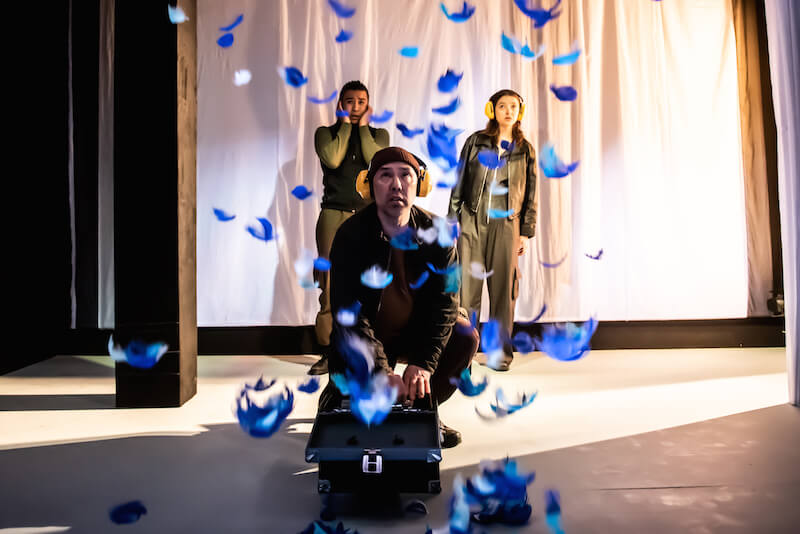
Four cast members (Daniel York Loh, Pandora Colin, Jules Chan, Pía Laborde-Noguez) rotate through an array of characters from soldiers to artists, parents, protesters, refugees and writers. Though sometimes a little confusing, through them we get a broad spectrum of viewpoints on the past, present and future of a regime’s rise to power. The banality of it all is highlighted in the opening scene where pest control workers are under deathly pressure to clear flocking birds from a parade route. The violence is seen in an attempted rape scene that turns into an accidental murder.
The pace of change is seen in a scene set years later where half-taught history and youth butts against lived experience of brutal executions from the previous generation. The circularity of events is seen as a teacher is pointedly discouraged from showing his class the poetry of a potential subversive author. Set against a simple set design from Ingrid Hu and lit by Clare O’Donoghue there’s a no frills approach to this production that lets the action speak for itself.
These vignettes allow us to dwell on the personal side of large scale violence and power movements. Because our attention is captured for an hour and a half it can engage in a way news reports and video designed for mass consumption simply cannot. In that respect it’s a successful piece of work. It allows these stories to sit with us, leaving some of their impact behind in a way other formats cannot hope to.
Though some of the pieces are baffling (the final sections, set long into the future are dislocated from both narrative and tone) we can find and hold onto a main impression of the complexity and layers involved in conducting and living with revolution and unrest. However a more concrete thesis to impart beyond this general feeling would have been welcome; it successfully sticks in the mind, but to what purpose?
Runs until 18 June 2022
