

Writer: Mauro Fazion
Director: Verônica Sarno
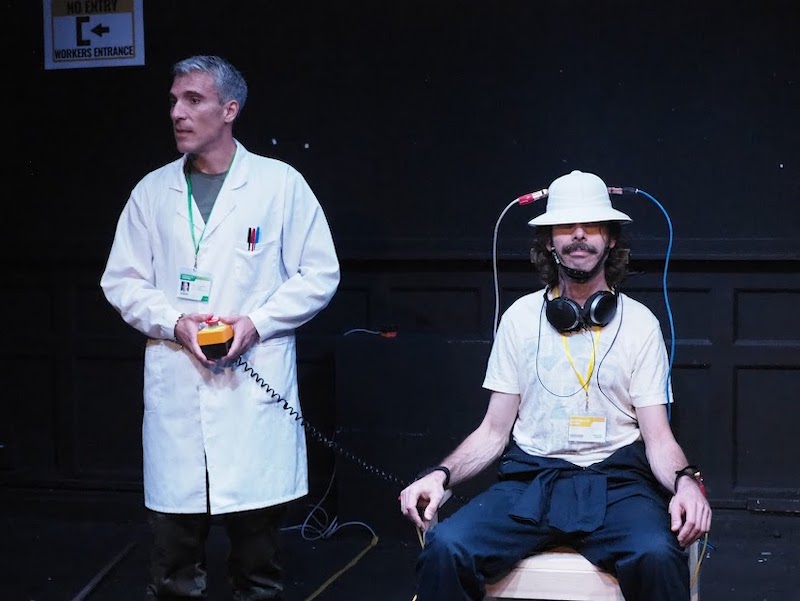
The Dying Wish opens on an electric chair, a new invention to replace the gallows, in a society with laws against everything from heresy to cross-dressing. We are treated to a farcical series of events, slowly leaning into an emotional end, seen through the lens of the executioners tasked with processing many state-sanctioned killings. The tone is silly, with moments of seriousness, in an attempt at Beckettian style.
While some of the humour in The Dying Wish does land, much of the social commentary is loosely compiled and suffers from a lack of clarity in the moral positions of the executioners (Omar Aga and Chris Gallagher). They swap ethical positions towards the end in a way that neither feels earned, either in tone or plot. Perhaps the most discordant scene involves the mother of the soon-to-be-convicted man, played in a discordant pantomime style by Andrea Furlotti, entering to feed cookies and coffee to all in attendance. The scene achieves nothing and serves only to maintain the silliness of the overall tone.
Nevertheless, some harmony is present. The lighting matches the starkness of the piece, and the piano motif is chosen well to match the haunting intent of its impact. The choice of topic also feels relevant for our times, when police follow orders without considering the validity of the laws they’re sent to enact.
Unfortunately, The Dying Wish is insensitive in its portrayal of some of the most vulnerable in society. Mario Fazion chooses to write Kiddy, an addict with mental health issues, in an oversimplified and stereotypical manner. However, it should be noted that Precious Scott brings commitment and raw emotion to the role, which manages to make the character land with some effect.
The engineer is also credibly acted and one of the executioners manages to find a suitable balance between absurdity and sincerity in a genuinely likeable fashion. Not all characters are played or written with an equal attempt at complexity, though. The Attorney, played unconvincingly by Romeo Olukotun, has only one dimension, and Fazion’s writing lacks any clarity as to his role: he seems at times to be prosecuting, at others to be defending, and Verônica Sarno takes the directorial decision to have him be the only character to break the fourth wall in a way that seems out of sync with the rest of the directorial choices. Fazion also writes a janitor who performs some pivotal plot roles but lacks even a veneer of character depth. Overall, the underwhelming quality of performances never becomes quite enough to overcome the failures of the writing.
The Dying Wish aims to be multiple things at once, heartfelt commentary and absurd romp, and sadly it misses at all of its targets. Tonally discordant and lacking substance, this piece feels like a training ground for its creators to work out the kinks of theatre.
Runs until 1 October 2025
The Reviews Hub Star Rating
-
4
