

Writer: William Shakespeare
Directors: Joe Murphy and Madeleine Kludje
Who would think an evening of revelry and joy with fairy folk could carry such profound messaging and further draw one’s attention to the looming threat of our ever-changing climate? But this modern interpretation of classic Shakespearean literature, while not necessarily to everyone’s taste, does just that, injecting a message relevant to our modern world without straying far from the original text. In her programme notes, Elizabeth Freestone, RSC associate and consultant, says that, despite the play being over 400 years old, it is a timely assessment of people-planet relations, something increasingly relevant as we tackle man-made climate change in our modern society; and, just like Titania and Oberon who debate their impact on the environment, so should we all consider how we are affecting the planet. The way they put across this message is clever and straightforward: by beginning and ending the performance with a news report, delivered first by Hippolyta and then by Theseus, standing in front of the UN logo and speaking passionately straight into the hearts and minds of the audience.
The messaging isn’t the only way that co-directors Joe Murphy and Madeleine Kludje modernise this performance. They have chosen to gender-bend one of the roles, as we see Lysandra (instead of Lysander) pursuing Hermia, and change one of the story beats to impact Oberon instead of Titania. This reflects our more forward-thinking and accepting society that embraces same-sex relationships more than ever and displays them with the same reverence as is given to hetero relationships.
Some of the choices made to modernise the performance, however, do feel strange, like turning the four Athenian lovers into private school pupils, keeping them in uniform for the majority of the performance, or the sudden appearance of a mobile phone to check the calendar. Other choices are strokes of brilliance, incorporating modern music and song into the performance: Sweet Dreams and I Wanna Know What Love Is being sung by Puck and Oberon, respectively, the former with excellent audience participation, feeling strangely at home in the performance.
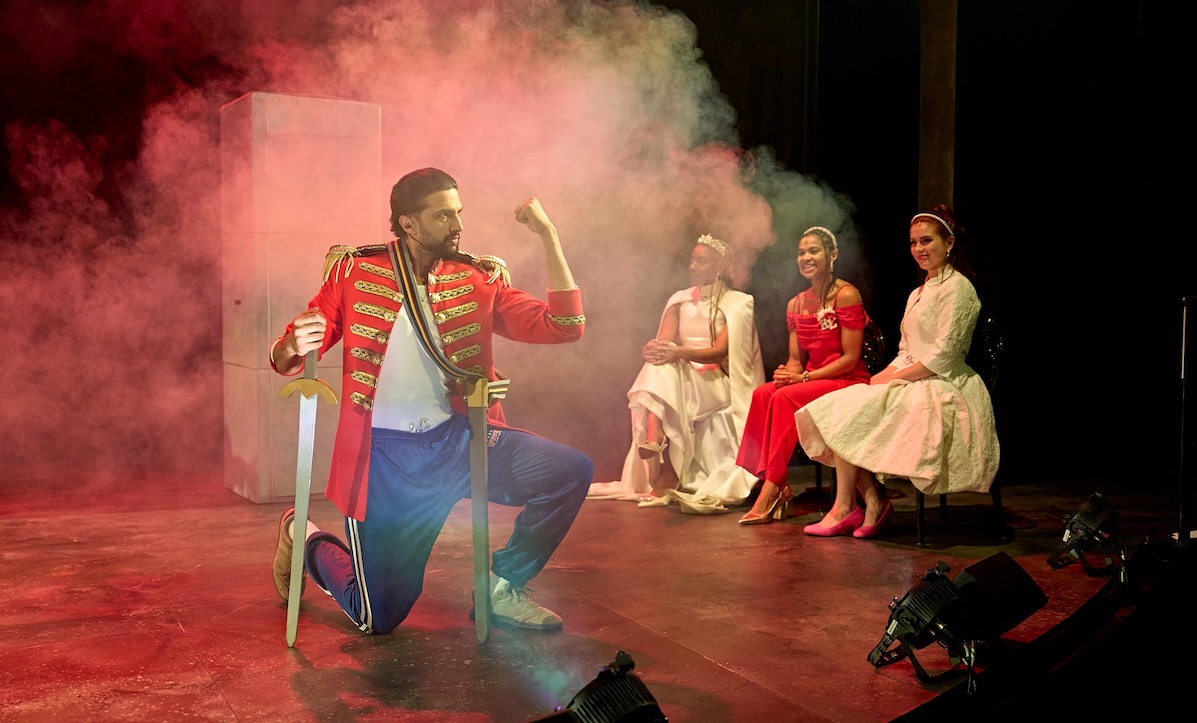
Another example is the set and costume design by Carl Davies. The set begins with towering black pillars that feel like an imposing and brutal urban environment, devoid of the colour and whimsy that this play promises. However, the pillars are revealed to be hollow with a transparent screen that reveals foliage and lighting within, transporting us into the forest and away from the city. And then there’s the costumes, which are a mixture of old-fashioned textiles and designs interspersed with modern details such as a fairy in bloomers and Doc Marten boots, and the character Puck in a pink, black and white ensemble that invokes the spirit of two-tone or the early 2000s emo scene with checkerboard patterns and brightly coloured hair.
With all this modern storytelling and deep, meaningful reflections, the performance needs a cast that impacts people, bringing the play to life and helping the audience buy in. This cast certainly does that. The absolute star of the show is Adam Carver, who plays the dual roles of Puck and Philostrate, and it is their performance as Puck that will be remembered for the longest time: oozing with charisma, humour and joy, their stage presence is intoxicating. The way they engage with the audience and even start a sing-along is a highlight of the show.
Ellena Vincent, who plays Titania and Hippolyta, delivers another great performance, especially as Queen Titania, whose scheming with Puck is very enjoyable to watch and with a gorgeous singing voice that we hear throughout.
Despite the strange decision to put the characters in school uniforms, the four Athenian lovers are also very impressive to watch. Individually, they are good, but together they play off of each other well and invoke a genuine feeling of friendship and rivalry, which we all experienced going through school. Isabel Adomakoh Young as Hermia, Qasim Mahmood as Demetrius, Evie Ward-Drummond as Lysandra, and Charlotte Wallis as Helena are all admirable, while the latter two deserve special congratulations for successful debuts.
This performance is well worth watching, whether you are looking for a new interpretation of this Shakespearean staple or experiencing it for the first time; the same whimsy and joy that is written into the original text is found here, but with just a sprinkling of environmentalism to make the audience think and debate our relationship with our world.
Runs until 24 May 2026
