

Conductor: Robert Ames
Creative Directors: Robert Ames and John Gosling
Multitudes, the multi-arts festival powered by orchestral music, is part of the Southbank Centre’s 75th celebrations and has brought together some of the world’s finest classical music ensembles – including six Resident Orchestras – to collaborate with other artists, spanning singers, dancers, poets and visual artists. Mark Ball, Artistic Director of Southbank Centre, seeks to create a fertile, acoustic space and multi-sensorial experience for new audiences.
Unnatural Harmony: Sounds of Lee Alexander McQueen is brought to you by The London Contemporary Orchestra. An evening of style, fashion, film, song, dance, and drag, it’s a homage to the music that inspired McQueen’s legendary shows, which were memorable, theatrical events, unlike anything else at the time. The British designer who died in 2010 after taking his own life at 40 is still mourned by the fashion community, for the loss of a rare, singular talent and his sense of anarchy, outrage and fearlessness.
For anyone who’s ever seen an Alexander McQueen show, Unnatural Harmony can only disappoint. Not endorsed, sponsored by or made with the involvement of the House of Alexander McQueen, it’s a tribute to, not an official collaboration, with the existing design house. The music, beautifully played by the London Contemporary Orchestra, is a medley of songs that provided the acoustic backdrop to some of McQueen’s catwalk shows and includes Björk’s Frosti, Philip Glass’s Morning Passages from The Hours, Nirvana’s Smells Like Teen Spirit and Mozart’s Adagio from Piano Concerto No. 23 in A, K. 488
All are part of McQueen’s back catalogue and selected by co-creative director John Gosling, who worked on some of the original live events. John Williams’s theme tune from Schindler’s List was, for instance, used for the finale of his A/W 2006 show, The Widows of Culloden. Paint It Black by the Rolling Stones was heard in the Dante show in A/W 1996. Duelling Banjos by A Smith was used in his S/S 2004 collection Deliverance, where he also collaborated with dancer Michael Clark. Clark’s company also features in this show. Homo-erotic Scottish-inspired dancing in kilts; skinheads with tattoos and red braces would, in the flesh, be undoubtedly impressive, but on large distant screens, become too removed, aestheticised and flattened.
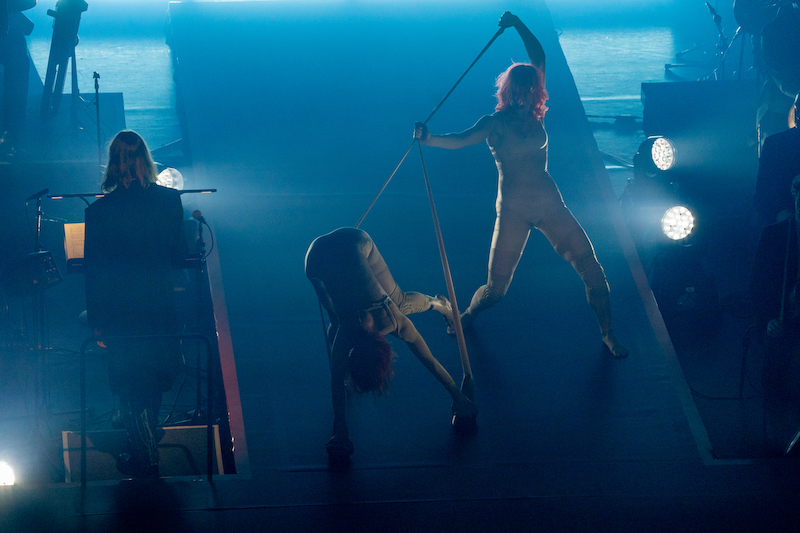
The live dance choreographed by Holly Blakley features Sari Mizoe and Willow Kerensa Fenner. Compelling and fascinating to witness, this androgynous and alien-like duo, with hair dyed flame orange and limbs that morph and meld separately and together, sometimes resemble the mutable forms of a Salvador Dali painting. Cabaret star and opera singer, Le Gateau Chocolat, is the lungs behind Lady Gaga’s Bad Romance, which was used for McQueen’s S/S 2010 Plato’s Atlantis. Chocolat brings humour and sparkle to the proceedings. When the peroxide blonde wig is cast aside, it’s the one badly behaved gesture of the night, and this is tidied away by a stagehand pretty quickly.
The Dark Ages Mix from The Witch Doktor by Armand van Helden is where everything fuses. Used in the McQueen S/S 1999 show entitled No.13, the Kenneth-Anger-like psychedelic, kaleidoscopic film editing and the frenetic beat of the music bring everything together, taking audiences to a fashion space close to McQueen’s sensibility.
Despite the impressive range of talent in this show, and there’s lots to admire, one can’t help thinking that perhaps the best collaborations happen organically. This feels forced, and never quite coalesces into one thing but remains a variety of independent creative acts in their own orbits. For something called Unnatural Harmony, the music is beautifully harmonious and too well-behaved to represent the McQueen many will remember. McQueen’s shows could be confusing, baffling, uncomfortable and gob-smacking, but here, the music—taken out of context, even with the support of a fabulous drag diva and two stunning dancers—is stripped of all emotion and decontextualised beyond meaning.
Reviewed on 29 April 2026
Multitudes runs until 30 April 2026
