

Book: Sergio Antonio Maggiolo
Music and Lyrics: Sergio Antonio Maggiolo and Guido Garcia Lueches
Director: Laura Killeen
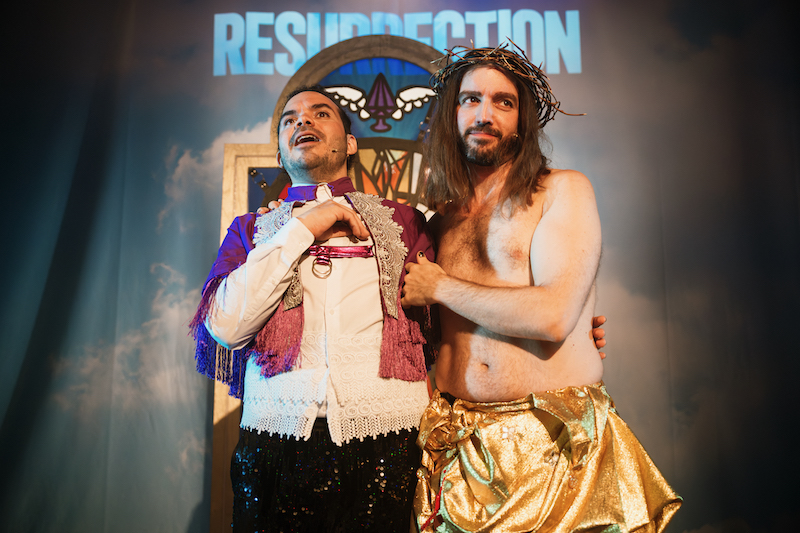
Most Christian religions ask you to love Jesus, but maybe it’s possible to love him a bit too much. In a big week for biblical fantasies following Christopher Brett Bailey’s I Saw Satan at the 7-Eleven, containing devilish sex scenes, Sergio Antonio Maggiolo, Guido Garcia Lueches and Laura Killeen’s new musical JEEZUS! centres on erotic thoughts about Jesus. Transferring from the Edinburgh Festival to the New Diorama Theatre, this very specifically 69-minute show (and it is too) is a bold, sacrilegious satire but with a big-hearted message about the true power of love.
Born to Peruvian parents Maria and José (aka Mary and Joseph), baby Jesús arrives by divine intervention after a prayer during the ceremony of miracles. As a teenager, altar boy Jesús starts to feel attracted to the male form but hopes to contain his newly discovered lusts as he prepares to sing at the local church, especially when lectured by his recently promoted soldier father. But a confession leads him to see the biblical Jesus in a new light.
JEEZUS! is certainly a raucous and rather naughty show that delights in shocking its giggling audience with explicit content. Yet co-creators Maggiolo, Garcia Lueches and Killeen bring the audience along with them, ensuring that everyone is part of the innuendo-laden comic coming-of-age scenario all delivered with a cheeky wink and a nudge. It helps that protagonist Jesús is very sweet, nervously exploring his developing body and rapacious mind with a confessional shamelessness and innate innocence – like a sexually liberated Adrian Mole fumbling his way to newly discovered satisfaction.
The story across the musical, however, needs a bit more work with 12 chapters that don’t quite hang together as tightly as they could or present a stronger message than merely love conquers all. There are some long, wayward sections, including audience interaction and a section in church school that doesn’t fully justify how much time it takes up. Other elements like Jesús’ relationship with his parents, his sympathetic mother and traditional father, could be better explored by building out the characters to create more jeopardy and give greater weight to the ultimate acts of defiance that bring Jesús and Jesus’ stories onto parallel tracks.
The creators explore homophobia in Peru, but some of the material could be reworked to expand on its political and religious underpinnings without losing the humour. There are throwaway references to Peru’s history in the 1960s and 1990s that mention terrorism, colonialism and dictatorship delivered as a jaunty hip hop number, but there are missed opportunities for satire here about countries dominated by specific types of men in both national and church leadership that shape Jesús’ sexuality as he seeks a purer communion with God (or certainly an impure one with his son).
In the title roles, Maggiolo and Garcia Lueches are having a great time as narrators and characters, the songs are perky, and Vivian Gabel’s choreography for two performers is full of dance and musical theatre references. It’s good fun on a Friday night, but its second coming could be even more spectacular.
Runs until 2 May 2026
