

Music/Lyrics: Richard Wagner
Director: Jack Furness
Conductor: Tomáš Hanus
What a joy. Director Jack Furness brings a new production of The Flying Dutchman to Plymouth with style, passion and simplicity.
Opening the opera, a woman in labour is alone on a sparse stage. Set against Wagner’s powerful overture, led by conductor Tomáš Hanus, a dichotomy between woman and man is immediately established and the music begins to represent the other worldly man who will invade Senta’s dreams and take her from this life. The opening scene spells the rest of the opera, themes of toil, solitude, joy and community are encapsulated within the parturition taking place onstage.
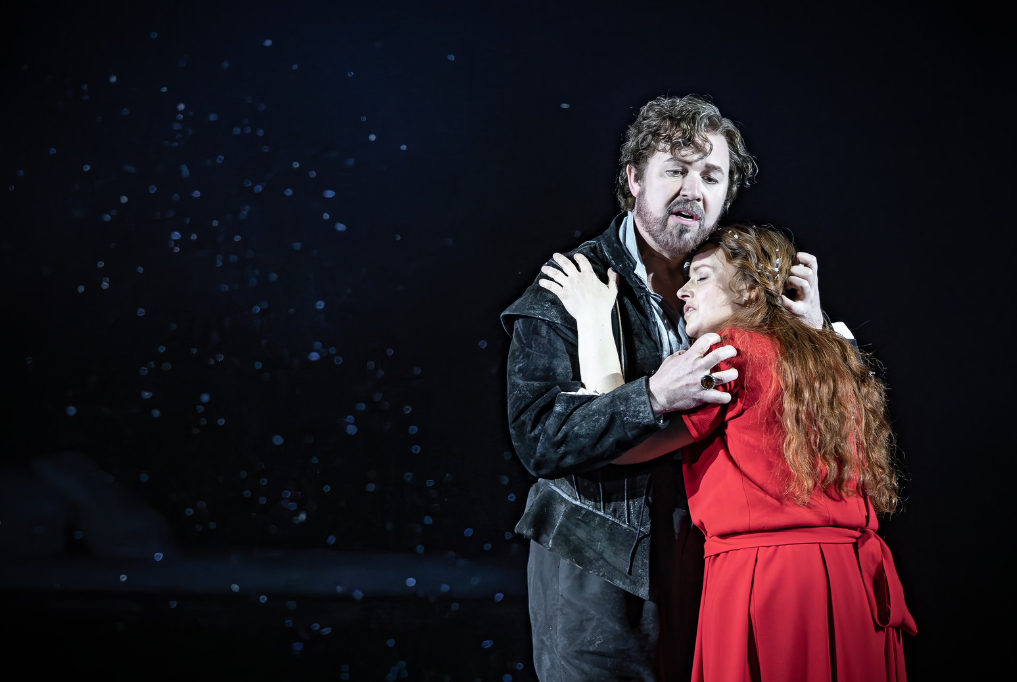
Aside from the opening scene, the first act of the opera is male dominated. Powerful performances by Simon Bailey, James Creswell and Trystan Llŷr Griffityhs, playing The Dutchman, Daland and The Steersman respectively, draw us in to the world of sailors and the fateful ocean tempers. The crews of two ships, the ghostly Flying Dutchman and Daland’s ship are opposed in both movement and costume; the modern fishermen in waders with natural movements are pitted against the eery figures of the Flying Dutchman who sway, apparently unaffected by the torment of the wind, resigned to their fate to sail the seas for eternity. The choreography of the two casts – natural versus supernatural is echoed in the set and lighting designs, by Elin Steele and Lizzie Powell respectively. Wagner’s famous invocation of the sea, its waves and textures, is precisely performed by the orchestra and is allowed to seep into the set, a simple yet effective abstract watercolour backdrop marked with a single straight red line. The power of the sea that pervades the stage is viscerally cut through when we meet the doomed ship; a harsh, unnerving straight line of light and smoke bifurcates all that is natural.
In the second act, the spareness of the set is joyfully disrupted with the disorder of choral scenes. A busy chorus of women, sat in a messy semi-circle around Senta, excellently performed by Rachel Nicholls, mend clothes and await the return of their men. The lack of perfection in how the women are sat seems to celebrate community, friendly ties, and shows a happy informality. Whether Wagner intended for there to be such humour in these scenes is slightly doubtful, but Furness brings a comical inflection to the dutiful women ensuring everything is ready for the return of their men – laughter can be heard around the auditorium. The joy and communal spirit of this scene is interrupted by Senta’s childhood sweetheart, Erik, played by Leonardo Caimi, – a hunter at odds with the coastal village community, who pines for the return of his love as she is slowly being swept into the figurative arms of the Dutchman.
Furness, with movement director, Rebecca Meltzer, bring one more scene that sings to coastal communities, as men and women come together to celebrate the homecoming Daland’s ship and crew. The joined forces of the two choruses, the male and female, is a joy to watch – we are reminded of the importance of the chorus to opera as a scene of joyful abandon spills across the stage, further highlighting all the Senta is giving up in willingly sacrificing herself to The Dutchman.
The whole cast and crew of the Welsh National Opera succeed in bringing Wagner’s The Flying Dutchman to the stage with clarity, humour and sea-curdling passion. At times, elements of choreography could have been more daring but the choice for simplicity allows the power of the story, characters and music to take the fore.
Reviewed on 24 April 2026.
