

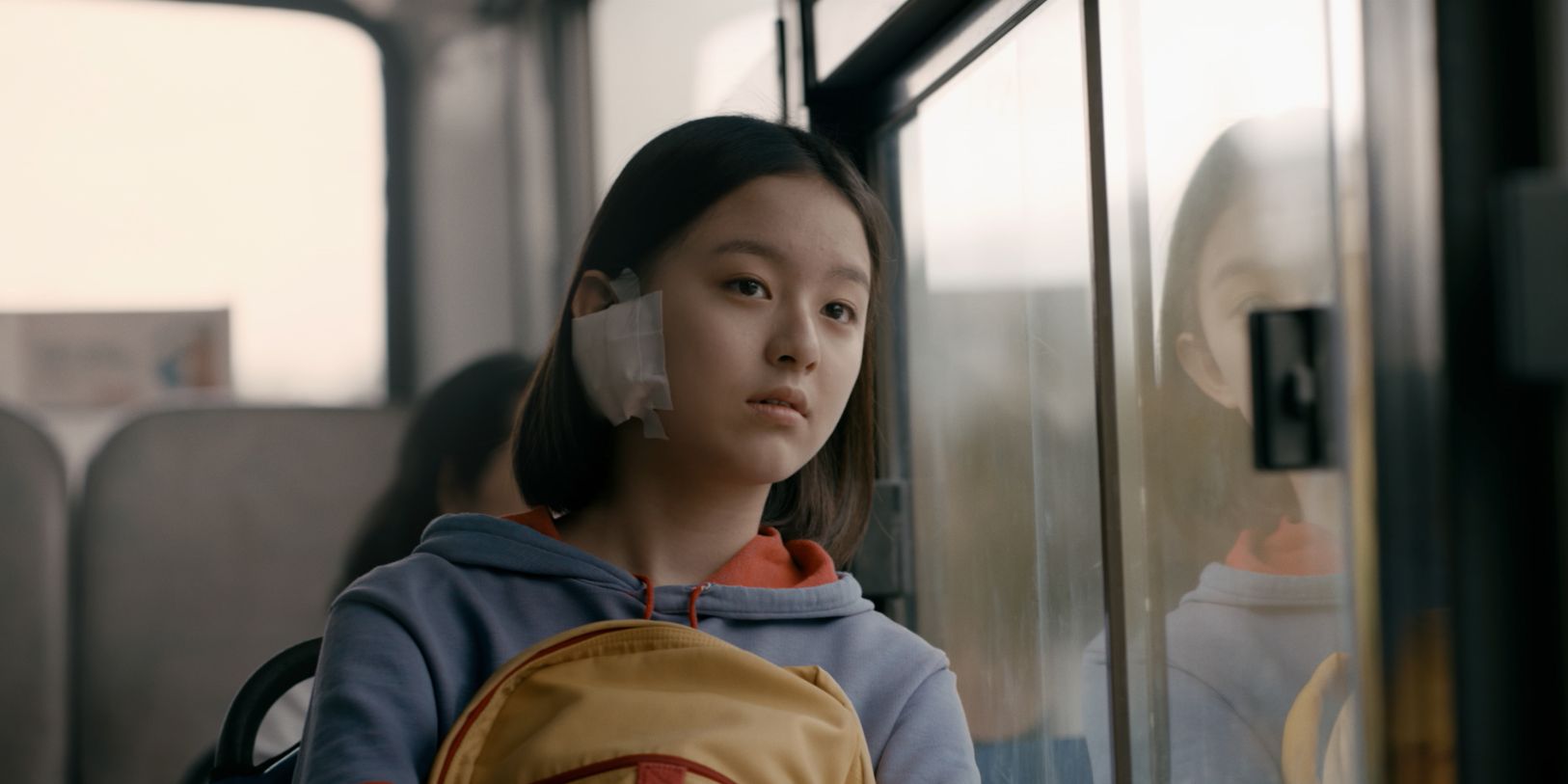
Writer and Director: Bora Kim
House of Hummingbird is the award-winning debut feature film of Korean writer/director Bora Kim. She brings a strong autobiographical element to this meditative coming-of-age piece which focuses on a few months in the life of Eunhee, a young school girl coping with the problems of a dysfunctional family and the intense dramas of adolescent friendships and relationships.
It is set in Seoul in 1994, the year North Korean leader Kim II Sung dies, but more signficiantly in Eunhee’s life it is the year of the Seongsu Bridge disaster. Eunhee is beautifully played by Ji-hu Park who brings a quality of watchful stillness and emotional intelligence to the part. We see her first in her final year of middle school where a dictatorial male teacher demands pupils nominate the two most disruptive of their classmates. Dreamy Eunhee, forever drawing in her exercise book, heads the list, largely because of her lower social status: she is looked down on because her parents run a shop. She has a boyfriend, Jiwan (Yoon-seo Jeong). It is a relationship of tender innocence, the camera capturing their shy smiles as they hold hands and talk.
Meanwhile at home Eunhee’s father is an unpredictable tyrant, favouring his only son, but frequently yelling at all three of his offspring about his embarrassment at their failure to study hard. His wife appears a defeated figure, often seen collapsed in the grip of depression, unable to engage with her children while mutely accepting her husband’s violent outbursts. Because we see them solely through Eunhee’s eyes, we are left to guess at the years of disappointment that underlies her parents’ behaviour. As the youngest, Eunhee also has to endure physical and verbal abuse from her brother and demands from her sophisticated older sister to cover for her secret meetings with her boyfriend.
Bora allows the painful scenes of family fracture to play out without editorial comment, capturing both Eunhee’s distress and her resilience. Despite the regular setbacks Eunhee suffers at school and at home, we see her joyfully bouncing on a trampoline with her best friend Ji-suk or dancing euphorically in a disco. Bora Kim’s script suggests a developing interior life but deliberately withholds Eunhee’s inner thoughts. Eunhee registers pain when Jiwan deserts her for another girl and also when there is a rift between her and Ji-suk. She also suffers when another schoolgirl, Yuri, develops a crush on her but later denies this when they move classes.
Eunhee’s life takes a turn for the better when a new teacher, Youngji, appears at her Chinese school. Sae-byuk Kim makes Youngji’s thoughtfulness and sympathy apparent, even when few words are exchanged between them. She clearly understands Eunhee’s sensitivity and eagerness to embrace life and notes her artistic talents. It is Youngji who gives Eunhee gentle tips from her personal philosophy about how to endure suffering.
But there are more twists and turns in Eunhee’s life. She finds a lump behind her ear. Her parents tell her she was go to the clinic, but neither is prepared to accompany her there. Later, however, when she is told she needs an operation, her father unexpectedly sobs. Hospital for Eunhee is a golden time. She enjoys the company of the older women on the ward and the visits from her parents and friends. Particularly thrilling for her is the visit of Youngji.
Eunhee’s family eventually begin to soften towards each other. But the process is at times painfully gradual and indeed the film’s main problem is its pace. Almost all the scenes are played out slowly, regardless of their relative importance. Gook-hyun Kang’s camera work favours lingering shots of still faces and empty rooms while Matija Strniša’s plaintive music plays out in the background. There is much about House of Hummingbird to like, but at 2hrs 18 minutes, the simple story telling begins to feel unnecessarily attenuated.
Queer East Festival 2023 takes place 18 – 30 April across venues in London. For further information: https://
