

Writer and Director: Juliana Rojas
As the title suggests, Brazilian director Juliana Rojas’s new film playing at the BFI London Film Festival is actually two films, City and Countryside. Despite the slither of a link, the two stories are very different, and one runs after the other. There is no merging of narratives here, with the result not cohesive at all. But there is enough mystery and mysticism to hold the viewer’s attention.
The first film is the better one, grounded in realism within a familiar cityscape. Joana has come to stay with her sister after the country farm she owned was completely washed away when a damn burst. She’s most haunted by the animals that were killed in the disaster, especially her favoured white horse. Having received no compensation from the government, Joana brings with her just one small suitcase. She will need to start a new life in the city.
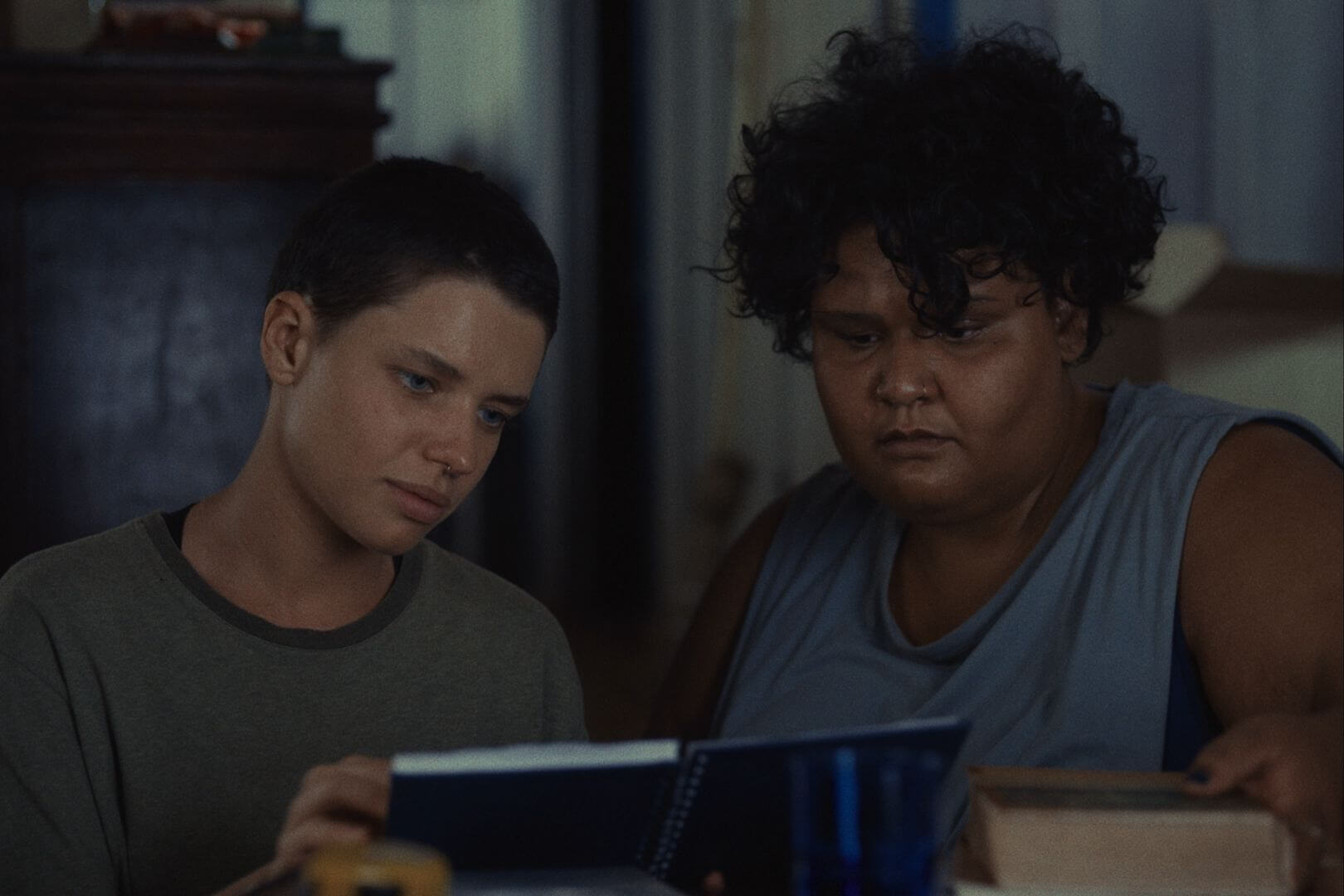
In the second film, the journey is reversed as city dwellers Flávia and Mara arrive in the countryside to take on the farm that Flávia has inherited from her recently deceased father. The couple are determined to make a go of it even though the land seems to have surrendered its fertility.
We have seen Flávia before, at least a photograph of her, in a box in one of the apartments that Joana cleans in the city. The only other clue to telling the audience that the films exist in the same world is the red light that has appeared alongside the moon. In the city, the red stationary light could easily be mistaken for one of the warning lamps that are placed atop cranes, but in the countryside, it shines brightly and unmistakably. Flávia and Mara, without any sense of urgency or real astonishment, wonder whether it could be a planet or a meteorite. In the city, the red light burns steady like a trusty companion.
As Joana, Fernanda Vianna is enigmatic, never really giving away too much of her thoughts, and neither is her character completely overwhelmed at having to forge a new life at an uncertain age. However, her memories of the white horse are unnecessarily romantic. More effective is when the horse mysteriously turns up on a city street at night. The ghosts in rural Brazil are more numerous. Flávia sees her dead father within the first few days she’s at the farm while other spectral figures roam the dense woods nearby.
Both stories are slow and, despite the supernatural element, they feel slight. We never get to know these characters; we watch from afar, unmoved. The camera attempts to make us care about Flávia (Mirelle Façanha) and Mara (Bruna Linzmeyer) by showing them having sex, their very different bodies complementing each other and a refreshing change from the bodies we usually see on screen. But even though these shots are intimate, we watch from a distance.
Perhaps this is a deliberate ploy by Rojas to make us feel that we, too, are in a strange land, unversed in local customs and with little knowledge of the indigenous flora and fauna. Rojas wrote the second film after losing her own father, and there’s a sense of unresolved grief and heartbreak in Campo, but it feels so personal that the story somewhat rejects the audience instead of drawing them in.
One story feels like a beginning; the other heralds an end. Rojas’s diptych is strange but unsatisfying.
Cidade; Campo is screening at the BFI London Film Festival 2024.
