

Music and Lyrics: Cole Porter
Book: Author Kopit
Director: Rachel Kavanaugh
When Philip Barry’s play The Philadelphia Story was adapted into the 1956 comedy musical High Society, it was Cole Porter’s first original film score in eight years. It included some of his finest and most enduring numbers, including Who Wants to Be a Millionaire?, Well, Did You Evah! and one of his most romantic melodies, True Love.
This stage adaptation, which premiered on Broadway in 1998 and has had several London stagings since, takes the same story and adds in many more Porter numbers from other sources, dropping a couple of the film’s lesser songs (nobody is going to really miss Little One or Mind If I Make Love to You?) along the way.
The plot is the same, though: socialite Tracy Lord (Helen George) is preparing for her wedding to the family accountant, David Seadon-Young’s George Kittredge. Nobody but Tracy and George seems to be totally on board with the impending marriage, especially Tracy’s headstrong baby sister Dinah (Naomi Pacquette) and Tracy’s first husband, Julian Ovenden’s Dexter Haven.
Throw in a brewing scandal involving Tracy’s estranged father, a couple of journalists sent undercover to report on the wedding, and a drunken uncle who is called upon to impersonate his brother-in-law to throw the hacks off the scent, and Act I gives all the hints that the play is heading towards riotous farce territory. It’s a set-up that would have Ray Cooney grinning with glee. Except, as with the original film, the story veers away from that interpretation of the comedy, abandoning each farcical setup almost as quickly as it is raised. While Arthur Kopit’s book, based on both the screenplay and the original play, maintains a level of comedy throughout, it is a rom-com with its emphasis firmly on the first syllable.
But this is a show that revels in Porter’s back catalogue, and it is the songs that are the real purpose of the show. Whereas the film was a great play with (even better) songs attached, this stage adaptation of High Society feels like a hearkening back to the early days of the Broadway book musical, where the story was little more than a mechanism to segue from one crowd-pleasing number to another.
That is not to say that the moments between songs are not entertaining in themselves. Comic turns from Felicity Kendal as Tracy’s mother, Nigel Lindsay as the permanently sozzled Uncle Willie, and Pacquette’s brilliant turn as Dinah keep the laughs coming thick and fast.
As Tracy, Helen George gives us a feisty, wild-at-heart vision of a young woman who is settling for life as an accountant’s wife on the rebound from the tumult of her first marriage. It’s a performance that is vocally impressive across her many songs, and high on physical comedy as needed.
Beside her, Julian Ovenden’s Dexter is a sharp romantic foil, although here his musical excellence feels a little flattened in between. This is a Dexter who’s content to wait for Tracy to return to him, rendering a rather passive romantic lead.
With a third candidate for Tracy’s romantic affections, Freddie Fox makes his musical theatre debut as Mike Connor. He forms a particularly strong double act with Carly Mercedes Dyer as his fellow interloping journalist. Dyer is rarely anything less than excellent, and she maintains that standard here: her photographer Liz may not have much to do beyond fend off the amorous advances of Uncle Willie, but the character has such an effervescence that even an underwritten role feels fleshed out.
Fox starts off almost basking in Dyer’s reflected glory, although their introduction together with Who Wants to Be a Millionaire? showcases that, in addition to a renowned ability in both drama and comedy, he also has an impressive singing voice. There may be a skittishness to his choreography – that opening number ends with a slight port with Fox and Dyer in hold that feels like it is running at half tempo, and in group numbers, he is often out to the very edges. But if Fox is not a complete triple threat, he is at the least a very satisfying double threat.
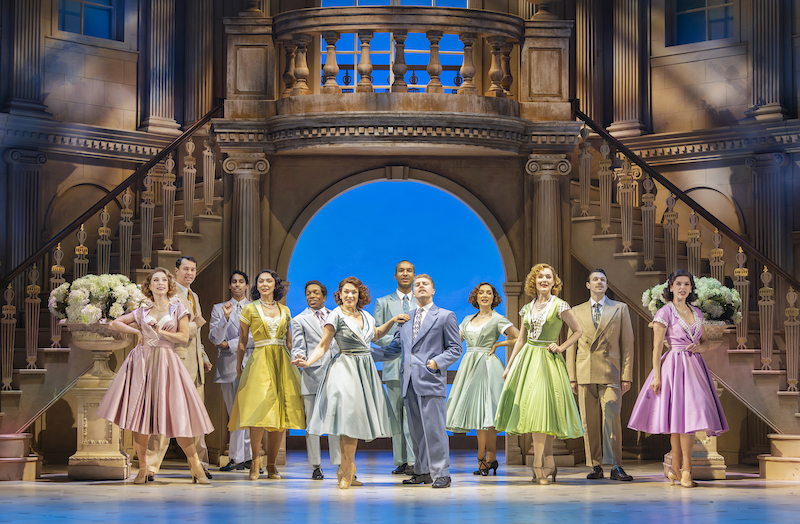
Anthony van Laast’s choreography occasionally feels stilted by some of the set’s larger components. From a ridiculously large table stuffed full of expensive ephemera to a swimming pool and sun loungers, all sitting in front of a stone mansion house that seems to take up most of the Barbican’s expansive floor space, some song performances feel constrained on what is one of London’s largest stages.
But when those are cleared away to afford space to the full ensemble, the dancing really shines. That’s particularly evident in the party scenes where, the night before the wedding, the Lord family plays host to a lavish party. Lindsay leads a rambunctious introduction to the party’s onstage jazz combo with Now You Have Jazz, but the greatest dance moment comes near the top of Act II. Let’s Misbehave starts off as a sultry call from Tracy to her fiancé to taunt her ex-husband, but gradually transforms into a wild affair of choreographic debauchery. It’s silly, sultry, and, to co-opt a word from Porter himself, swelegant.
And the same goes generally for all of High Society. Cramming in so many musical numbers does occasionally make the story feel a little sluggish, especially in Act I. But with its combination of classic songs, great dance numbers, and a great central performance by Helen George, this is one summer revival that is truly an elegant, swelegant party indeed.
Runs until 11 July 2026
