

Writer: Samuel Beckett
Director: Leo Bacica
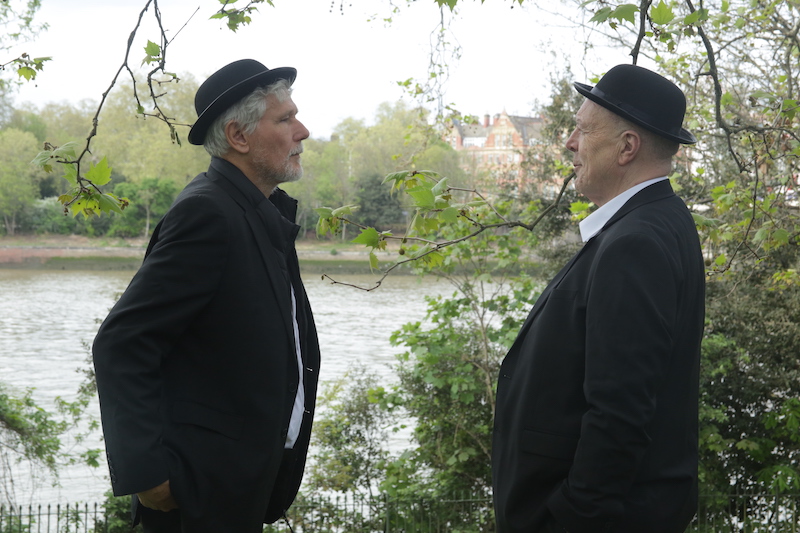
Two old school vagabonds in tatty, dark clothes and battered bowlers pass the time. One tries to remove a boot which hurts. The other eventually helps. They talk about this and that and wait because someone is coming. The most famous play where nothing ever happens is at Battersea’s Arches Lane Theatre. Samuel Beckett’s landmark piece, Waiting for Godot, is back to ponder the pointlessness of existence and the futility of life.
Vladimir and Estragon, two lifelong friends, are down on their uppers. Like an old married couple, they’ve rubbed along for over 50 years: companionably, amicably, irritably, cantankerously. Strutting Vladimir is performed with Scouse undertones and a light touch by part-time DJ, Rich Allen. Steve Broad, who graduated from Guildhall in 2018, fully inhabits a working-class Estragon with a minimal, nuanced performance.
Although advertised at two hours plus an interval, this production, with its drawn-out beats and pauses as trains rumble past, is closer to three – with an interval. The waiting of Vladimir, Estragon, and the audience is enlivened by the arrival of Pozzo, a regal, imperious character performance by Kunal Narwani. He leads his slave, Lucky (not), on a rope. Mark Muravjov is the beleaguered serf behind the pig mask and multi-roles as the wide-eyed child. Pozzo commands, and Lucky obeys. Lucky dances to order, as though trapped in a large net. And when ordered to think, there is a diatribe of verbal diarrhoea, a mishmash of big intelligent words garnered from theology and academia.
With a range of approaches employed—including some attempted audience participation, a flash of rap from Lucky and some contemporary references added to the script that include the 1990s and Canary Wharf—the direction is not entirely cohesive. These choices add very little to the Waiting for Godot experience and disturb the purity of the piece. Things are made to happen when nothing is supposed to happen, perhaps in an attempt to make Godot more palatable for a contemporary audience.
When Vladimir asks the child, “Do you see me? Do I exist?” this could be the rallying cry behind every social media post. Penned decades before social media was invented, this is the space where everyone hopes to be seen and to exist. It means something…or does it? Pozzo, as a symbol of a fascist state or totalitarian regime, and Lucky, as a symbol of the blindly led masses, feel horribly relevant. Although written in the post-war years when audiences were recovering from the ravages of war and in fear of nuclear annihilation, Pozzo and Lucky feel emblematic and prescient of changing times.
Waiting for Godot is not for lightweights. It’s hardcore and requires audience stamina. This is performed philosophy; epic existentialism that asks a series of profound questions about how we make meaning of our lives, including the relationships we choose. Waiting for Godot is likely to bore, perplex and potentially infuriate those who seek traditional storytelling, entertainment, or recognisable story patterns. Alfred Hitchcock said, “Drama is life with all the boring bits cut out,” so what does that make Beckett’s masterpiece? Art imitates life. It can be long, dull and uneventful – but there is always hope that something is around the corner. Let’s just hope it’s not Pozzo brandishing his whip.
Runs until 7 June 2026
