

Writer: Martha Loader
Director: Patrick Morris
Alice returns from an Antarctic research expedition plagued by apocalyptic visions of melting ice, only to find catastrophe has arrived at home too: the family house is recovering from a flood, her daughter Alba is asleep, and her mother, having spent the interim looking after Alba, is contemplating a cruise to see the Antarctic herself.
In Bruntwood Prize-winning Martha Loader’s Albatross, an unexpectedly intimate story of maternity, protection and family is viewed through the distorting lens of climate emergency, repackaging neglect and ambition as the supposed salvation of the planet.
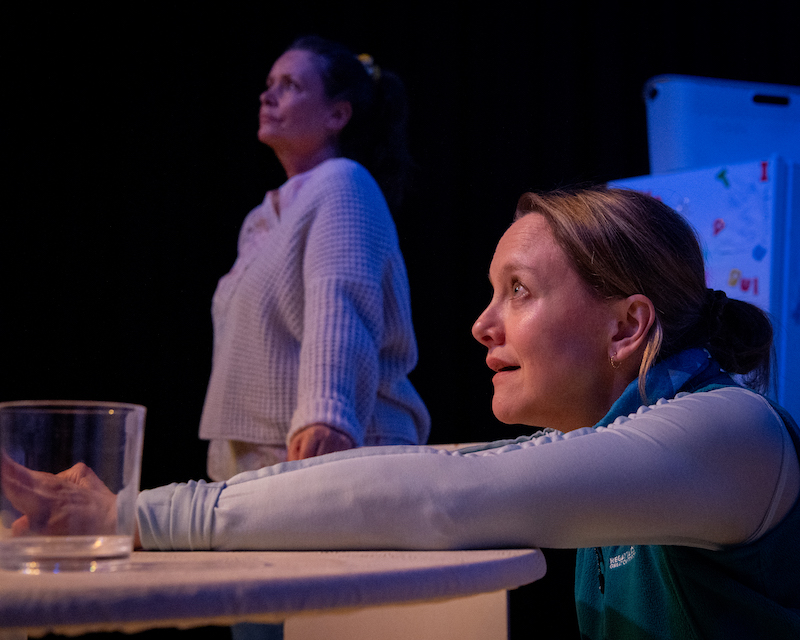
A production that first appears to be focused on climate change reveals itself as an intimate battle over life beyond motherhood. Eve, played by the stirring Agnes Lillis, has spent much of her life permitting her daughter the freedom to dream, only now to be told that desiring freedom of her own is a betrayal, not merely of Alice, but of humanity.
That air of moral superiority persists. In Alice’s conflict between her family and her “duty”, she plays every available card. Arguing that children in other countries are raised by grandparents, Eve retorts that in places such as Africa, families have no choice because survival demands it. Alice’s answer – that she too, that humanity too, has no choice – lands as an ugly exposure of her self-importance. Yet the scene is delivered with such earnestness that it is difficult to know whether the play is mocking Alice’s sanctimony or endorsing it.
The irony is that, in apparently setting out to humiliate Eve for her “climate ignorance”, Albatross repeatedly makes her pragmatism seem like sense. Lillis, the evening’s standout, gives Eve’s resentment a tender, bruised grounding: hers is not indifference to the future, but frustration at having spent her own life nurturing everyone else’s, while her ambitions advance at a glacial pace. Meanwhile, Alice insists that “your generation owes us” while relying on the domestic security that Eve has dedicated her life to providing.
Martin, played by director Patrick Morris, threatens to make the play’s condescension towards such practical, commonplace concerns explicit. Crafted to believe in crystal energies, fossil healing powers and so on, Martin is a suspiciously convenient character: of course, the man inspiring Eve to care about family beyond a duty to the climate must be a conspiratorial crank.
Albatross teeters on the edge of something more poignant: an exposure of hypocrisy, perhaps even futility, on all sides, once family enters the equation. Sadly, its preachy instincts overwhelm that possibility. It becomes hard not to feel that ordinary needs for comfort, escape and renewal are dismissed as ignorant by a play too enamoured of Alice’s grand cause, rather than used to tell a richer story.
And yet Albatross is more affecting than this suggests. Chris Dobrowolski’s quaint domestic set gives the family conflict a pleasing warmth, despite the atmospheric and symbolic water damage, while Lillis and Morris frequently find its gentler, funnier pulse. Caroline Rippen, as Alice, is equally effective at conveying the nerdish excitement of a woman genuinely electrified by her work, even as her family buckles beneath it – a difficult contradiction to sustain. Together, they give the evening a generosity that the writing does not always allow itself.
Without giving away its resolution, the play does finally allow empathy to dwarf accusation, compassion to win over ambition. That warmth goes some way towards tempering its hectoring imbalance and makes its missed opportunity all the more frustrating. If Albatross truly subjected Alice’s self-righteousness to the same scrutiny it applies to Eve’s supposed ignorance, it might turn a compelling family conflict into something exceptional. Still, for all its moral grandstanding, it leaves behind an unexpectedly moving sense of renewal and hope.
Runs until 30 May 2026
