

Writer: Andrew Atha
Director: Jasmine McHayle
Just a few years ago, a play about an AI-powered robotic girlfriend would have felt like pure science fiction. Now, with people using AI as therapists or even claiming to fall in love with ChatGPT, zoe.exe feels much closer to social commentary.
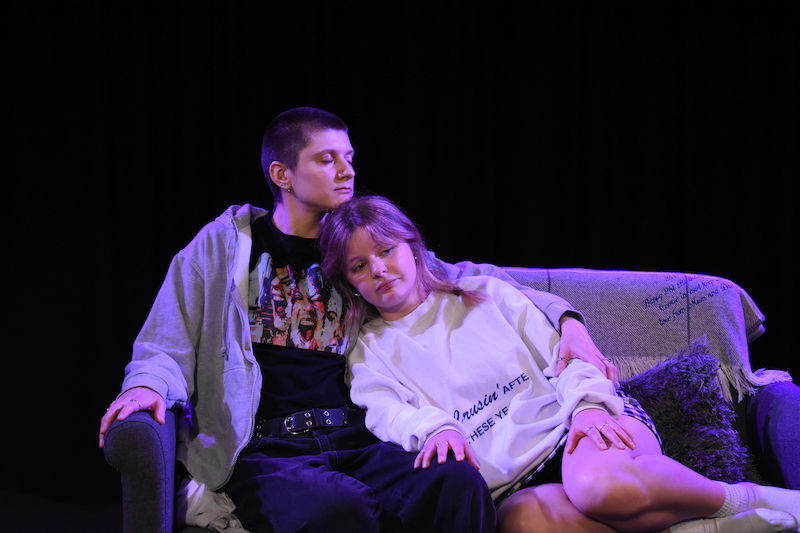
Jo (Rachel Duncan) has recently broken up with her girlfriend Zoë (Rhiannon Lucy Bird), and her roommate Zack (Izaak Hamilton-New), who works at a tech company, decides to recreate Zoë as an AI-powered robot girlfriend. He asks Jo to help make the robot as human as possible by sharing everything she knows about the real Zoë.
Jo is understandably furious: Zoë was not a string of data, but someone who knew her so well she could instinctively understand how she felt. When the real Zoë returns, however, she reveals that Jo had treated her like a machine too — programming her to respond perfectly to every emotional need until she eventually cracked and left. The play raises unsettling questions about the emotions and imperfections AI removes, and whether those flaws are exactly what make us human.
Jo jokingly describes the situation as a “discount Black Mirror.” Although the script lays the groundwork to remove that discount sticker, it never quite gets there. The play explores the breakdown of a friendship, but it does not dare to explore any truly twisted consequences of a computer that can convincingly feel like a person. There are a few things holding it back.
zoë.exe is billed as a dark comedy, but with its central debate and relationship arcs, it is essentially a drama. The comic opening makes some of the emotion feel a bit jarring. Jo does not quite seem shocked or even blown away enough by the robotic replica of her girlfriend; she is too busy making sarcastic jokes, playing passive-aggressive games of Guess Who, and complaining about her job. All of this is funny, but it muddies the reality of the world and wastes time getting to the play’s dramatic core.
There is also just too much going on in terms of plot. So many threads are set in motion that the ending feels shoddy. There is no resolution to the argument between Jo and Zack after he delivers an incel-y speech about how technological developments are there to help lonely men like him find connection in a world where women only want a man with an “eight-pack and a trust fund.” After a fairly thorough exploration of AI, the play seems to tack on another huge contemporary debate at the end without offering any real answer or opinion. It cheapens the discussion of AI by making the play look like an attempt to squeeze as many popular “2026” topics as possible into one show.
This is not to say that the script isn’t rich with great dialogue and conceptually interesting. The acting is also excellent from each cast member. Hamilton-New plays exactly the kind of naive optimist who would become entranced by technological development and dance along with it — literally — without question. Duncan, meanwhile, is sceptical of everything: moody, guarded, but wanting care and attention just as much as Zack does.
Then there is Bird, who is uncanny as the AI Zoë. She is like a cross between a Barbie, a character from a Ladybird book, and a Chucky doll. As the real Zoë, however, she becomes a flustered, emotionally sensitive woman. Her ability to embody these two characters is showcased in an impressive scene where she switches between them mid-conversation, the lights flashing blue and red with each change. Having said that, none of the characters is hugely likeable. Zack is a little too wet, Jo a little too mean, and Zoë a little underdeveloped, and this somewhat caps the impact of the emotional payoff.
zoë.exe is not as unsettling or emotionally devastating as it could be, but its ideas are timely, its performances strong, and its central questions genuinely thought-provoking. Even when the play overreaches, it is never uninteresting.
Reviewed on 27 May 2026
Peckham Fringe runs until 5 June 2026
