

Writer: Florence Howard
Director: George Chilcott
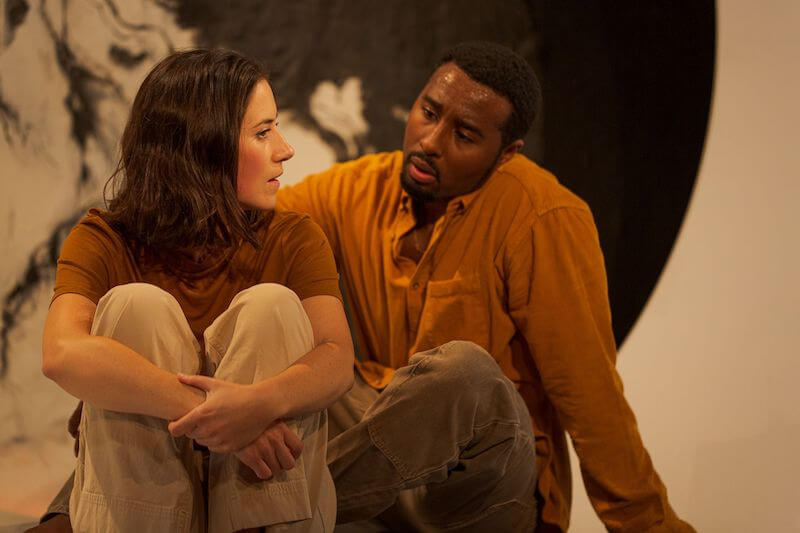
Florence Howard’s new play about the decision not to have children begins promisingly and looks electric on Carly Brownbridge’s smart set of squares and circles. Ben and Aggy are looking for her engagement ring, In the search, Ben finds a baby scan photograph in Aggy’s bag. He looks delighted, but she says that she won’t be having it.
This moment is the most interesting in the play, but the action switches back in time and we see them, spent after the first time they have sex. Ben is eager, perhaps too eager while Aggy is a little more guarded, aware that it’s still only their first date. They recount the events of the night before and the anecdotes they told each other over two bottles of wine. Ben is particularly interested in Aggy’s story about her mother who left her when she was a baby.
For a 70-minute play, the next 20 minutes or so run slowly as we see Ben and Aggy become closer. He discovers that she doesn’t like music; he doesn’t like reading. When he moves in, he brings a record player hoping to introduce her to the soul greats. They plan a holiday to Japan. He goes out and gets drunk. It’s very bland.
When the subject of motherhood is finally broached – he wants children, she doesn’t – the discussions and arguments circle around without really going anywhere. Ben believes that Aggy’s decision rests on the fact that her own mother left her. Aggy doesn’t agree; she says that the decision is more like an instinct.
But Ben won’t let it go, saying that not having children will signify a lack within their relationship and that his parents would be disappointed. Aggy says that the two of them are more than enough. Ben pushes and suggests, bizarrely, that she should give it a go. Important as these discussions are, in Agatha, they are repetitive and depthless. The arguments lack drama and philosophy.
Fortunately, the acting is excellent and Howard plays Aggy as fiercely independent. Aggy is caught between being true to herself and the compromise that marriage entails. Towards the end of the play, you can clearly see the conflict within Aggy. As Ben, Trieve Blackwood-Cambridge brings out the excitement of a young man in love, and his keenness is initially endearing. But Howard’s script runs against Ben’s character whose refusal to accept Aggy’s decision almost makes him the villain of the piece. The final scene, another flashback, seems superfluous and is played at a glacial speed, draining it of any real emotion.
In today’s society, everyone, straight or gay, is under pressure to have children and so Agatha is timely. However, in keeping the plot so domestic Howard limits the reach of the message that some people just don’t want kids.
Runs until 15 July 2023
