

Writer: Robert Bolt
Director: Jonathan Church
Reviewer: Lela Tredwell
With superb performances, stunning costumes and tense historical drama, A Man For All Seasons is a tale of political intrigue and betrayal in Tudor England. First published in 1960, the award-winning script, originally written by Robert Bolt, is brought back to life in this beautifully realised production.
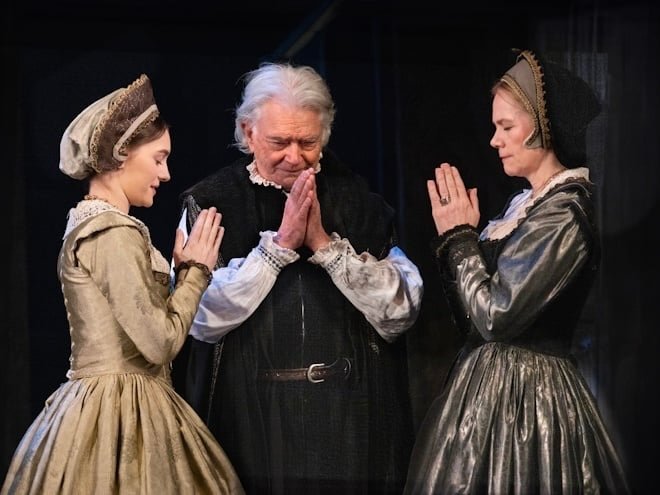
Screen sensations, The Tudors, The Other Boleyn Girl, and the adaptation of Hilary Mantel’s Wolf Hall have helped keep this period of history alive and kicking. A Man For All Seasons is the story of the stand made by Sir Thomas More (Martin Shaw), Lord Chancellor to King Henry VIII (Orlando James), and thorn in the side of the rising Thomas Cromwell (Edward Bennett). Lacking a male heir, the King wishes to remarry. The only problem being, he still has a wife, and the Pope isn’t too happy about that technicality. While other men choose allegiances regarding the King’s predicament, Thomas More stays silent. In doing so, he infuriates just about everybody around him.
Martin Shaw is outstanding as Thomas More. Charismatic and considered, he engages us from the moment he appears onstage and sweeps us along in his quiet cause. Gary Wilmot brings welcome comic relief as The Common Man. Without him this would be a very depressing tale indeed. The villains of the piece are well drawn with a deliciously sinister Cromwell embodied by Edward Bennett, Calum Finlay as the shifty Richard Rich, and Orlando James who shines as Henry VIII, suitably strutting about the stage and flitting between whimsy and threats.
Accompanied by strong performances from Timothy Watson as Norfolk, Nicholas Day as Cardinal Wolsey, and Asif Khan as Signour Chapuys, it is a production that shows so well the complexities of the personalities it portrays. Some of the most compelling scenes of the production are those with Sir Thomas More’s family. Abigail Cruttenden plays More’s vexed wife Alice so splendidly we can feel her fury. Rebecca Collingwood expertly portrays his daughter Margaret, acting extremely well alongside her paramour William Roper (Sam Phillips). The pair’s love interest gives us something to hope for in this fated tale. It is the More family interactions that also develop the depth of sympathy for Thomas that we require to care about his political plight.
Designed by Simon Higlett, costumes are luscious and sets are both aesthetically pleasing and imposing. Walls shift like a puzzle box creating new environments but still keeping us contained within this unsettling Tudor world. Scene changes do come across as a bit clumsy at times as actors move props while speaking, distracting us from their dialogue. Wilmot’s The Common Man regularly breaks the fourth wall effectively but its actions like stacking chairs on tables as he does so that seem to shatter the magic of the moment.
From the Emperors of Rome, to the Tudor court, to modern day politics, the thrill of a volatile leader and the environment of political backstabbing stalks us. As we have grown ever more weary of hearing privileged men argue over semantics, this old tale retold lacks a fresh or bold take on this era. However, as a production it does brilliantly bring to life this tense political drama. It is superbly acted and beautifully imagined. The pace reflects our own frustrations with Thomas More (Shaw) and why the man won’t just go along with the nonsense, but as More tells us over and over again it is more than his life on the line. This tale tells us how you can align yourself with the gaslighting and the unstable logic of the spin, or you can take a stand. A stand probably won’t make you popular but it might just save your spirit and maybe even your soul.
Runs to 26th July 2025
