

Music: George Frideric Handel
Libretto: Nicola Francesco Haym
Director: Marcio da Silva
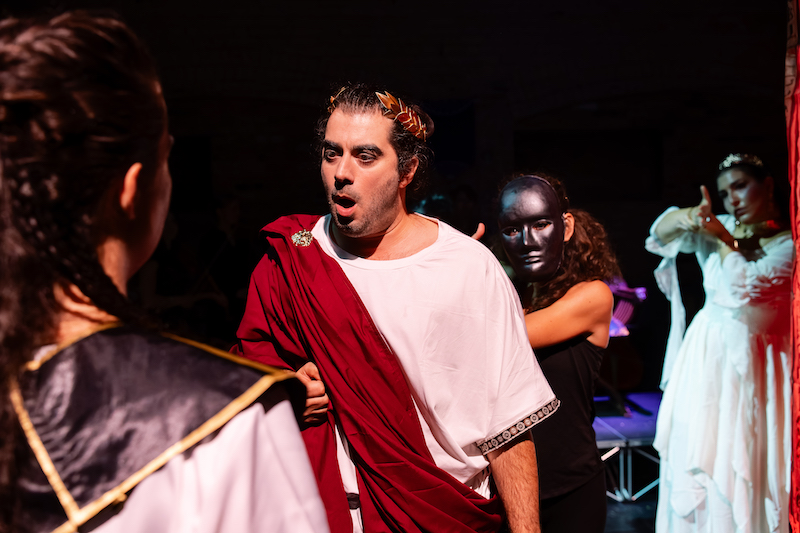
Conquering hero Julius Caesar arrives in Egypt, dressed in a short white tunic, purple toga, golden laurel wreath, and falls in love with the disguised Cleopatra. Serbian soprano Radoslava Vorgić is mesmerising as the Egyptian Queen, variously playful and plangent, in this intimate chamber staging of Handel’s baroque Giulio Cesare in Egitto. The opera premiered in London in 1724. It sounds like a simple-enough love story, but this multi-layered tale is also a geopolitical psychodrama, full of masks, avengers, death-plots, seduction, usurpation, threats of sexual violence, and severed heads.
Since 2007, the Arcola Theatre has celebrated radical and contemporary stagings of opera with a summer Grimeborn festival, punning on the more rural, 90-year-old Glyndebourne in East Sussex. This year’s Grimeborn line-up includes new works about social and gender inequality and the climate crisis alongside reinvigorated classics. The fabulous New Trinity Baroque, founded in London in 1998, are at the Arcola for the first time, bringing an adapted version of a show that has been touring Southern Europe. Recreating a sound that Handel might recognise, the ensemble plays period instruments, including a Baroque bassoon and oboe, violone (early cello) and an outlandishly long-necked chitarrone, a huge lute.
New Trinity’s Artistic Director Predrag Gosta multitasks as conductor, harpsichordist, producer, and costume designer. There is a lot of ritual robing and violent disrobing in this production. Under layers of Roman or Egyptian finery, the cast all wear the simple black T-shirts and leggings to which almost every character is reduced at some moment in the show. Cleopatra’s brother, the evil Tolomeo (commandingly sung by Spanish mezzo-soprano Julia Portela Piñón), wears a striped pharaonic head-cloth. At various stages, Cleopatra puts on and off a white shift, beaded collar, cobra crown, and pleated golden cloak. It’s reminiscent of Shakespeare’s older version of the same character, who tells her ladies in waiting: “Give me my robe. Put on my crown. I have/Immortal longings in me.” The look is completed by dramatic kohl eyeliner and lashings of iridescent green eye shadow.
At this earlier stage of their stories, both Cleopatra and Caesar stay alive while other characters perish. In a brief introductory address, Stage Director and baritone Marcio da Silva, who plays Egyptian General Achilla, tells the audience that the death of Caesar’s rival Pompey, which occurs offstage at the start of the opera, was a defining moment in Roman history. He also talks about the role of repetition in Baroque music, singing the same phrases over and over so that “time stands still”.
Belgian countertenor Sandro Rossi is Giulio Cesare, plunging from heroic to pensive arias, meditating on mortality. Rossi has a special interest in the roles Handel wrote for 18th-century Italian contralto castrato Senesino, which include Giulio Cesare. There’s a stand-out performance as Pompey’s widow Cornelia by Italian contralto Federica Moi, with a voice like warm honey, while Croatian soprano Silvija Radjen Kumar spiritedly tackles the role of Cornelia’s stepson Sesto, out for revenge for his murdered father.
The staging is necessarily quite basic, given the cramped space, with a couple of banners and a makeshift tower on a plinth in the middle of the small stage, lit in a range of colours. The English surtitles are a bit stilted. But the music is exquisite. Many of the singers and instrumentalists are award winners, and specialists in early and Baroque music, performing across Europe and beyond. This sublime show of authentically orchestrated 18th-century artistry makes for a transporting night in one of London’s most innovative theatres.
Runs until 5 September 2026
