

Writer: William Shakespeare
Director: Holly Race Roughan
Co-director: Naeem Hayat
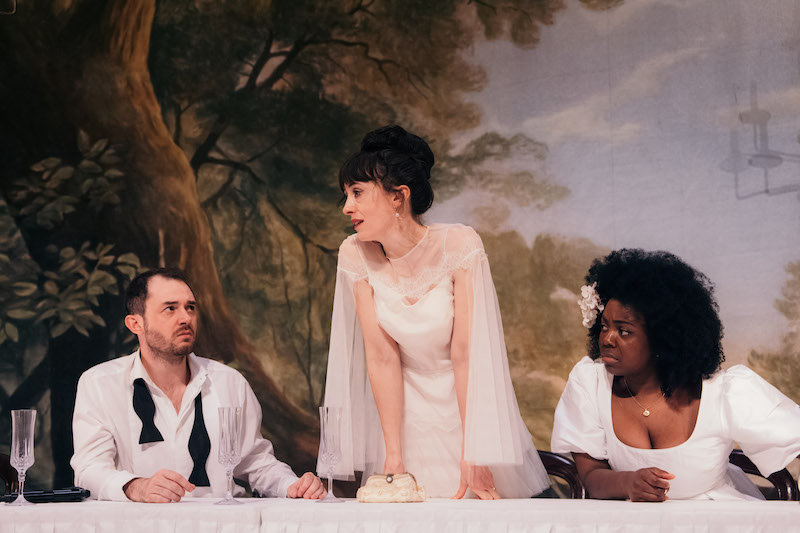
Athens is a tyranny. Its citizens live in fear of the despotic whims of their patriarchal ruler, Theseus, who is about to force the captive Amazon queen, Hippolyta, to marry him at gunpoint. It’s not an unusual reading of A Midsummer Night’s Dream. Recent productions have presented Hippolyta in chains or –in Nicholas Hytner’s version at the Bridge Theatre – war-trophy-style in a glass box. For this Theseus, played with nervy unpleasantness by Michael Marcus, tyranny seems to mean jumping on tables, dressed in military uniform, shouting and waving guns around.
Directed by Holly Race Roughan of touring theatre company Headlong, this version also subverts the warmth and light implied by midsummer. The Sam Wanamaker Playhouse is generally lit with warm yellow candlelight. For this show, Lighting Designer Joshie Harriette has added a cold, bluish-white electric glare, robbing the theatre of its trademark golden glow. The playhouse has a gallery of live musicians, and the percussion-heavy sounds, composed and designed by Nicola T. Chang and directed by Richie Hart, add to the unsettling atmosphere, but deliberately contribute few upbeat moments.
Snow is falling onto a white plastic stage, smooth as an ice rink. Disrupted seasonal patterns are one of a litany of woes that Titania, Queen of the Fairies, describes when we first meet her. They are caused by a supernatural quarrel, which also brings floods, fog, mud, contagion, crop failure and depression. This production, the first time Shakespeare’s Dream has been performed in the Sam Wanamaker Playhouse, has a decent helping of comedy, but very little joy.
Estonian actor Sergo Vares plays the fairy servant Puck as overworked and melancholic, helping himself to champagne as he moonlights as a waiter and actor. Robin Goodfellow becomes Starveling, the sommelier. Dressed in the fairy’s standard-issue tutu, tights and ballet shoes, his smudged make-up, tail coat and single long black glove make him look a bit like an extra from Cabaret. He opens the play by slowly eating a banana and then reciting much of the epilogue, followed by some lines of Oberon’s from the middle of the play.
The directors clearly feel Shakespeare’s script needs improving rather than interpreting. “Perchance to Dream” shout some large gold letters above the stage, introducing a quote from Hamlet into the set. Danny Kirrane’s emotional Bottom is – amusingly – an “executive chef” rather than a weaver. He borrows speeches from the lovers, the fairies, and later from Romeo and Juliet’s Mercutio, another comic character, but one with a totally different turn of phrase.
But at least these lines are actually by Shakespeare. Several poorly-written words and phrases are inserted into the text in defiance of scansion and occasionally sense. This is not just a bit of ad-libbing for comic effect or clunky rephrasing to make the lines clearer to a modern audience (there’s plenty of both those, too). Bottom’s line to one of the fairies: “I desire you of more acquaintance, good Master Mustardseed” has been chopped in half, so he simply tells Titania “, I desire you”. This textual tinkering messes up lines of poetry and, towards the end of the play, goes completely off the rails.
In Max Johns’ bleakly minimalist design, the forest is gone. In its place is an upright black piano (the city is represented by a wedding table). Titania can’t nod off on the flowery bank Oberon describes, but has to sleep uncomfortably on top of the piano. The fairies’ lullaby is replaced, for some reason, by Billie Eilish’s dance-pop song bad guy and Bottom’s cheerful ditty about birds has become Black Sabbath’s War Pigs.
The most entertaining and least-modified scene comes as the young runaway lovers, drugged and exhausted, fall for the wrong people and argue about it. David Olaniregun’s Lysander has most of his lines stolen in earlier scenes, but comes into his own here as he rejects the bewildered Hermia (Tiwa Lade) to follow Helena (Tara Tijani) instead. His wooing involves baring his highly-toned upper body, leading his much slighter rival Demetrius (Lou Jackson) to do the same. All four lovers are passionate and convincingly bamboozled; the actors are impressively versatile as they double as uncanny tutu-clad fairies.
Hedydd Dylan, doubling as Hippolyta and Titania, nimbly parallels two tales of coercion: threatened by Theseus and gaslit by Oberon. Pria Kalsi plays the Indian changeling, over whom the fairies quarrel, as well as a slightly bland Flute, the server/Thisbe in the play-within-a-play scenes. Kalsi is a sweet, snowman-building child in red scarf and mittens, but clearly used as a pawn in the quarrel rather than an object of real affection. Both overwrought fairy monarchs sit her on their knees only to push her off again as they start fighting.
In Hytner’s influential production, Titania and Oberon’s roles are swapped with intriguing results. Here, Hermia and Lysander speak each other’s lines as they look for a place to sleep in the “forest” so that she is up for a cuddle while he seems to friend-zone her in his anxiety to act as “becomes a virtuous bachelor and a maid”. As with most of the many changes the show makes to Shakespeare’s text, it’s not clear what the swap adds.
This wintry production promises to explore the play’s “shadowy underbelly”, as nearly every contemporary version does. In a world facing ever more serious challenges from climate breakdown and autocracy, A Midsummer Night’s Dream certainly has some urgently relevant themes. But the shock ending fails to elucidate them, bringing neither catharsis nor content.
Runs until 31 January 2026 and tours in 2026
