

Book: Patricia Resnick
Music and Lyrics: Dolly Parton
Director: Paul Jepson
Hearing the words ‘9 to 5’ most people will think of one of two things; a day at the office of Dolly Parton’s hit song. This week the two collide as Landmark Theatres’ production of 9 to 5 the Musical arrives in Guildford. The musical, based on the 1980 film of the same name – itself a fictionalised retelling of the very real 9to5 movement, struggled to make an impact when it opened on Broadway in 2009 but has since gone on to become a firm favourite with this tour being it fourth UK outing.
Landmark Theatres’ creative director Paul Jepson directs this production which opens with a message (and a bit of singing) from Dolly Parton herself. The Queen of Country sets the tone for the following two and a half hours; this is a show which wants its audience to have fun while it makes an important point about sexism and equality.
Hanging up the skates she wore in the recent revival of Andrew Lloyd Webber’s Starlight Express, Black British Theatre Award winner Jade Marvin shepherds the cast as senior supervisor Violet. She is confident and adds depth to the show, something which the script arguably lacks.
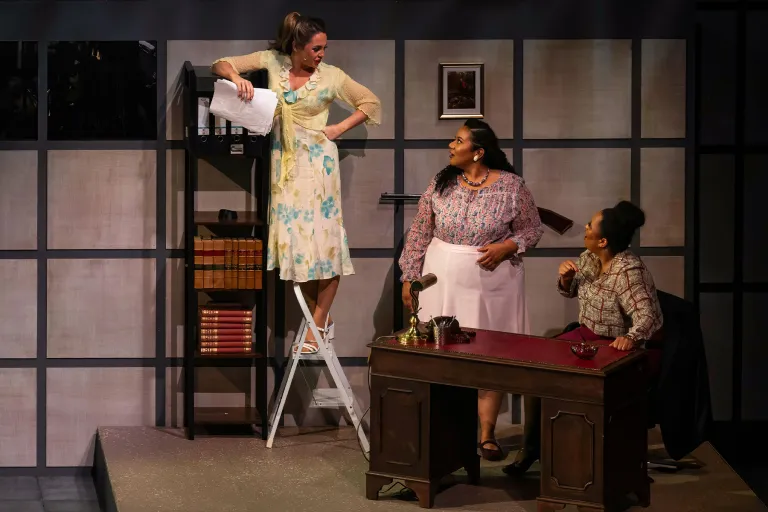
She is joined by Irish actor Karla Tracey making her professional UK debut as Doralee, the part made famous by Dolly Parton in the film. She has perfected the southern drawl that Parton is known for and brings Doralee to life through her vocal talent, especially as she commands the stage in her rendition of Backwoods Barbie. Tracey has outstanding control of her voice and body, creating a perfect example of a woman who uses both to keep herself safe; first by being the flirtatious and submissive secretary that CEO Frankling Hart Jr. (played by Tim Rogers) wants before taking control of many aspects of the women’s plans to improve working conditions at Consolidated Industries.
The trio of leading ladies is completed by Kayla Carter as newly-divorced Judy (portrayed in the film by Jane Fonda) who enters the workplace and quickly finds herself in the middle of office politics. Carter is immediately watchable as out-of-place Judy and shows perhaps the most growth of any of the characters as she develops into a natural leader throughout the show. Towards the end of the second act, Carter’s Get Out and Stay Out might have been the strongest musical number of the show – an anthemic moment of transformation into the confident woman Carter’s Judy has become.
Tracey, Marvin, and Carter carry the show with their powerhouse vocal performances, supported by a strong ensemble.
Tim Rogers and Jessica Martin complete the principal cast as CEO Franklin Hart Jr and personal assistant Roz respectively. Rogers is a seasoned performer who brings an instant unlikability to Hart with his sexism, harassment, and toxic masculinity, while Martin steals the show with her high energy performance of Heart to Hart, running and dancing across the stage in a dreamlike manner with Rogers making an appearance. The number proves that Martin is a master of comedy as she uses the full stage to her full advantage.
As director, Paul Jepson has ben ambitious in his vision for the show, although the show itself feels flat in many areas to be saved only by the talent of the cast. Lisa Stevens’ choreography is strong and energetic, making good use of the ensemble to create a sense of urgency on stage and bringing the fast-paced monotony of corporate America to life.
Amanda Stoodley designed the show, mostly successfully although a large clock print (set at 1:50) seemed out of place. The dual-level set allowed for separation and a pull-out photocopying station. It was a strong concept even if not entirely successful in its execution, forcing the cast to be solely responsible for the show’s energy against a sea of greys. It is complimented by lighting design from Andy Purves, expertly differentiating from the mundane office environment to the show’s dream sequences.
For a show with an important story at its core – the fight for equality in the workplace – it felt unchallenging and safe. With its comedy venturing into the absurd, 9 to 5 the Musical does miss out on the opportunity to fully explore the serious point it sets out to address and, five decades since the events of the film, feels as though it could have been sharper in its satire and more deliberate in its demands for better.
Until Saturday 1 August, then on tour.
