

Writer: William Shakespeare
Director: Sean Holmes
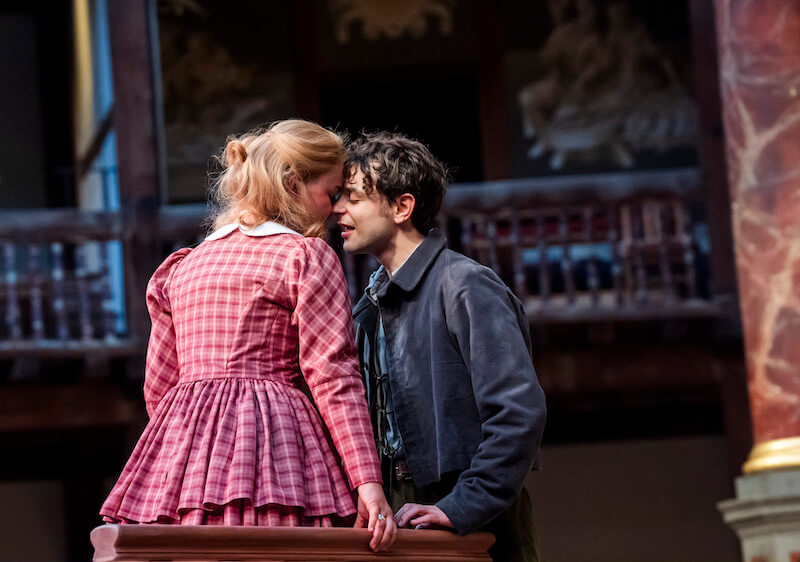
The saloon bar doors swing open. Guns hang in holsters, and the wooden walls are ominously smudged with blood. There are cowboy boots and Stetsons, flouncy gingham dresses, and country dancing. Director Sean Holmes’s Wild-West-style Romeo and Juliet swaggers into the Globe with its thumbs stuck firmly into a thick leather belt. The music, composed by Grant Olding, channels these same frontier-town tropes with its mix of bluegrass and ragtime, banjo, mandolin, harmonica. It’s a suitably unstable setting for a play about reckless behaviour, lawlessness, and the limits of tribal loyalty.
Two powerful families have been feuding for generations until their children meet in a crowded room. Shakespeare’s totemic story of young love has become a byword for clichéd romance, but this production is fresh and enjoyable. The actors playing the title couple are young. Lola Shalam (Juliet) and Rawaed Asde (Romeo) both graduated from London drama schools in 2023. Asde’s Romeo has an everyman charm, verbally sparring with his friend Mercutio and moving on from a hopeless crush to a new infatuation with amusing rapidity.
Shalam’s Juliet is no feeble, lovestruck damsel, but a real, warm-blooded human. She enters, all cowboy hat and stroppiness, and what at first seems slightly affected emerges as a nuanced performance. Her dilemmas are poignant as she visibly matures from bored teenager to purposeful, passionate young woman. She’s funny too, sarcastically mocking Romeo’s oath to the moon and giving a modern spin to lines like “Oh she is lame!”
For a play about violence, bad parenting and suicide, this Romeo and Juliet has surprising amounts of comedy. Jamie-Rose Monk as Juliet’s loquacious Nurse has fabulous comic delivery (“what saucy gentleman is this?”) while still bringing a glimmer of sadness to the fleeting, stoical mentions of her dead child and husband. Joe Reynolds, as Juliet’s other suitor, is an entertainingly dandified Paris. Juliet’s father, Lord Capulet (a mercurial Colm Gormley), even manages to get a laugh out of the line “Well, we were born to die”. Michael Elcock’s Mercutio balances light-hearted panache with fiery vigour, joking and angry to the end.
The throwaway nature of some lines could be part of a reframing of the play as a story about impulsivity. Nearly all the characters are in a hurry: messengers running, but not arriving; servants bustling and being redirected; guns drawn and fired before the shooter knows their victim’s identity. “Too like the lightning,” as Juliet says of their brief encounter in the garden, “which doth cease to be/ Ere one can say, ‘It lightens.’” She asks Romeo with genuine curiosity: “What satisfaction canst thou have tonight?” Their love story is full of spontaneity and frustration. “Wisely and slow; they stumble that run fast,” advises Friar Lawrence (John Lightbody), but he is as guilty as any other character of rushing into ill-thought-through courses of action.
The minimal staging, designed by Paul Wills, is effective. Juliet’s balcony and – later – her simple bed with its patchwork quilt are both wheeled on through the audience standing in the yard below the stage. They become almost ritual settings. The musicians’ gallery opens to reveal the band, eliciting a cheer.
As often at the Globe, the live music is a strength. It serves to contrast the formal dances of the older generation with the energy and movement of youth. When Romeo’s gang arrive at the Capulet party, they bring a new style and dynamism. Musical director Charlie Laffer’s resonator guitar, which produces a twangy Western-style sound, also provides an unsettling ambience in some scenes.
Apart from a few unholstered guns, the Wild West setting is slightly incidental by the end. There is a strange dance-of-death at one point that hints at both the European Danse Macabre and perhaps the more upbeat Mexican traditions of the Día de los Muertos. The play is nominally set in 1880s America, but it feels mostly contemporary. Both lovers use London accents.
The Globe’s audience frequently includes school groups, tourists and visitors who are not native English speakers. Productions generally try to clarify Shakespeare’s centuries-old text, and this dynamic Romeo and Juliet is no exception. Major plot points are underscored by music and movement.
Against this backdrop of big gestures, the young lovers manage some naturalistic moments. Their relationship is tender, but not particularly intimate. Their morning-after scene, often staged in bed, takes place already almost fully dressed. The catastrophically quick arc of their liaison feels even speedier than usual. There is still space for emotion, but the overwhelming sense is the tragedy of rashness and unthinking haste. It’s probably a more consequent theme for today’s audiences than yet another paeon to undying love.
Runs until 2 August 2025

1 Comment
We saw this last night – thought it was superb! The first half in particular is very funny – not what i expected but it felt like this is how Shakespeare wrote it. This is how he wanted it. The balcony scene is fabulous! Great work!