

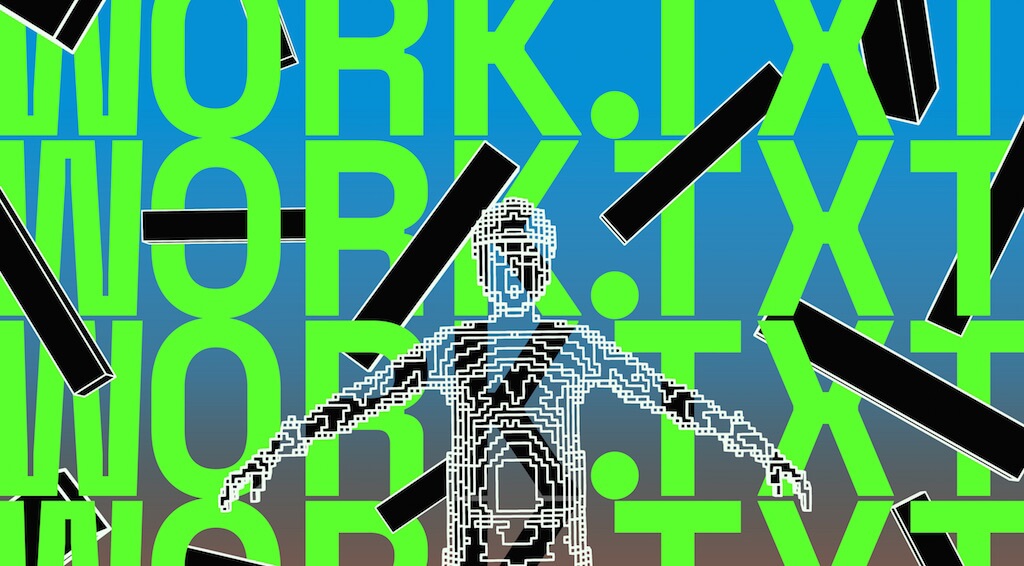
Writer and Director: Nathan Ellis
The premise of work.txt promises a story about the gig economy, never switching off, work seeping in to every aspect of life etc, except the story is told by you, the audience. There are no actors, instead you are the worker: “You’ll clock in at the beginning. You’ll get short breaks at regular intervals. You’ll work in a team, and under your own initiative.” and so on.
It’s not quite as radical as all that, but it’s certainly an original format. The audience is instructed, via a semi-automated PowerPoint, what to say and do, with no cast to guide them but themselves.
It’s a very clever mechanism and, with the heavily ‘creative industry’ crowds at Soho Theatre there are enough audience members who’ve dabbled in theatre to save us from any truly sputteringly shy performances. But unless you know the person on stage, are the person on stage or you’re giddy with excitement to volunteer yourself, the gimmick wears thin pretty quickly. You are at least spared if you’d rather not get on stage though, which is very much appreciated.
There is a plot: Someone decides, in the throes of a working day, to lie down in the lobby without explanation and stay there indefinitely. It’s basically Radiohead’s Just video but without the rad soundtrack and, like, actual professional performers to tell the story. Plus, that video lasts four minutes at most, and this is an hour-long production.
Writer Nathan Ellis seems well aware of the potential criticisms of the show. That’s sort of the problem really: The script is so self-aware that self-awareness is basically the protagonist, and the actual point is lost amongst knowing, wry quips. The script has predicted a variety of niggling reactions, at one point assigning a ‘cynical audience member’ a rant about how this isn’t real theatre, that they’d seen Mamma Mia The Musical just last week and “that was proper theatre”. But self-awareness does not “proper theatre” make.
The play concludes with a sort of semi-serious ramble about various existentially surreal future predictions which don’t seem to be saying anything in particular, “In 50,000 years, light will dress for the job it wants”, furthering the impression that the script is by the by. The form, however, is fairly effective in as much as instead of paying a professional cast, the audience is made to work, not only not being compensated for their work, but actually paying for the honour, which many will find a familiar ploy in the gig economy.
The content is just a bit too pleased with itself, and forgets to make the point it came here for, but there is something in it. Perhaps if it spent less time trying to convince the naysayers.
Runs until 12 March 2022
