

Director, Music, Sound & Video: Jaha Koo
Dramaturg: Dries Douibi
Scenographer, Researcher & Media Operation: Eunkyung Jeong
The name of Jaha Koo’s show Haribo Kimchi comes from two different places: Haribo, the German company known for producing gummy sweets, and kimchi, the famous Korean dish. Together, they indicate the unusual combination at the core of the show: a story about food and home from a displaced traveller.
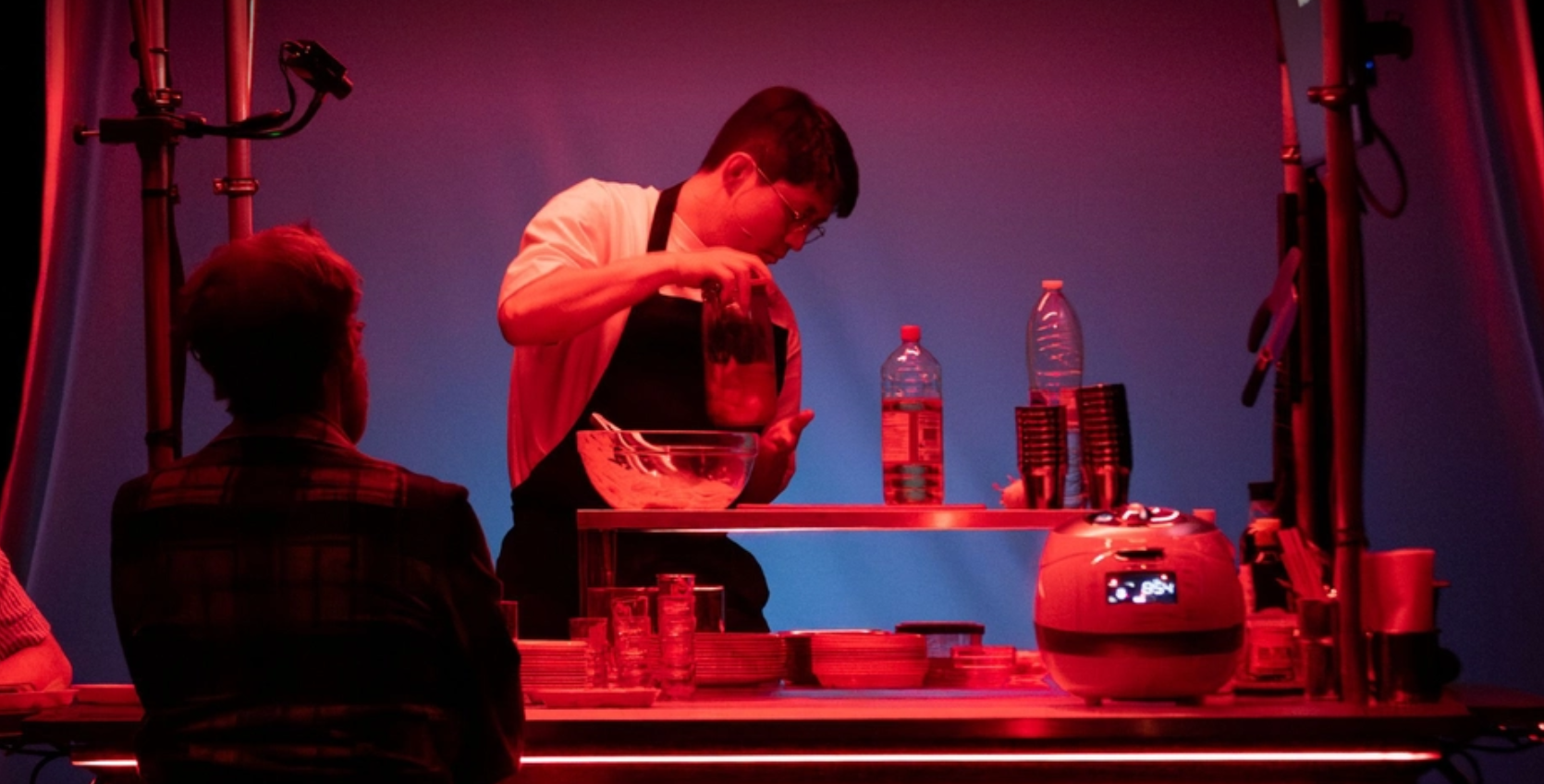
As the show begins, a pojangmacha, a kind of late-night snack bar in Korean culture, sits at the centre of the stage, covered in curtains, with projections showing a Korean street view and the sounds of a Korean street playing around it. Koo then reveals himself from the pojangmacha, dressed like a Korean teenager in the distinctive style of a cook and waiter, and invites two audience members to sit as customers as he begins to tell his story. It starts with his encounter with a snail while he was buying cabbages to make kimchi, an encounter that becomes connected to the stress he was experiencing at the time. He then serves the two audience members their appetiser of kimchi. As the titular food, kimchi is connected not only to his experience in Korea, but also to when he first moved to Europe with 10kg of kimchi from his grandmother. He also explores how the evolution of kimchi was hugely impacted by history, when in the medieval period its main ingredient changed from salt to pepper.
He follows this with a serving of cold seaweed soup, accompanied by a story about when he first moved to Germany and met a fellow Korean living there who gifted him a bag of crispy seaweed. The fried chicken is connected to his father’s story, when his vivid memories of death become closely connected to the smell of fried chicken. The gummy bears recall his memories after he moved to the Netherlands, while the eel brings back his memory of visiting Korea for the first time in ten years.
Koo grew up in Korea and studied at DAS Theatre, and both influences can be seen in his work. The Korean influence comes through in the use of animation and Vocaloid to express complex feelings, as well as in the pojangmacha setting and the food itself. At the same time, his use of projection, digital screens and a camera on stage reflects the language of contemporary European theatre. The invitation for audience members to eat on stage also recalls Ivo van Hove’s Network, where food and eating similarly become part of the theatrical experience.
Koo ends the show with a toy eel singing that home is not a fixed place but the place where you stay. It is a simple image that brings together the show’s stories of food, movement and belonging.
Runs until 24 August 2026 | Image: Contributed
The Reviews Hub Star Rating
-
8
