

Writer: Tom Dugan
Director: Mark Liebert
Tom Dugan’s top-notch bioplay Wiesenthal enjoyed a well-received outing at the King’s Head Theatre a couple of years ago and now comes to Wilton’s Music Hall direct from a run at the Edinburgh Festival. Dugan is a past master of meticulously researched one-person history plays, and Wiesenthal, gifted with a stonkingly good central performance from Christopher C Gibbs as the eponymous Austrian Nazi-hunter, as well as cleverly understated direction from Mark Liebert, feels as fresh and timely as ever.
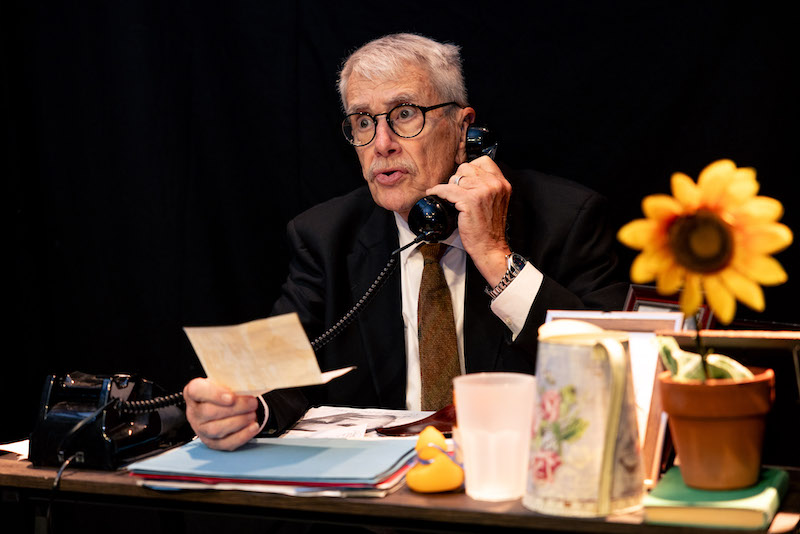
April 2003, Jewish Documentation Centre, Vienna. Wiesenthal, on the cusp of retirement, sits at his messy, paper-strewn desk, clearing decades of files and mulling over his life, motivations, and achievements (or, as he puts it, his “greatest hits”). He is also fielding calls from his long-suffering wife and attempting to resolve some last-minute unfinished business: the rendition from Syria of murderous SS Officer Alois Brunner. The extradition subplot adds ticking-clock tension to the piece, but it is unnecessary. There is quite enough drama in Wiesenthal’s life alone to make for 75 riveting minutes.
An architect by trade, Wiesenthal finds himself imprisoned in the Jewish ghetto in Lvov (now Lviv) and is then enslaved as a labourer in over a dozen concentration camps. Saved from likely death on a forced march by a fortuitous encounter with an Allied tank, he later joins the American War Crimes Office, smearing red ink on his face to look healthy enough to do the work.
Feeling himself “an independent kind of guy”, he sets up the Jewish Historical Documentation Centre in 1947 to collect evidence for Nazi war crimes trials. The narrative takes us through his move back to Vienna (“if you want to find a cure for malaria you must live among mosquitoes”), the capture and trial of Adolf Eichmann (“a twitching bookkeeper”), and many others. Wiesenthal comments with palpable dismay that only 5% of those war criminals on whom he kept files are ever brought to justice.
In a baggy black suit, Gibbs’ self-deprecating Wiesenthal shuffles around his office, cracking jokes and fussing with pot plants while his memory fails. Yet underneath the decrepit elderly facade remains a steely ambition to bring Nazis to justice. What motivates him? Partly it is his responsibility to the dead, embodied in the form of a boy called Albert, whose letter he finds in a prayer book. Partly it is the conviction that “evil will always be a part of us” and we “must speak of all genocide to prevent all genocide”, a belief with obvious and enduring resonance.
Dugan serves his subject well and delivers a cleverly crafted, thought-provoking, and deeply affecting piece.
Runs until 5 September 2026
