

Writer: Benedict Andrews, after Sophocles and Ingmar Bergman
Director: Benedict Andrews
The last time Cate Blanchett graced the National’s stage was for When We Have Sufficiently Tortured Each Other, a play whose title begged a thousand puns about how the audience felt after having to sit through it. Thankfully her new role, in which she and Nina Hoss (Blanchett’s costar in the film Tár) swap characters each night, is less of a slog. It is intellectually and emotionally draining at times, to be sure, but certainly feels like something worthy of both the actors and the National in general.
Benedict Andrews’ Electra/Persona is all about dualities. It is, itself, essentially two different plays: the first half is a condensed, modern-language adaptation of Sophocles’ Electra, in which the titular character sits, depressed, mourning the death of her father, Agamemnon, at the hands of her mother, Clytemnestra, and plotting her revenge. That’s followed immediately (between the printing of the programme and the performances, the production has lost a planned interval) by another adaptation, this time of Ingmar Bergman’s film Persona. One of the principal connections between the two is that the second play revolves around Elisabeth Vogler, a successful actress who has just played Electra on stage and who, ever since, has physically and emotionally shut down, unable to speak. As she recuperates, Anna, the nurse looking after her, finds her own personality merging with that of her patient.
The evening starts with a coin toss by an audience member, won on press night by Blanchett, who opts to play Clytemnestra and Anna (a choice suggesting the toss itself may be a red herring, and that the actors know which roles they will be playing in advance). This means that Hoss steps up, rubbing white make-up onto her face to take on the role of Electra. This tale of familial hatred and revenge sees Hoss’s take on the titular character deep in grief for both her father and her brother, Orestes – not dead, but exiled – while her mother, who freely admits killing her husband in the bath, did so to avenge their daughter Iphigenia, whom Agamemnon sacrificed to the gods to keep his soldiers safe as they sailed off to the Trojan War.
The duo makes good use of Magda Willi’s set, a steep continuity of pine steps, and adorns themselves with clothing that allows Hoss to both lampoon and embody other members of her family, from Agamemnon’s medla-betsrewn jacket to Orestes’ more casual tracksuit top.
Andrews’s dialogue emphasises the similarities between mother and daughter: both women use the same turns of phrase, both when mocking each other and in their natural modes of speaking. As with all Greek tragedies, it’s all driven by the most dysfunctional of family dynamics. There are a few slyly amusing moments, and Ella Lily Hyland’s contribution as Electra’s surviving sister Chrysothemis is of note. But principally this is about mother and daughter circling each other in an eddy of self-destructive grief and revenge, and as a condensation of Sophocles’s original, it works pretty well.
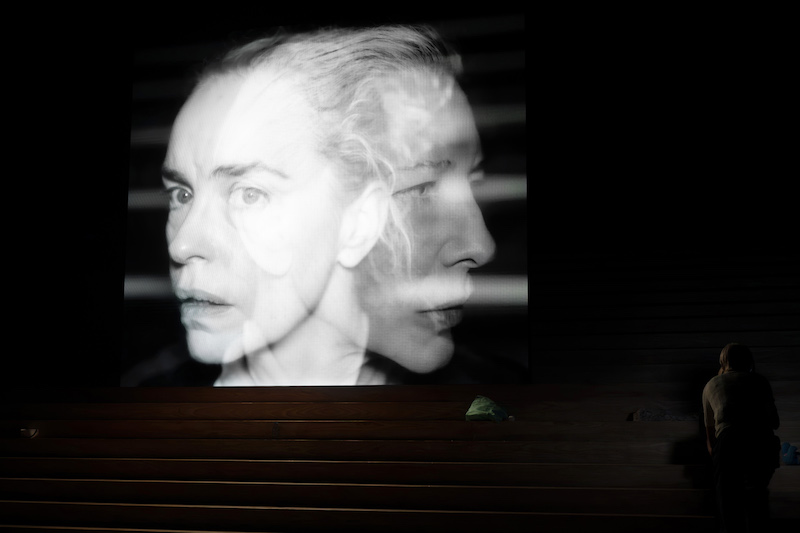
After a short pause for breath as stagehands mop up the stage blood, the switch to Persona delivers an altogether different style of theatrical storytelling. Hoss, now largely silent like Elisabeth, carries a handheld video camera that projects a continuous black-and-white square of extreme close-up. From that, we can see every thought flicker across her eyes and face, as Blanchett takes up the vast majority of the second piece’s dialogue.
If the parallels between the two stories seem loose at times, they are nonetheless present, as the lines between patient and nurse seem to blur and coalesce. There is a constant play for dominance in both, but the variation between Anna’s loquaciousness and Elisabeth’s silent, 12-foot-high face makes the second act the far more interesting of the pair.
And yet it is all somehow slightly detached. We are always aware of the theatricality in both Andrews’s direction and his writing, which pulls away from the emotional grip both actors otherwise command. That ultimately leaves Electra/Persona as a fascinating and commanding watch, though slightly sterile. There is certainly less of the torture one felt as an audience member of Blanchett’s first National Theatre outing, but her return is discomfiting and unsettling in places.
Runs until 10 October 2026

1 Comment
Interesting. I went to the opening night of previews and had the interval. i think I would have struggled without it, but im not a theatre expert and maybe it’s better with it. I was interested to see what the reviews would be like, with the guy next to me declaring in the interval “this is f*ckin awful” and that he wanted to walk out, and then didn’t even clap the cast at the end!
Electra was a bit tough for me, so the Persona part I preferred. I imagine being in the front row would have been very confronting! (and weird being on camera as a risk!)