

Writer: Nicholas Wright
Director: Georgia Green
Vincent in Brixton is simply riveting. In this new production at the Orange Tree, Nicholas Wright’s drama imagines an intriguing period early in Van Gogh’s life when he comes to London to work as an impoverished art dealer. It is known he lodged with a widow, Mrs Loyer, and her daughter Eugenie and that he lost his heart – but whether to mother or daughter has never been clear.
Wright exploits the shadowy nature of this episode to create a moving and often very funny drama, and it’s one alive with nuance. We see Vincent, a naïve twenty-something, fall for Eugenie at first sight. But at the heart of the play is the gradual deepening of his relationship with the sensitive, melancholic widow.
Every element of this production works. Expertly directed by Georgia Green, the inner nature of each character is brought out.
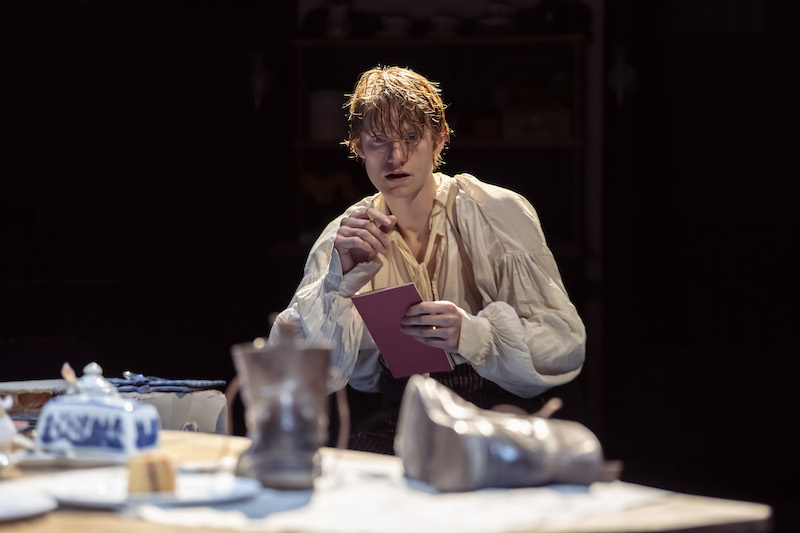
Jeroen Frank Kales is the perfect embodiment of the awkwardly abrupt and impulsive Vincent. He often stands and stares in bemused wonderment. He has no understanding of social niceties. On being asked by fellow lodger, Sam Plowman, if he can keep a secret, he blurts out an emphatic no. At other times, he is aglow with uncontainable energy. He’s altogether a bit of a handful, but kindly Mrs Loyer is won over by his sincerity and agrees to take him in for a couple of weeks. Vincent promptly sits at the kitchen table, waiting to be served.
Amber Van der Brugge is wonderful as Vincent’s uptight sister, Anna, who no sooner arrives than she fills a bucket from the sink and sets to work: the house, in her view, is filthy. Through her, we get a glimpse of the sheer strangeness of the Van Gogh family. She, like Vincent, is earnest and tactlessly outspoken, but is also conventional and quick to judge, lacking his passionate nature.
In contrast, Ursula Loyer (Niamh Cusack), Eugenie (Ayesha Ostler) and Sam, her secret lover (Rawaed Asde), form a warm family unit, all prepared to accept their strange guest for what he is. Cusack is marvellous as the capable Mrs Loyer, whose secret melancholy is sympathetically observed by Vincent. Cusack convinces both in her character’s gradual blossoming into love, and in her fall into near catatonic despair. Through this imagined relationship, Nicholas Wright deftly suggests that in Vincent’s instinctive empathy lies the clue to the troubled depths of his own nature. Ostler charms as good-humoured Eugenie, and Asde is excellent as the twinkly, but not wholly reliable Sam.
And then there is Charlotte Henery’s magical set. There’s a full-scale range that actually works. There’s something bubbling in a pan at the start, and hot items are pulled from the cover. Throughout the first scene, Cusack cuts Brussels sprouts, boils potatoes, separates eggs and shapes patties, and it’s all real. When she sticks a scalding frying pan in the sink, there is a satisfying hiss of water. This attention to detail is remarkable: from the humble plates to a little china soap dish that no one but nearby audience members will see, it’s all beautifully thought through.
Lucía Sánchez Roldán’s lighting creates the intimate dark of a Victorian interior, and Donato Wharton’s sound design provides pleasing bursts of bird song to suggest a sunny exterior we never see, along with his appealing music.
Part of the joy of the play is realising that we are in possession of a secret as yet undiscovered by Vincent himself, who has yet to find his true calling. When we see him in the final act, it’s a shock to find he’s found a calling – it’s just that once again, it’s the wrong one.
Runs until 18 April 2026
The Reviews Hub Star Rating
-
10
