

Composer: Wolfgang Amadeus Mozart
Libretto: Lorenzo da Ponte, translated by Orlando Jopling and Danielle de Niese
Conductor: Orlando Jopling
Director: Danielle de Niese
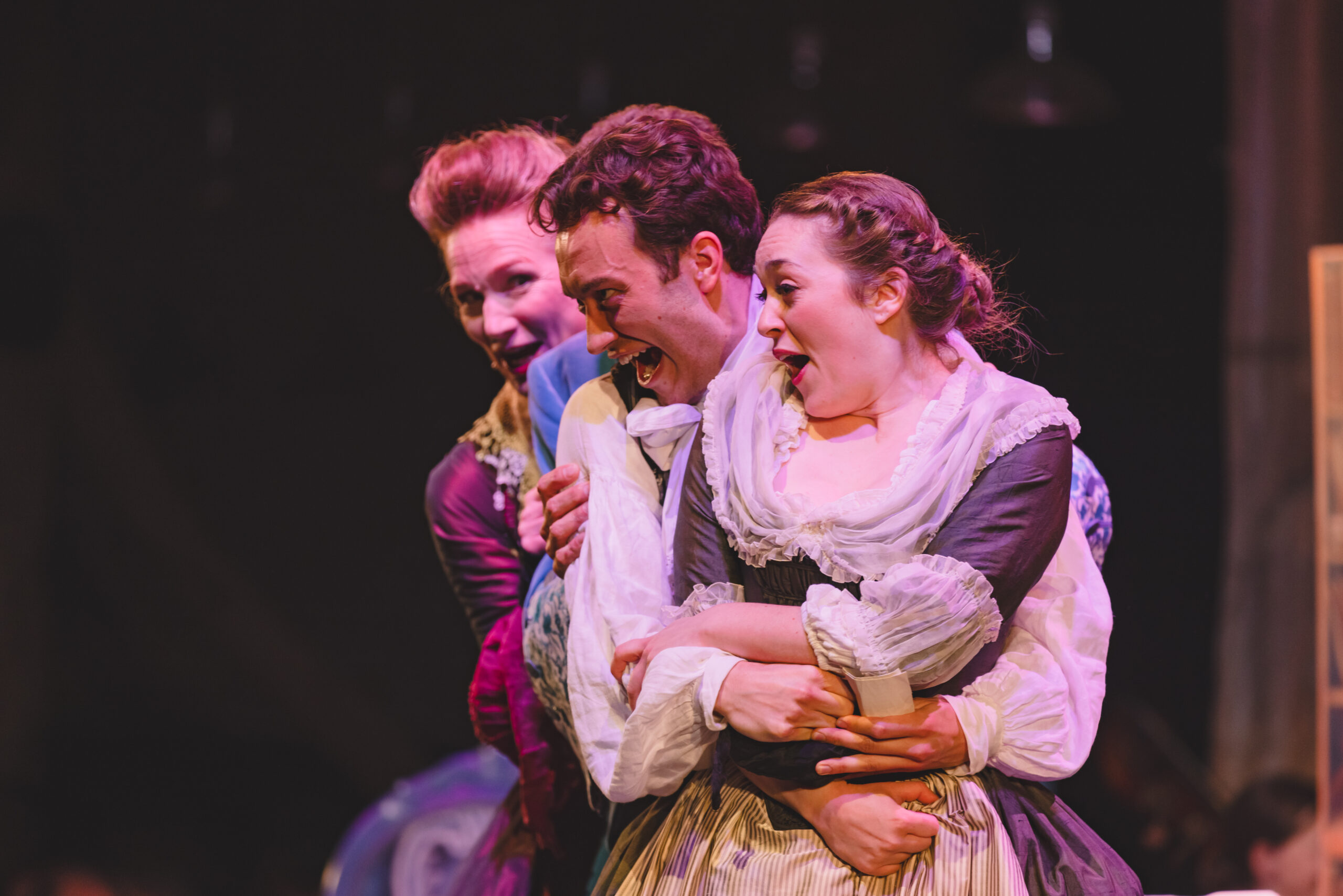
The Australian/American soprano, Danielle de Niese, now domiciled in this country, is a major figure on world stages, so her recruitment as director for the brilliant, but small-scale, Wild Arts represents a striking coup – a tribute to her love of The Marriage of Figaro and Orlando Jopling’s powers of persuasion. Wild Arts tour every summer on what you might call the festivals and country house circuit, playing sometimes in spacious surroundings, occasionally even a theatre, but also such charming, yet demanding, venues as Aldborough’s Grade 1 listed church, crammed below the chancel arch.
In some ways Figaro is an obvious choice: Mozart’s orchestra is not large (imagine cutting the orchestra for Wagner’s Ring down to 10 players!) and the chorus sections are few and far between and cuttable. On the other hand, what are you to do with the multiple hiding places, the locked room in Act 2, not to mention Cherubino’s leap from the window, and, above all, the assorted pavilions in the garden in Act 4? Furthermore, disguise is a lot easier in a theatre than in open church.
De Niese’s solution is to offer some sort of symbolic representation of these things – a screen, a chair, whatever – and rely on the music and the spry performances of her predominantly young cast – and it works perfectly. Incidentally, there is no hint of cutting corners in casting: even the tiny part of Barbarina is delivered with distinction and a real sense of fun by Eleanor O’Driscoll.
Some of the details of the production must have been improvised for this appearance at the Northern Aldborough Festival: the entrances through the church and scenes played out at the back of the nave are cleverly plotted. But De Niese puts her stamp on the performances. There is, always lurking beneath the high spirits, a real sense of danger: the Countess, for instance, is on the verge of an affair with Cherubino, the Count is desperately determined to have his way with Susanna. Interestingly Marcellina is much younger than is habitual, making sense of Susanna’s fury when finding Figaro in her maternal arms.
The balance between characters is perfect. Jack Sandison’s Figaro is less the Machiavellian plotter than the ordinary chap inventing excuses and plots as he goes, clearly in love with Susanna, initially deferential to the Count, and decorating everything with a polished baritone. Ellie Neate’s Susanna is wonderfully spirited, clearly in charge, and occasional shrillness is forgivable.
As the Count and Countess Timothy Nelson and Elinor Rolfe Johnson are a contrasted couple, he correct in everything until his sexual appetites and short temper get the better of him, she sadly recalling past days, but with a spirit unusual in the role; she and Susanna are a formidable duo. And she provides the musical highlight of the evening, a gloriously tender “Dove sono”.
Abbie Ward’s Cherubino doesn’t really capture the boyishness at first and the full fun and frolics of dressing up a girl as a boy as a girl are underplayed, but she makes the most of her opportunities with a beautiful “Voi che sapete”. Olivia Ray (as convincing as a bride as she is a mother, as Marcellina), Timothy Dawkins (adding a gruff Antonio to his Bartolo) and William Searle (finding the silliness in Basilio and Don Curzio) complete a formidable cast.
The orchestra under Orlando Jopling was, unusually for opera, neither in front of, nor behind, the action, but by the side of it. It played throughout with verve and precision, the depleted wind section performing miracles.
Reviewed on 26 June 2026.
The Northern Aldborough Festival finishes on 27 June; Wild Arts tour until the end of September.
