

Writer: Brian Friel
Director: Allan Hart
Overall, this is a pretty pleasing, thought-provoking take on a play which has acquired near classic status in the 46 years since it premiered.
Translations is set in Ireland in the 1830s where the colonising British are constructing an ordnance survey map, Anglicising (“standardising”) place names and setting up National Schools where attendance will be compulsory and everything will be taught in English. Friel is clearly linking the annexing of his country by the British with later “Troubles” which were rife in 1980 when the play was written.
The setting is a “hedge school” run by an elderly man and his son, at which adults can learn Latin, Greek, mathematics and more. It’s a play about language. Friel’s skilled script allows us to believe that most of the cast are speaking Gaelic most of the time although the play is written in English.
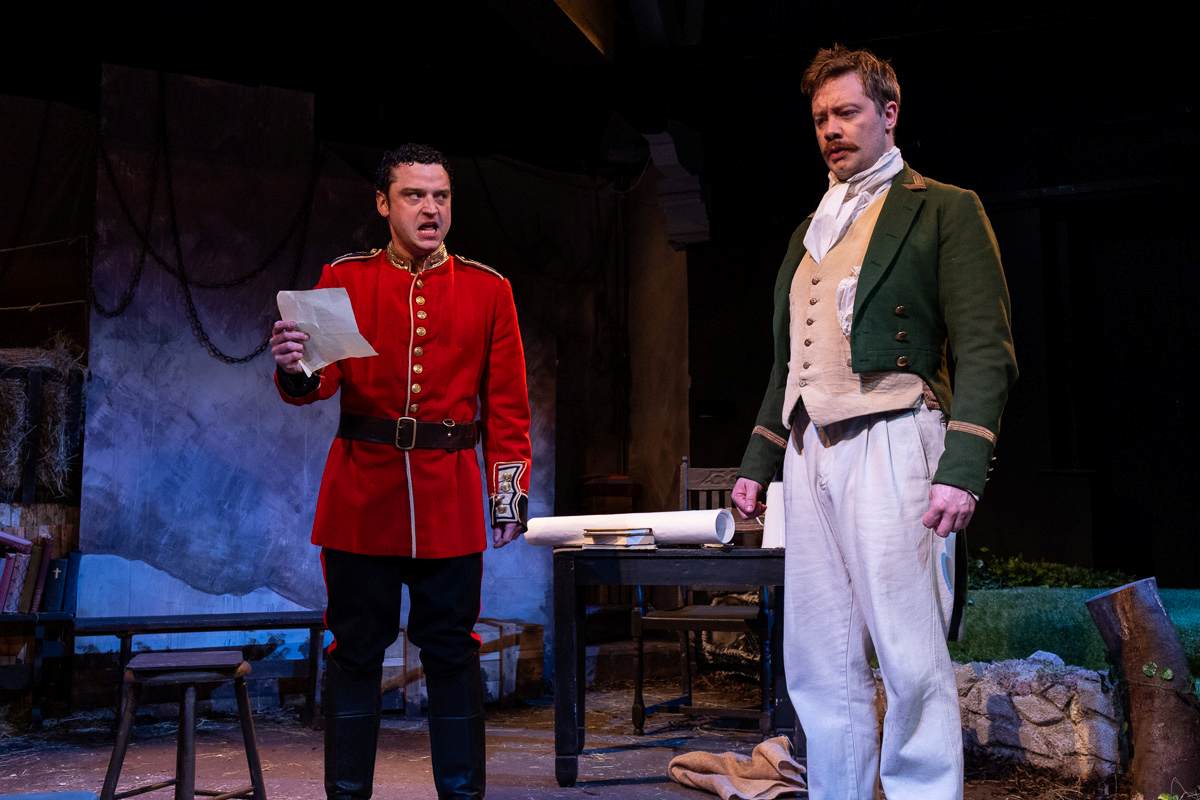
This production delivers the message as movingly as any professional take on Translations – staged on Max Batty’s all-encompassing set with a homely room complete with manger and stairs at the back. Grassy steps at stage left suggest the outer entrance. It’s an imaginative use of the Tower Theatre’s triangular playing space. The incidental Irish folk music (Colin Guthrie) adds ambience.
The generally good cast includes an outstanding performance from Oscar Gill as Owen. He is the worldly son who has come home from England to his father and brother. In cahoots with the army, he has a foot in either camp, acts as a translator and Gill’s interpretation gives him real depth. Varvara Barmpouni impresses as Sarah, an elective mute, gradually learning to speak again. Her role involves a lot of eloquent active listening. Allan Maddrell’s work as the gentle, kind, troubled Manus is pleasing too.
Rather less successful is Robert Pennant Jones as the elderly, hesitant, doddery Hugh. Everyone else in the cast speaks with an Irish accent (carrying degrees of authenticity) which is why the voices of the two British officers (Charlie Patterson and Peter Molloy – both strong) always come as such an intrusive shock. But Pennant Jones sounds like a rather mannered, slow-of- speech Etonian and it grates.
Translations is probably Brian Friel’s best known play partly because it has long been a curriculum favourite which means that many people have studied it at A Level. Its fame is also due to its universal, timeless message which it speaks at so many levels. Language and culture lie at the heart of identity and any attempt to dent that is profoundly, dangerously disruptive. Think of the Taliban, the Russian war with Ukraine or even “woke” vocabulary manipulation in the UK.
Runs until 28 March 2026
A version of this review was first published on https://susanelkin.co.uk/
