

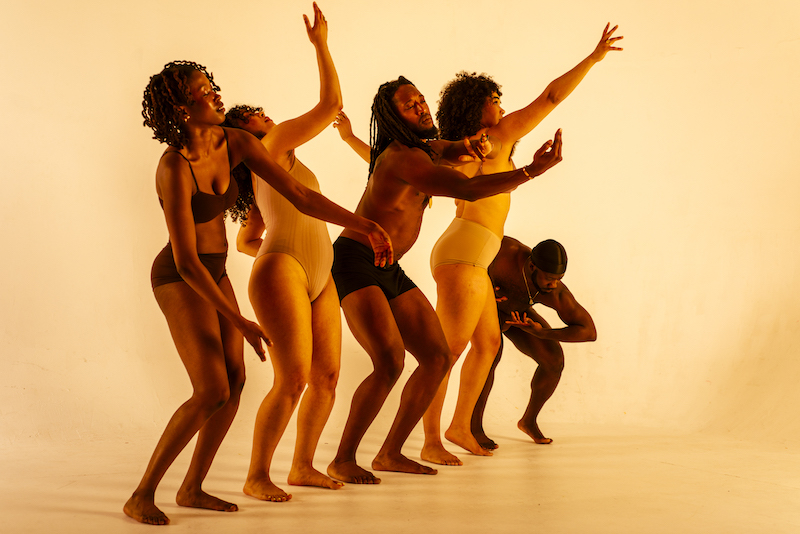
Choreographer: Akeim Toussaint Buck
While reggae emerged in Jamaica in the 1960s, its musical and dance roots descend further back into history and across many cultural and geographical branches. In FREE, choreographer Akeim Toussaint Buck’s company Toussaint to Move works within that and beyond, bringing in contemporary dance, jazz, capoeira and more to create a lively hour of non-stop dance.
The stage of Sadler’s Wells East becomes a communal room for this performance, the usual tiers of seats blocked off so that everyone occupies the same space. It’s an attempt to democratise the work, perhaps, to say that the professionals are sharing not just their performance but also their love of dance and its emotional truth.
There is still a line between the audience and the dance company, and it is held by an array of supernumeraries of varying skill (some of whom hail from the new Academy Breakin’ Convention, based in the Sadler’s Wells East building). The team dances along, encouraging the audience to get up off the few chairs and bean bags dotted about and to let themselves rejoice in the music – always, though, leaving enough space for the tightly choreographed corps of five dancers to express the work.
There is, of course, a divide remaining between people who have come to watch the professionals and the professionals themselves. While the staging may feel like it literally levels the playing field (or, in this case, the dance floor), in reality, it does make it harder to see and appreciate the work of Buck’s choreography and his five dancers.
Mostly, though, this is a celebration of reggae, of Jamaica, of Rastafarian faith. The music, by Buck’s band Buck and The Magnificence, combines the expression of freedom with devotion to something higher.
For the most part, that is how the whole hour progresses. The closest the work comes to exploring something different is when one of the performers breaks ranks to call for the freedom for various countries – “Free Angola, Free Congo, Free Palestine” – only to be suppressed by the other dancers, plaguing their hands over his mouth while leaving rictus grins on their own.
It’s a statement, perhaps, about how neither organised dance nor the arts in general are as free as we would wish. And that is reflected, too, in the hierarchies still present on this flat, democratised stage. At its edges, the audience dances truly free, but their movements are far less interesting than the ones in the centre, the moves that are carefully planned and controlled – and yet perhaps even more joyful.
Freedom is a nebulous concept, something we take for granted, something we yearn for while simultaneously admiring the elegance of conformity. FREE expresses that concept in a unique, thrilling way.
Runs until 8 November 2025
