

Writer: William Shakespeare
Director: Sarah Tresillian
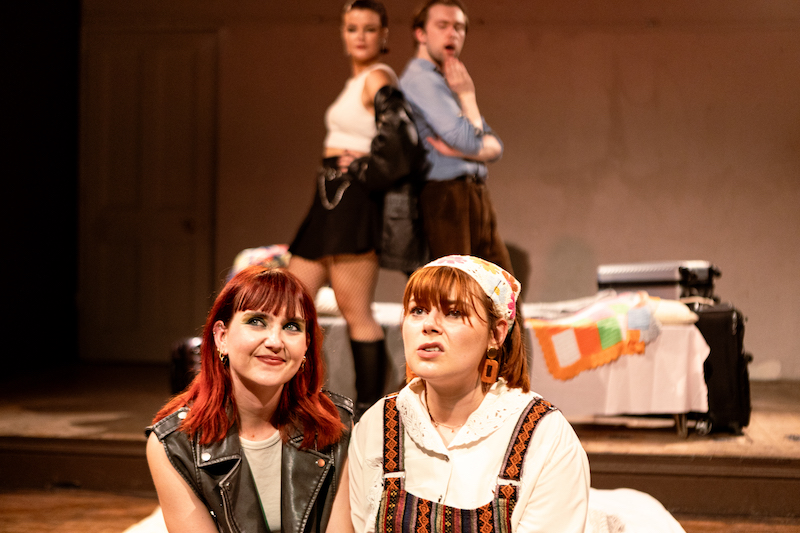
There’s a party going on as the audience arrives for this upbeat production of A Midsummer Night’s Dream, and the young cast’s happy vigour infuses all but the most sombre moments. In the opening minutes of the play, angry patriarch Egeus demands that his daughter Hermia must marry Demetrius, the man her father has chosen, or suffer the heavy punishments of Athenian law: marry, die or become a nun. In this production, Lysander, the lover Hermia has chosen for herself, is a woman, suggesting that Egeus is homophobic as well as controlling.
The gender switch works surprisingly well, illuminating several moments in the couple’s tempestuous journey. It also allows Hermia (Tess Hermann) unexpected moments of comedy: in response to Duke Theseus ultimatum that she must obey her father, die, or “abjure / Forever the society of men,” she makes a noise that suggests “that doesn’t sound so bad.” In other productions, Lysander and Demetrius are sometimes interchangeable Athenian bachelors, but here they are pleasingly distinct. Caroline Kane plays Lysander persuasively, in leather miniskirt and fishnets, with seductive panache. Ben Willows’ formal, arrogant Demetrius starts off sycophantic (to Egeus) and cruelly dismissive to his former girlfriend Helena (Katie Rogers) before waking to new humility later in the play.
Hermia and Helena have powerful moments, too. Helena’s speech about their childhood friendship (“So we grew together / Like to a double cherry…”) becomes a statement of female solidarity that makes their baffled quarrelling more poignant. Much of the play’s power surely comes from Sarah Tresillian’s superb direction. Staged in the round, there are occasional issues with blocking and the sightlines from the side, but the intelligent delivery outshines these quibbles. The actors have a clear, fresh understanding of each line that sheds new light on centuries-old poetry.
Bethan Corley as Hippolyta/Oberon and Jordan Matthew as Theseus/Titania are particularly impressive, commanding the busy stage with moments of stillness and pathos. Lots of productions have Duke Theseus and his warrior bride Hippolyta double as the fairy king and queen, and the text hints at their interconnection. The decision here to swap genders in the fairy realm adds a touch of genius.
Corley’s jealous Oberon watches the action with a compelling attention and brings a range of emotions to the fairy king’s love potion plot. There’s no panto-dame-style caricature of femininity in Jordan Matthew’s Titania. Instead, he gives regal richness and depth to her pertinent description of environmental crisis and infuses lines that are often thrown away with soulful conviction.
Gabriel Harris is perfectly cast as the chaos-loving fairy Puck, in gold trousers, bringing his queer, mischievous energy to a vital role. There’s also plenty of comedy from Jay Sweeney as “let-me-play-the-lion-too” Bottom and the loveable band of fairies/actor-mechanicals played with joyful enthusiasm by Imogen Honey Strachan, Harriet Stevens and Harry Howells. The fairies, dancing on stage and then sneaking off for a cigarette, leaving the fairy queen unguarded, are thoroughly entertaining. Paige Leavy is exasperated director Peter Quince and a terrified Master of Revels Philostrate.
Harri Compton’s sound design provides birdsong for the forest and some hilarious musical stings when characters wake up, enchanted, and fall instantly in love. Lighting designer Trekessa Austin adds an amethyst glow for the magical power of the flower “love in idleness”, represented by test tubes of purple glitter. There are a few frilly shirts and miniskirts, but the “groovy 70s makeover” promised in the blurb doesn’t really materialise. The set consists of three beds, accentuating the sense that the play is partly an elaborate bedroom farce, but they do feel a bit like trip hazards, slightly crowding the stage. This is not a flawless production, but its joyous power more than compensates for minor weaknesses.
Director Sarah Tresillian, self-confessed “huge Shakespeare nerd”, launched the theatre and workshop company Shakespeers last year to make the playwright’s work accessible to contemporary audiences. On this showing, her company is delivering beautifully on that promise and it will be interesting to see what she tackles next.
Runs until 6 June 2026
