

Writer and Director: Pedro Almodóvar
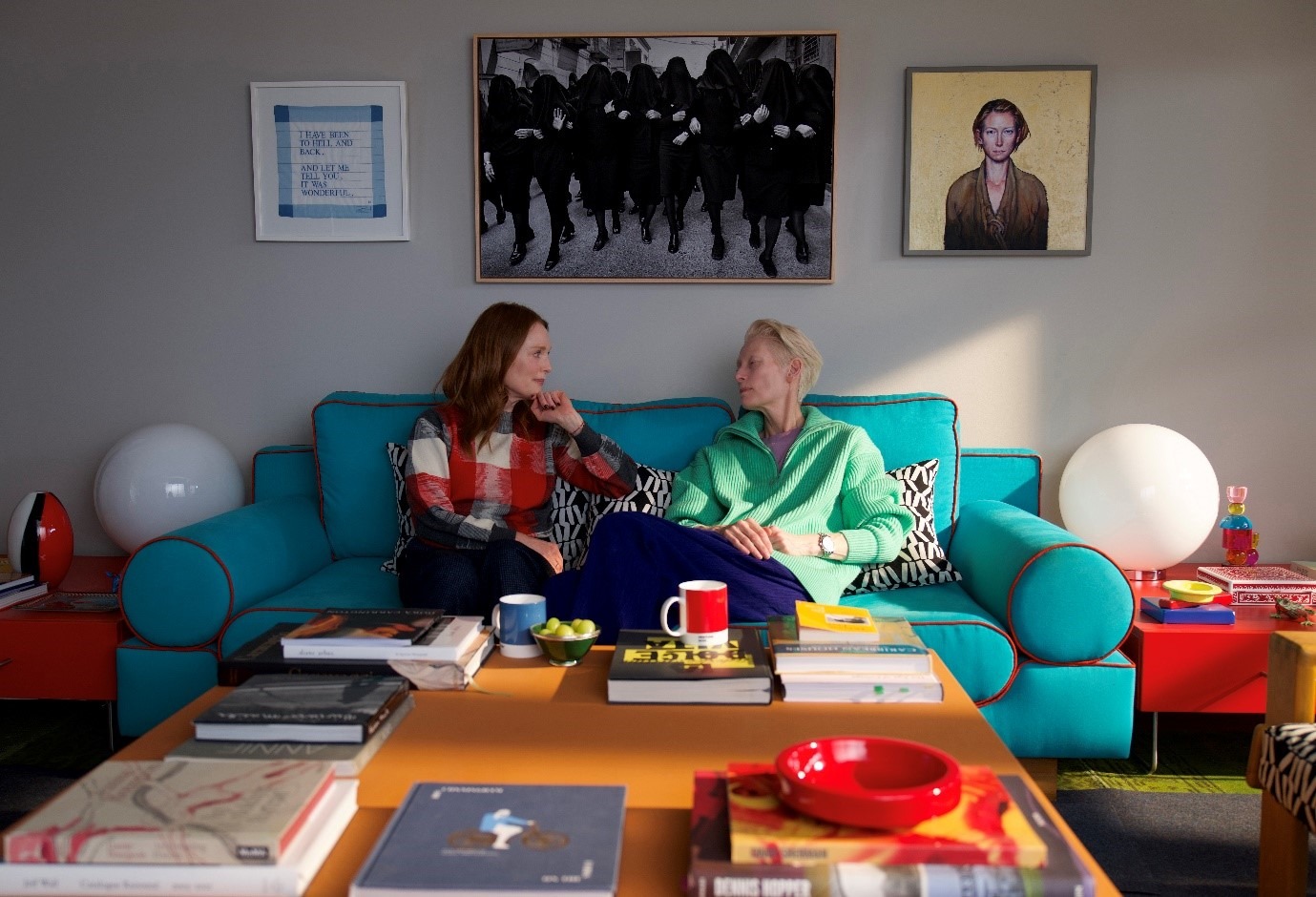
Pedro Almodóvar’s first English-language film is like Beaches for a new generation. This is not a criticism, by the way. In both movies, two women go to a secluded spot so that one of them can die. Bette Midler and Barbara Hershey travel to a beach house while Julianne Moore and Tilda Swinton rent a modernist lodge in the woods near Woodstock in upstate New York. One of the reasons for Beaches’ success was its release date, 1988, in the middle of the AIDS crisis. Watching a friend die was tragically too common for many people at the time. The Room Next Door, based on a book by Sigrid Nunez, seems like an update of this story, but this time with literary allusions that gesture towards the eternal.
Watching snow fall outside the window of her hospital room where she is being treated with cervical cancer, Martha (Swinton) is reminded of James Joyce’s The Dead, the last story in Dubliners. The Irish master ponders upon the inevitability of death in elegiac sentences. Martha’s friend Ingrid (Moore) is writing a fictional biography on artist Dora Carrington, who shot herself in the stomach after her best friend writer Lytton Strachey died from stomach cancer. In addition, the film references Virginia Woolf and Edward Hopper, both chroniclers of loneliness.
If this all sounds as depressing as The Hours, the story of Woolf’s suicide and how it resonated through the decades, all played out to the tune of Philip Glass’s melancholic piano, then Alberto Iglesias’s score for The Room Next Door is brighter, swelling with melodramatic flourishes of earlier cinema. While the subject matter might recall Stephen Daldry’s adaptation of Michael Cunningham’s novel, there is something, too, of Todd Haynes Carol. Haynes’s film was direct in its portrayal of same-sex desire; in Almodóvar’s film, it whispers at the edges.
It’s surely not a coincidence that Julianne Moore, who starred in The Hours, is here in The Room Next Door, too. She has the calm, put-together demeanour that becomes melodrama so well, especially when the music can take care of the emotions. Here, Moore is slightly aloof, and Ingrid’s fear of death implies that she will be the one to gain knowledge of what it means to be alive.
Swinton has the more testing role in Martha, a war correspondent who already has seen her fair share of death. Knowing how lonely one’s last breath can be, she doesn’t want to die alone, surrounded by her belongings. Instead, she wants to die in a strange but beautiful location with someone in the room next door.
Almodóvar shoots freely as usual, with intimate close-ups of the pale faces of the two actors, particularly Swinton’s, only occasionally gashed with scarlet lipstick. For the Spanish director, the story is the priority, the implications of betrayal and double-crossing ratcheting up the tension as the fatal day approaches. But this doesn’t mean that Almodóvar has no eye for detail. On one of the walls of Martha’s Manhattan apartment rise paintings of giant carnations, and in her hospital room, white tulips swoon on a vase while sunshine narcissi burst out of a pot, but the camera never lingers upon them.
The Room Next Door is not as manipulative as Beaches, and neither does Bette Midler sing The Wind Beneath My Wings at the end. Instead, its sorrow is emptier, chillier like Moore’s Ingrid, who always keeps her emotions at arm’s length. The Room Next Door is far removed from Almodóvar’s early comedies, which sweated with energy in the Spanish language. In contrast, this is looking into the unknown with unblinking eyes.
The Room Next Door is screening at the BFI London Film Festival 2024.
