

Director: Daniele Rugo
Life Support is the most powerful, urgent film you are ever likely to see.
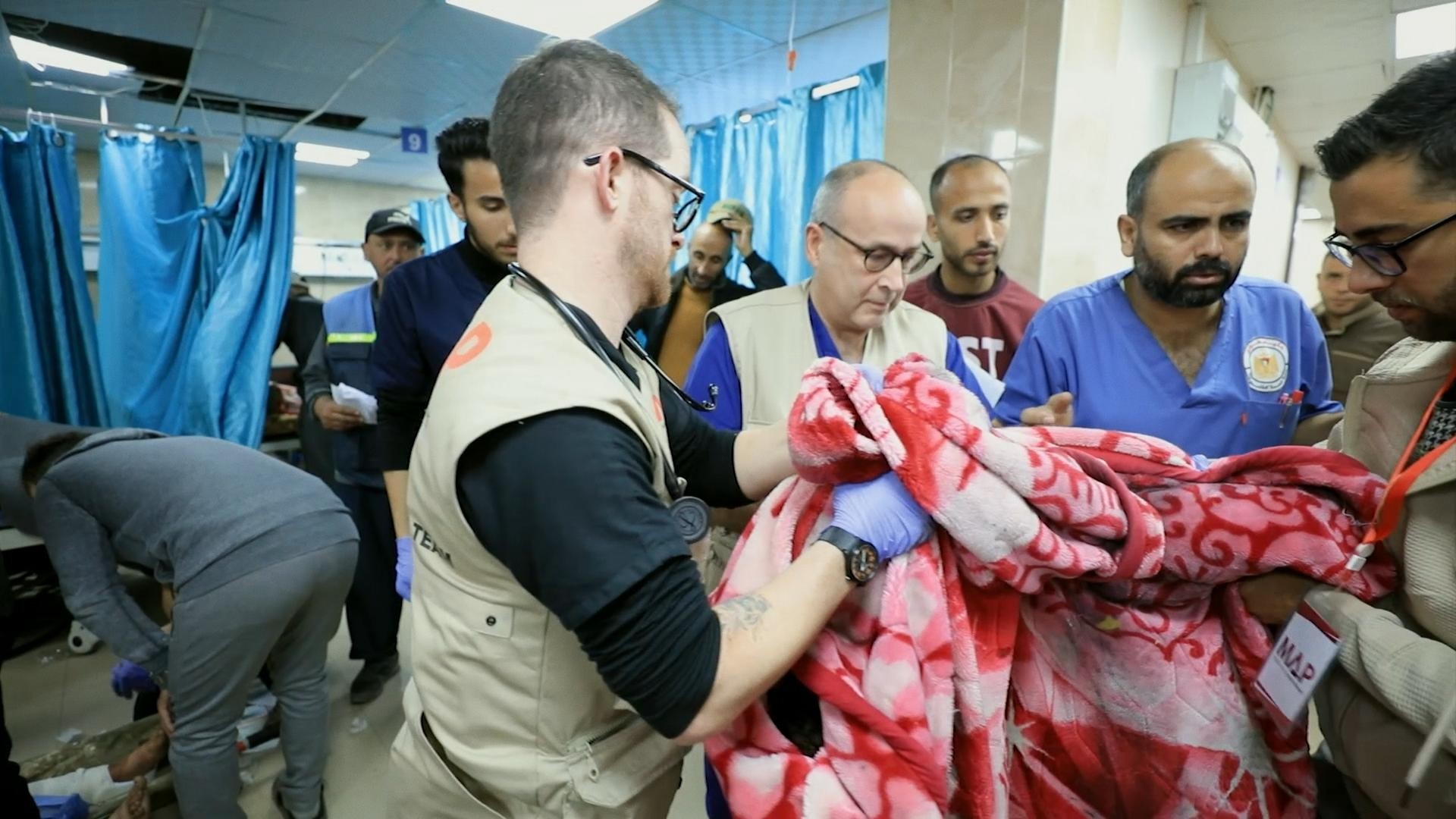
International doctors speak directly to camera over the course of some fourteen months as they return again and again to offer help to hospitals in Gaza. While they undoubtedly risk their own lives, their vision remains steadily on the people they are trying to help. Each speaks calmly and candidly, stressing the importance of being there to advocate for Gaza and to bear witness to the ongoing atrocities.
Beneath the calm observations of Daniele Rugo’s documentary, a collage of talking heads and footage from local camera operators, is an undeniable passion. You can’t take your eyes off it.
The medical health workers who speak (there is no narrator), know that the full horror of what is going on, the truth blocked from the media. At first there’s a sense akin to exhilaration as western doctors take the shocking lack of medical supplies into their own hands. In April 2024, Dr Victoria Rose, a British surgeon, packs twenty-three suitcases with equipment begged from colleagues. As she’s driven from Rafah, she passes lines of stationary lorries, unable to deliver the aid with which they are loaded. When she reports in August 2024, she’s only allowed to bring in one bag. She’s packed it with children’s clothes and her one tray of surgical instruments. Now there are no signs of life in the rubble-strewn streets.
Every inch of the four Gazan hospitals fills up with displaced Palestinean familes. Doctors have to treat critically injured patients lying on the floor. There are no antibiotics. Many won’t survive. An ICU is bombed. Many Palestinians health workers are now displaced. Unsurprisingly, there are signs of fatigue amongst the staff. A ban on the importation of sanitary products means there’s no shampoo, no soap: a petty humiliation that pushes everyone closer to despair.
In November 2024 Dr Tanya Haj Hassan, who has been on the ground in Palestine, delivers an excoriating report to the United Nations in New York. Often close to tears, she details the atrocities: a thousand health care workers killed in Gaza, many more taken captive. She gives evidence of an inhumane policy of triple strike attacks by the Israeli forces. Once a location has been struck, there’s a pause. Then when rescue workers arrive to retrieve casualties, there’s a second strike; then a third.
Dr Rose speaks with deadly clarity to a government meeting in Westminster. Critical infrastructure is being destroyed, she tells them. Religious buildings, hospitals and schools – the very heart of a people’s culture is being systematically eradicted. Earlier in the documentary, Dr Rose spoke of the beauty of Palestine. She feels its important we understand: “It’s what the original Middle East was,” she said, talking of universities and gardens, of there being a real buzz about the place. It’s a powerful reminder of what is at stake
British doctor, Professor Nick Maynard, speaks warmly of his love for his Palestinians colleagues and patients. But by the end he cannot disguise his distress and anger. There is absolutely no evidence, in his view, of any signs of Hamas militants in the hospitals where he has worked, hospitals where he’s had unlimited access. Claims of Hamas occupation, he says, are put out by the Israeli and “parroted in the media.” The full force of Maynard’s anger is directed at the British government for failing to intervene.
It’s a “frankly genocidal frenzy,” another colleague spells out. A palliative care doctor, unable to give dying patients pain medication, calls it “torture.”
70-80 % of Palestinian children admitted to hospital are observed to be suffering from acute malnutrition. We see distressing footage of emaciated children in hospital beds, unlikely to survive the injuries for which they’ve been admitted. “Wounded child: no remaining family” becomes a horrifically common label.
A neonatal ICU is forced to give premature babies sugar water as Israelis at border crossings have confiscated all formula feed. There is an even worse story about babies left in a NICU – too awful to describe here.
May 2025 sees the opening of the Gaza Humanitarian Foundation (GHF), backed by Israel and the US with the stated purpose of distributing humanitarian aid. By mid August the OHCHR report that of the 1760 Palestinians killed since 27 May, 994 have been killed in the vicinity of GHF sites.
There are – or were – only four hospitals in Gaza. They’re repeatedly targeted by air strikes, so there’s often just one hospital functioning.
Life Support doesn’t pull its punches. One doctor after another spells it out: “This is ethic cleansing”; “There are war crimes being committed every single day.” “It’s genocid.”
‘The views of this film,’ reads a disclaimer at the end, ‘are not those of the UN’.
Amidst all this, Life Support gives powerful witness to a very special quality of the Palestinians. As another of these heroic doctors believes: “I think the Palestinians will survive with their humanity intact.”
Life Support is screening at Sheffield DocFest 2026.
The Reviews Hub Star Rating
-
10
