

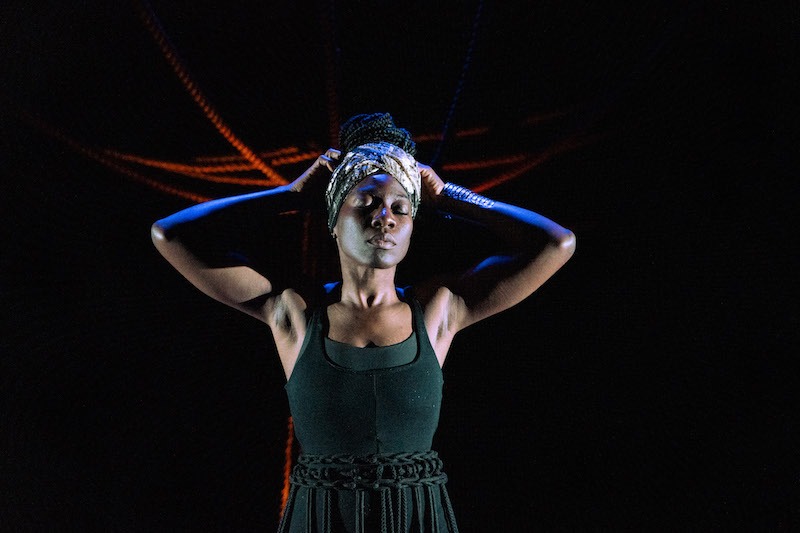
Writer and Director: Julene Robinson
Following a brief premiere production at The Other Palace, Julene Robinson revives her 75-minute show The Night Woman for a run in the Barbican’s intimate Pit space. Performing three characters exploring their Jamaican ancestry as well as present and future conceptions of Black, female identity, Robinson’s approach blends philosophy and spirituality with dance and music to reflect on the nature of darkness and its role in creating and sustaining a form of inheritance for the women in the story.
The Night Woman is bookended by two narratives that recreate the life and interactions of two characters by dramatising their conversations as well as giving them each a monologue about their lives. The first character draws heavily on Robinson’s own family experience as a young woman who is guided into adulthood and a fuller understanding of her Jamaican culture by a beloved grandmother, part of a local group of Obeah women, seen by others as either witches or healers.
Largely with vocal descriptions and character creation, Robinson creates a strong scenario in this section of the play, with a vivid and caring relationship growing between the family members, while Robinson also describes some of the rituals and practices that shape the Obeah view of the world. Here too, the writer-performer begins a discussion about the innate suffering along with the cultural and political heritage of Black people, each generation being “born into war” she argues and abandoned by God. This becomes the through-line of The Night Woman.
The final chapter, though much shorter than the rest, returns to the idea of birth with a woman spotting the man she will marry and describing their first sexual encounter which later becomes the arrival of their first child. There is a confidence in this character about her destiny, yet the audience spends too little time with her to fully explore her scenario. Robinson does, however, tie this conclusion to an opening section about the universal darkness being the crucible of love and life.
The middle section is the least theatrical, the embodiment of The Night Woman herself which is essentially a treatise on humanity’s fear of the darkness and the role of religion in teaching society to fear her. Although Robinson’s passion and desire for expression are clear and the silky confidence of the character is enjoyably drawn, the show becomes repetitive here and a little muddled as narrative gives way to philosophical speeches and dense poetic allusions.
Robinson’s stage design brings together a nest of ropes that take on multiple purposes throughout the show in reference to plantations and slave ships that create images of captivity and maltreatment, while later the ropes become a tree, emphasising the spiritual connection with the natural world that underpins The Night Woman. Handling a single piece of rope as a performance aid, Robinson binds her arms and hands with it, turns it into elements of her costume and uses it as a prop, an effective device to create movement and change on stage while encouraging focus on the words of her story.
Although the show needs some clarity in its middle section, The style and tone of The Night Woman are particularly strong and the three characters an interesting approach to exploring the connections between the past and the future.
Runs until 21 October 2023
