

Writer: Noël Coward
Director: Philip Wilson
This is a very welcome addition to the usual menu of Coward comedies, in that Philip Wilson’s production is the first since a couple of late 20th-century revivals in which Celia Johnson and Diana Rigg took on the title role created for Marie Tempest in 1927. The Marquise Eloise de Kestournel is the vivacious former lover of both Raoul and Esteban, and her unexpected reappearance in their lives throws a spanner in the works of the intended marriage of their – and, as it turns out, her – respective children.
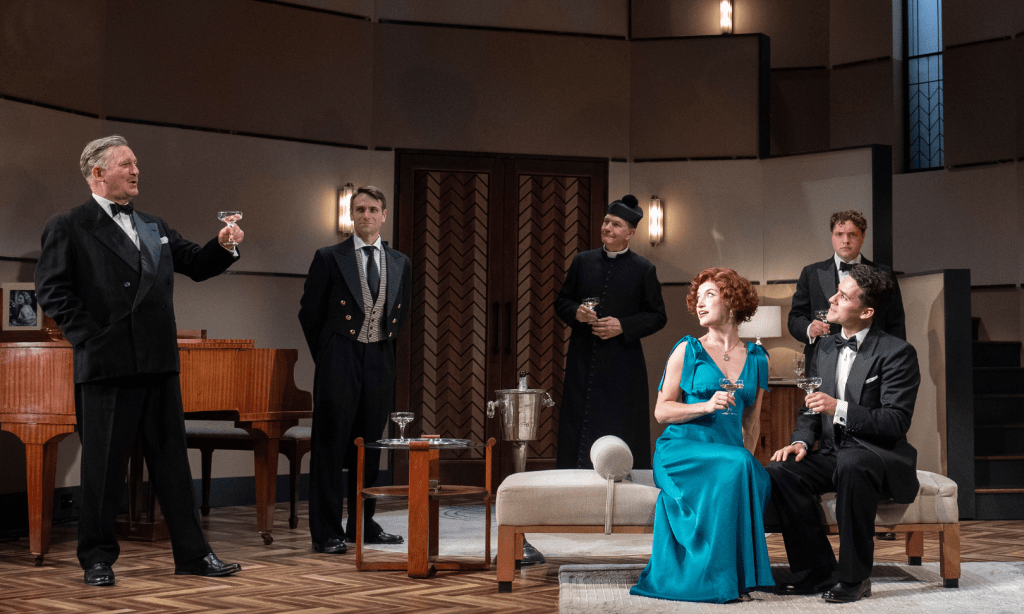
Originally set in 18th-century France, Wilson moves the action to Coward’s own time, and, as with Jonathan Miller’s revelatory production of Rigoletto in which he moved the action from the Renaissance into Verdi’s own time and the music suddenly made sense, the setting seems entirely at one with Coward’s language and attitudes. Like Terence Rattigan, he is concerned with emotions that need to be hidden or suppressed (and one of the impediments to the marriage of the young people is that Miguel is really in love with a male dancer). And Colin Falconer’s costumes and art deco set are impressive, though the huge staircase must have been a nightmare for the actors who had to go up or down it.
Eloise is, like Madame Arcati in Blithe Spirit, a disruptive and anarchic figure, and Juliet Aubrey brings a welcome joie de vivre to her performance. Her blend of winsomeness and authority is refreshing and fun, and the challenging of societal norms gives bite to the play. Her lovers are pleasingly contrasted: Simon Shepherd’s Raoul pompous but loving, and Tristan Gemmill’s Esteban elegant but conflicted, and they make the most of the comic duel – first with a slap, and then with rapiers – which Eloise inspires between them.
Eva O’Hara is delightfully spirited as Raoul’s daughter Adrienne in her relationships with her lovers and in her growing warmth towards Eloise, and indeed all the minor characters contribute to the pleasure of the piece. One scene in which Raoul decides to get drunk with his servant Hubert (Lee Peck) is an interesting oddity, but comes to nothing – and sometimes Coward fails quite to justify an idea, as with the concept of Raoul’s live-in Catholic priest Father Clement (Martin Carroll). But there is a seriousness of purpose at work beneath this surface, and the selection of Coward’s If Love Was All as a song for the whole cast to join in at the end seems entirely appropriate.
Runs until 13 June 2026 and on tour
The Reviews Hub Star Rating
-
8
