

Writers: George Ryder and Brodie Husband
Director: Emily Prosser-Davies
Bringing together a disparate group of individuals who might not otherwise mix is a potent way to create drama. In George Ryder and Brodie Husband’s The Lost Art of Keeping a Secret, that mechanism is a group of five new university students assigned to live in the same shared house.
Among their number are several people focused on partying with drink, drugs or both, an athletic student facing parental pressure to succeed, and the quiet loner who struggles to fit in. There is also a sixth bedroom, locked and apparently unused, whose closed door looms over the comings and goings of the house.
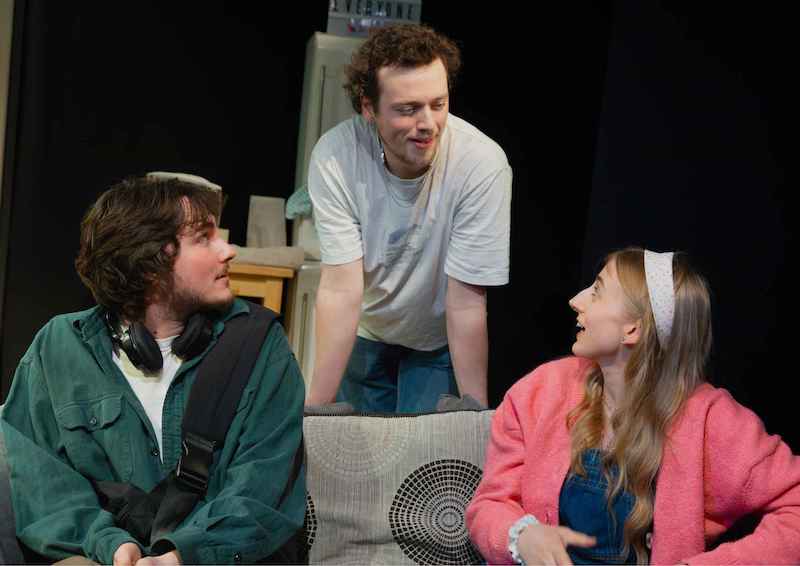
While the contrasts between the students feel authentic at first, some of the archetypes do have a whiff of the over-familiar, as if they are all the first draft of a new rush of Hollyoaks characters. Rugby shirt-wearing party boy Luke (Ryder) and Katie Emanuel’s meek, churchgoing Charlotte exemplify this cookie-cutter approach to character creation.
Faring slightly better are Emily Dilworth’s Bex, outwardly as much of a raver as Luke, but with a past that means she needs to draw clear boundaries, and cowriter Husband as the ostensible comedy character. His Henry combines the hackneyed role of slovenly, black T-shirt wearing slob with the role of drug dealer, always able to produce a small sachet of some powder or other on demand. Completing the quintet, Ollie J Edwards’s Kane is the quietest of the lot, staying home to watch films while the others go out partying.
As the play follows the students’ first year, matters progress apace. Ryder and Husband’s dialogue feels natural and unforced, but the plotting is dominated by matters less interesting to those in the audience who are not students themselves. Some areas fizz with potential, notably between Luke and Bex as a drunken one-night stand during Freshers’ week turns into a year-long tension. The locked room and its potential link to one of the housemates are alluded to throughout, without feeling connected to the mundanity of the students’ lives.
The reveal of what that room is, who has been using it and for what comes in the play’s final half hour. Husband and Edwards both get a chance to steer their characters into more serious realms, demonstrating their versatility, though the story elements still feel removed from the day-to-day of the previous hour.
The play comes to a rather gruesome ending, but one that feels unsatisfying. As one character reveals their sad but brutal past, the secret that has been kept feels less like a lost art and more like a bolted-on nightmare. It’s as if The Lost Art of Keeping a Secret cannot decide if it’s a slice of student life, or a study of psychotic behaviour and reliving past trauma – and as a result, ends up falling short of being either.
Runs until 7 March 2026
