

Writer and Director: Paul Hendy
The Last Laugh runs at 80 minutes, with a cast Q&A following the interval that forms part of the evening rather than an optional extra. Most of what matters happens in the first act, and those who left before the second half missed some worthwhile material — not least the show’s own history. What began as a short film and premise tester found its way to the Edinburgh Fringe, where it was spotted as worthy of a West End run and given a slot at the Noël Coward Theatre before setting out on tour. A film version is now in the works too, confirmed by the cast during the Q&A.
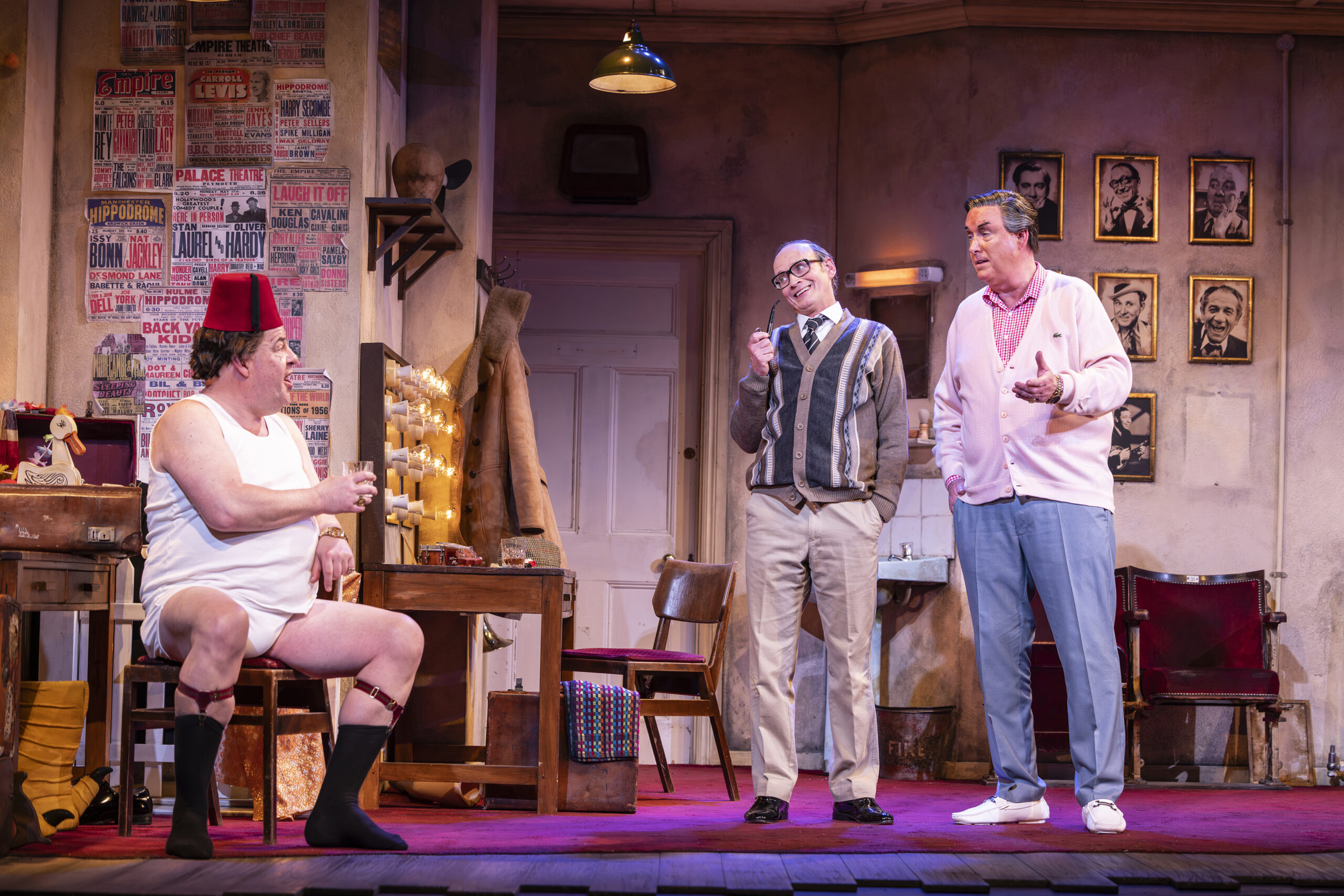
Paul Hendy’s script places three of Britain’s best-loved comedians together in a shabby dressing room in an unnamed theatre and lets them talk. The set (Lee Newby) does a fine job of setting the scene – there’s clutter of props, old show posters on the wall, photographs of famous comedians.
Damian Williams is first to arrive as Tommy Cooper, a man who seemed to find it easy to be funny, and his version of one of the most instantly recognisable comedians in British history stands up well against the many impressions that we’ve seen before. Simon Cartwright’s Bob Monkhouse follows — a trickier prospect, since Monkhouse is impersonated far less often — but Cartwright has an authenticity that comes from more than research and watching videos. He knew Monkhouse for some fourteen years, and the Q&A reveals that Monkhouse himself helped him hone the impression. Steve Royle completes the trio as Eric Morecambe, another performer who seemed to make comedy look effortless, and Royle’s version is instantly recognisable in look and manner. When Monkhouse suggests the others find performing easy, they’re quick to correct him — however natural it looks, none of it comes without work.
That’s the heart of the piece – three very different approaches to the same craft. Monkhouse writes his own material, including a large number of jokes now credited to other comedians, and keeps a meticulous record of where every joke originated — so when Cooper delivers a gag, Monkhouse can name its author and its date. Morecambe relies on a scriptwriter, acknowledging he lacks the skill to write his own material. Cooper admits to lifting much of his from wherever he could find it. The contrast plays out in performance too — Cooper’s in-your-face improvisation, Morecambe’s classic physical comedy, Monkhouse’s deadpan delivery — and Hendy’s script, threaded with snippets of classic routines and lines familiar to anyone who grew up watching these three, never feels like a tribute act stringing gags together. The dialogue carries a real sense of authenticity.
Much of the entertainment comes from watching each performer given space to run through a chunk of their own routine, delivered for each other and for an audience they can’t quite see beyond the dressing-room mirror lights. Williams’s Cooper undercuts every trick with a mutter or a shrug that gets its own laugh; Cartwright’s Monkhouse works the room with a precision that never quite relaxes; Royle’s Morecambe leans on timing rather than material, and the gap between the three approaches says as much as anything stated outright. There’s a natural quality to the conversation between the trio, too — competitive but affectionate, the sort of shorthand only old colleagues share — that keeps scenes which are essentially three men talking in a room from ever flagging.
Beneath the comedy, the play finds room for the people behind it. Cooper’s dressing-room routine, the notorious lateness and the elaborate stalling before facing an audience turns out in the Q&A to stem from stage fright rather than eccentricity. Monkhouse’s family life, including his son’s wheelchair use, and Morecambe’s account of what touring cost his family both surface as the play progresses.
It’s a fascinating watch — not just an evening of well-known jokes and routines, welcome as those are, but a study of what makes different comedians funny in different ways. The payback at the close adds a poignancy that the preceding eighty minutes have quietly been building towards.
Well worth catching on its tour.
Runs until 12 September 2026 and on tour
The Reviews Hub Star Rating
-
9
