

Choreographer: Aszure Barton
Conductor: Martin West
Opening Sadler’s Wells autumn season, San Francisco Ballet’s Mere Mortals may prove to be the best dance show of the year. Electrifying and spectacular, this is ballet from the future.
However, despite choreographer Aszure Barton’s modern moves that put one in mind of Hofesh Shechter or Botis Seva, Mere Mortals is based on one of the most ancient stories we have: that of Pandora’s Box (or Pandora’s Jar, as the programme notes have it). Opening the box, Pandora unleashed all the ills of the world. In Barton’s update, AI is one of the evils released, and her show comes to London in the same week that some scientists suggest that there is a 10% chance that AI will kill the human race in a decade.
Only one thing is left behind in Pandora’s box and that is Hope, and it is Hope (Wei Wang in a rubber suit) who appears on the stage first, bathed in red light with a huge quantity of dry ice swirling around him. It’s the first of many arresting images in this 80-minute show. As the live orchestra play Floating Points’ eclectic score, the initial sounds similar to an aeroplane taxiing on the runway, Wang begins to dance. A tempo finally appears from the pit, but Wang hits none of its beats, even when the drums begin a rapid machine-gun fire.
Suddenly, the stage is crowded with what seem to be scores of dancers, all dressed in Michelle Janks’s tailored costumes, black jackets and black long skirts. And these performers do hit the beat, frantic and propulsive. Prometheus (Harrison James) arrives and is carried aloft in ceremony. He switches between this modern style of dance and more traditional arabesques, his legs looking impossibly long, half-hidden under his military skirt. As the dancers march around the space in interlocking columns, only Prometheus looks out to the audience.
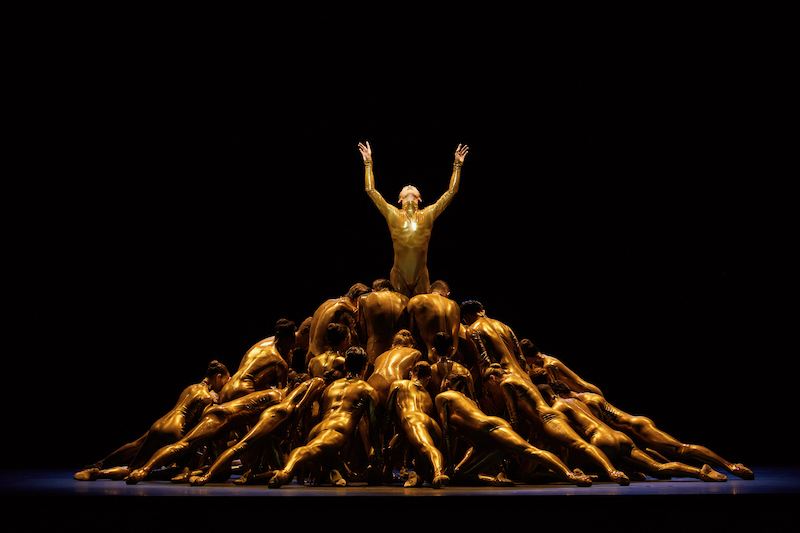
Janks’ costumes change so nearly everyone is wearing black rubber, and then change again, with the performers wearing tight gold costumes. There’s something Hegelian in the process and the world that Barton has portrayed: thesis, antithesis, synthesis and repeat. Figures appear to be birthed from a pile of people: Pandora, and then Hope again, this time in gold.
Packed into bunches or rows, the dancers are almost like automatons, and when they come on swivelling their hands and their hips, the effect is tremendously invigorating, made even more so when you realise that each dancer is en pointe. The most conventional ballet moves come in the last third, where Pandora (Jennifer Stahl) and Epimetheus (Joseph Walsh) dance a pas de deux to the sounds of Miriam Adefris’ vulnerable harp. It’s a long section, their moves loving and fragile. Stahl comments in the programme that Barton has instructed the pair to whisper things in each other’s ears as they drape and merge their bodies, and that these whispered things should be different each night.
The music by Floating Points, electronic and yet orchestral, especially when it seems to echo the scores of black-and-white films, is peppered with dramatic silences complemented by Jim French’s stunning lighting design and Hamill Industries’ visuals. At one point, Pandora is alone on stage, her silhouette looking alien-like, watching videos of the Earth, but the images are far from the apocalyptic promises that jumped out of her box; they imply rebirth: Hope. But as Wang bends delicately above the other dancers, we realise how precious Hope is, particularly in these dark days.
Runs until 12 September 2026
