

Book: Robert Mark Kamen
Music and Lyrics: Drew Gasparini
Director: Amon Miyamoto
Of all the movies that could be turned into stage musicals, 1984 box office hit The Karate Kid isn’t one that immediately leaps to mind. However, with original screenplay writer Robert Mark Kamen at the helm, there is a clear understanding of what made the original film so beloved. The difficulty is that, in bringing this story to the stage, the production sometimes embraces the more familiar tropes of musical theatre, complete with big emotional numbers and a level of cheesiness that feels at times more High School Musical than The Karate Kid.
While Drew Gasparini’s original songs bring energy and spectacle, their inclusion comes at the expense of character development. The story is condensed into a succession of scenes that rush through important moments, leaving little room for key relationships to develop naturally. Daniel’s mother (Sharon Sexton) seems almost oblivious to everything he’s dealing with, making her Act Two ballad If I Could Take His Pain Away feel like it comes completely out of nowhere. Similar issues arise with smaller supporting characters, such as Freddie (Finley Oliver), whose storyline is introduced only to disappear for much of the show. Even Daniel and Mr Miyagi’s relationship suffers somewhat from this pace. Their bond is something we’re expected to immediately understand, rather than something we’re given the time to watch develop.
That said, overall, the cast is a real strength of the production, bringing a level of warmth and sincerity that helps overcome some of the script’s shortcomings. Adrian Pang’s portrayal of Mr Miyagi proves to be one of the production’s biggest highlights. His performance is a fitting tribute to Pat Morita’s iconic characterisation, perfectly capturing the quiet humour, warmth and wisdom that made the role so beloved. His clear and assured vocals add further depth to a performance that is utterly charming throughout.
Gino Ochello makes a remarkably assured professional debut as Daniel LaRusso, capturing the character’s endearing awkwardness and vulnerability. While he perhaps lacks some of the sharper edges of the original, his warmth makes it impossible not to root for Daniel-San. Abigail Amin brings charm and sincerity to Ali Mills, with her duet Slow Song adding a welcome tenderness to their relationship.
As Johnny Lawrence, Joe Simmons is every inch the cocky adversary, capturing the nuances of the role without simply imitating William Zabka’s original performance. Matt Mills’ Sensei John Kreese fully embraces the character’s pantomime villain energy, earning loud boos from the audience, but his standout moment comes in The Whole World Will Be Watching, where his stunning vocals transform the catchy Act One finale into a memorable highlight. The ensemble provides strong support throughout, bringing energy and commitment to the production’s larger musical numbers.
The choreography by Keone and Mari Madrid, alongside Amon Miyamoto’s direction, is one of the production’s more inconsistent elements. While the intention behind the karate-inspired ensemble sequences is clear, they often lean too heavily into spectacle, with the performers’ repeated appearances in gis sometimes feeling more distracting than impactful. The movement lacks the precision and cohesion needed to convincingly capture martial arts, with some sequences appearing messy and out of sync rather than controlled and powerful. However, this is not the case in Kreese’s Cobra Kai dojo, where the direction and choreography work together brilliantly to create fight sequences that are precise, intimidating and filled with a genuine sense of menace.
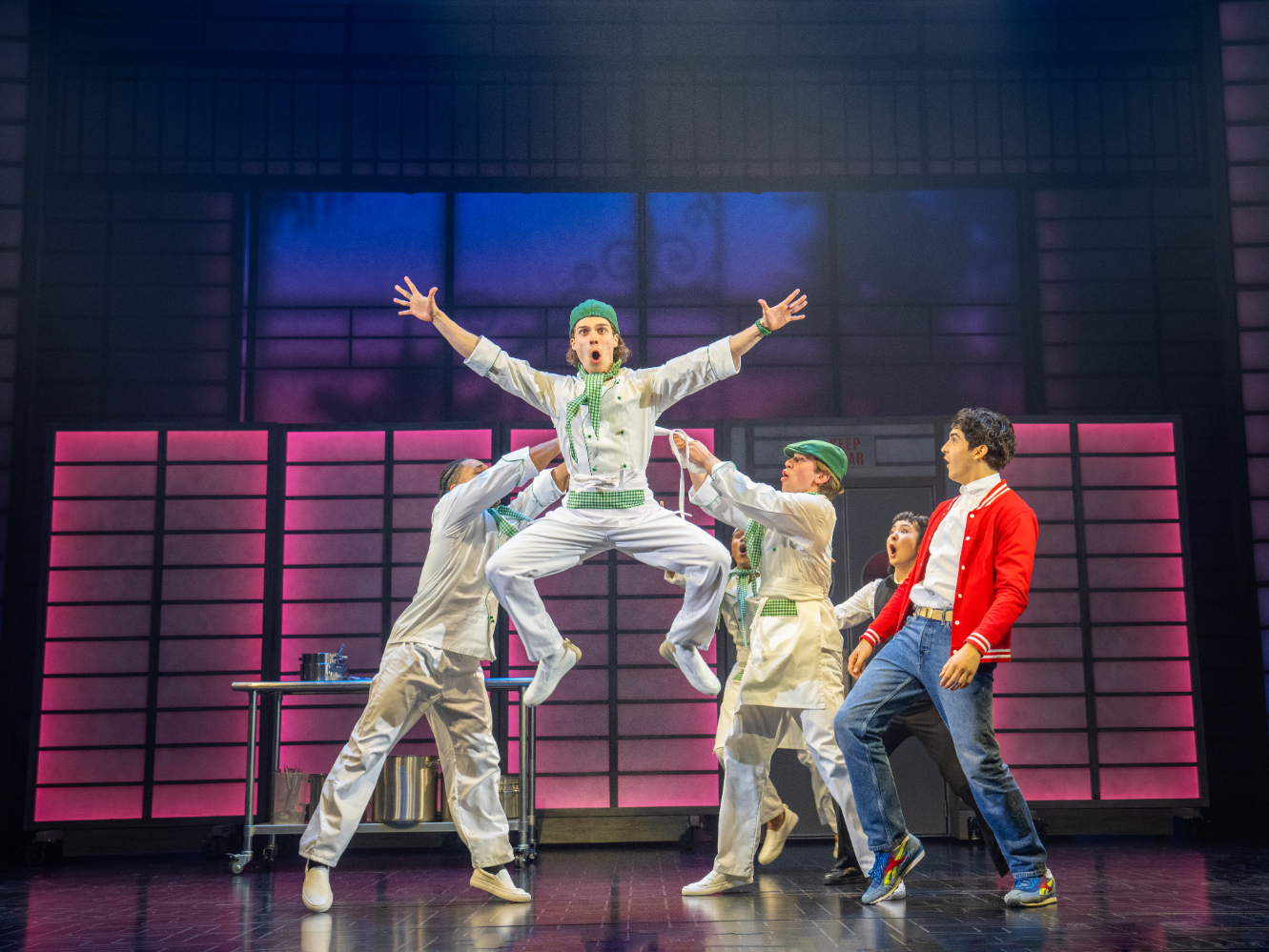
Derek McLane’s set design is visually striking, with large Shoji-style doors immediately creating the atmosphere of a karate dojo. However, the design doesn’t always work as smoothly in practice. At this performance, the larger doors at the front of the stage created several awkward moments, with loud bangs and pauses as they were moved into position. The smaller doors, wheeled on by ensemble members, also occasionally pulled focus from the action, as the careful choreography of getting them onto their marks was very noticeable while actors were already delivering their lines. Bradley King’s lighting design is strong throughout, with the striking red tones during Strike Fast Strike Hard No Mercy proving particularly effective. The production also makes excellent use of McLane’s minimalist backdrops, which provide a fantastic canvas for Peter Nigrini’s beautiful projection design.
Ultimately, The Karate Kid doesn’t quite pack the punch of the original film, with its rushed storytelling and exaggerated moments preventing it from delivering a true knockout blow. However, thanks to a confident cast and a genuine sense of heart, this is a production that is easy to enjoy for all ages. It’s cheesy, yes, but ultimately charming.
Runs until 25 July 2026 and on tour
The Reviews Hub Star Rating
-
6
